A Prime Minister on the Factory Floor
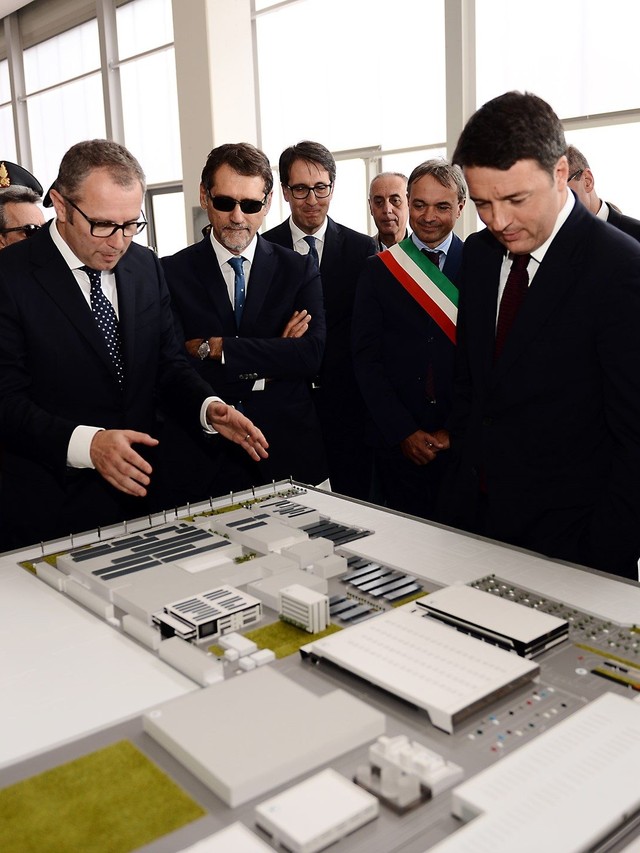
On September 23, 2016, Italian Prime Minister Matteo Renzi walked through the same Sant’Agata Bolognese production halls where the Huracán and Aventador take shape, then stepped into a construction zone that told a very different story about Lamborghini’s future. CEO Stefano Domenicali guided the delegation through the skeleton of a 70,000 square-meter manufacturing hub, a facility being built not for another mid-engine supercar but for a luxury SUV scheduled to arrive in 2018. Political photo opportunities at Italian factories are hardly novel. But the substance beneath the optics mattered: a sitting prime minister publicly endorsing the single largest capital project in Lamborghini’s history, at a moment when the company was preparing to fundamentally redefine what it builds and how many it sells.
Domenicali framed the project as a collaboration between the Volkswagen Group’s industrial resources, the Italian government, and the Emilia-Romagna regional administration. That language was carefully chosen. Lamborghini wanted Rome’s involvement on the record, and Rome wanted credit for keeping high-value manufacturing on Italian soil. The visit crystallized a reality that would define the next chapter of the company: the Urus was not merely a new product line. It was a national industrial project, backed by public money and political will, that would reshape Lamborghini from a boutique supercar maker into something far larger and more consequential.
Why an SUV Was the Only Path Forward
The Urus concept first appeared in 2012, and for years the question among enthusiasts was not whether Lamborghini could build an SUV but whether it should. The LM002, which ceased production in 1993, proved the brand could make something large, loud, and impractical in the best possible way. The Urus represented a fundamentally different proposition: a high-volume vehicle designed to bring new buyers into the brand and, critically, to generate the revenue needed to sustain the supercar side of the business.
Lamborghini projected the expansion would double its sales volumes. For a company that, at the time, built roughly 3,500 cars per year, that kind of growth does not happen by adding a third supercar variant. It happens by entering a segment where wealthy buyers already shop in large numbers, a segment Porsche had already proven enormously profitable with the Cayenne and that Bentley was entering with the Bentayga. Lamborghini was not chasing a trend. It was following a financial blueprint that its own parent group had validated years earlier.
The practical implication, even in 2016, was clear: the Urus would become the car that funded Lamborghini’s wilder ambitions. Every Aventador successor, every limited-run special edition, every motorsport program would benefit from the SUV’s contribution to the bottom line. Enthusiasts who bristled at the idea of a Lamborghini SUV were, in a sense, arguing against the financial engine that would keep naturally aspirated V12s in production longer than the market alone could justify. And it was precisely this financial logic that made the Italian government willing to invest in the project’s success.
Inside the Sant’Agata Expansion
The scale of construction underway during Renzi’s visit deserves attention because it reveals how seriously both Lamborghini and Rome took the Urus as a national undertaking. The expansion encompassed a new factory dedicated to SUV assembly, a logistics center, a test track, and additional R&D departments. Lamborghini says the project would also bring a significant increase in its workforce. One 2015 report suggested the company planned to hire as many as 500 new employees for the SUV project alone.
For a company that had operated for decades within a relatively compact campus, effectively doubling its physical footprint was an industrial transformation, not a renovation. The new test track, designed with multiple surfaces for SUV validation, signaled that Lamborghini was serious about engineering the vehicle to its own standards rather than simply rebadging a platform from elsewhere in the VW Group. The R&D expansion suggested the company intended to develop proprietary technologies for the SUV, reinforcing the argument that this would be a genuine Lamborghini rather than a luxury crossover wearing the wrong badge.
The logistics center might sound unglamorous, but it addressed one of the core challenges of scaling a bespoke manufacturer. Moving from 3,500 units to 7,000 requires entirely different supply chain management, parts flow, and quality control infrastructure. Getting that wrong would have been catastrophic for a brand whose reputation rests on craftsmanship. This was the kind of infrastructure that no supercar company builds without long-term institutional backing, and that backing came from both Wolfsburg and Rome.

Matteo Renzi and other dignitaries examine a detailed architectural model during a visit to a facility.
Government Backing and the Politics of ‘Made in Italy’
Renzi’s visit was not a casual drop-in. One report from 2015 indicated that Rome planned to offer up to €80 million in tax breaks and other benefits to keep SUV production in Italy. That figure, if accurate, represented a substantial public investment in a single automotive program, and it reflected a broader Italian strategy of using luxury manufacturing as an industrial policy tool.
Italy’s government views its luxury automotive brands as national assets in a way that goes beyond economic output. Ferrari, Lamborghini, and Maserati function as global ambassadors for Italian design and engineering. Keeping their production facilities on Italian soil, rather than allowing them to migrate to lower-cost locations within the VW Group’s global network, carries political weight that transcends normal industrial incentives. The Italian government has continued this approach in subsequent years, including advocacy for exemptions that would protect luxury marques from the EU’s 2035 combustion engine restrictions.
Domenicali acknowledged this dynamic directly, crediting the project’s feasibility to VW Group synergies combined with support from both the national government and the Emilia-Romagna regional administration. The subtext was unmistakable: Lamborghini stayed in Sant’Agata Bolognese because Italy made it worth staying. For a brand whose identity is inseparable from its geography, that was a strategically vital outcome. The Urus project, in other words, was as much a triumph of Italian industrial policy as it was of Lamborghini product planning.
What the Urus Meant for Lamborghini’s Brand Identity
The anxiety among enthusiasts in 2016 was real. Would the Urus dilute the brand? Would Lamborghini become known primarily as an SUV company? These questions echoed the same concerns Porsche fans raised when the Cayenne launched in 2002, and the answer played out in a remarkably similar pattern. The Cayenne did not destroy Porsche’s sports car credibility. It funded the 918 Spyder, the GT division’s expansion, and an entire generation of sharper 911s.
Lamborghini’s bet followed the same logic. The Urus would bring in buyers who might never consider a low-slung supercar for daily use but who wanted the badge, the performance, and the theater that Lamborghini delivers. Many of those buyers would eventually cross-shop into the supercar range. And the revenue from SUV sales would underwrite the kind of engineering extravagance, carbon fiber monocoques, naturally aspirated V12 flagships, limited-edition hypercars, that purists demand but that a 3,500-unit supercar company cannot fund indefinitely on its own.
Dealers who were initially skeptical about the Urus quickly discovered that SUV customers represented an entirely new demographic for the brand, particularly in markets like the United States, China, and the Middle East where a practical Lamborghini opened doors that a two-seat supercar simply could not. The Urus did not replace the Aventador buyer. It created a buyer who did not previously exist in Lamborghini’s ecosystem. That new buyer, in turn, justified every euro of government support and every square meter of new factory floor that Renzi toured that September morning.
The Long-Term Impact on the Supercar Landscape
In September 2016, Lamborghini was entering a luxury SUV segment that Porsche already dominated and that Bentley was actively contesting with the Bentayga. Ferrari, notably, had not yet committed to what would eventually become the Purosangue. Lamborghini’s decision to move first among the Italian supercar brands gave it a timing advantage that proved significant: by the time Ferrari’s SUV arrived years later, Lamborghini had already established the Urus as the default choice for buyers who wanted Italian supercar DNA in an SUV body.
The competitive calculus also extended within the VW Group itself. Lamborghini needed to justify why its SUV deserved a distinct identity, dedicated manufacturing, and government-subsidized expansion rather than simply sharing more heavily with the Bentayga or the Audi Q8. The answer lay in positioning: the Urus would be faster, louder, and more visually aggressive than anything else in the segment, a true Lamborghini translated into a different form factor.
For current and prospective Lamborghini buyers, the strategic takeaway from Renzi’s 2016 factory visit looks obvious in hindsight. The expansion worked. Lamborghini’s production site eventually grew from 80,000 to 160,000 square meters. The company’s output surged past the projected targets. The revenue generated by the Urus funded exactly the kind of supercar development that enthusiasts care about most, from the Revuelto to the Temerario and whatever comes next. The prime minister’s visit was political theater, certainly. But the factory being built behind him was the foundation for everything Lamborghini builds today, proof that when a supercar company becomes a national project, the results can reshape an entire brand.


