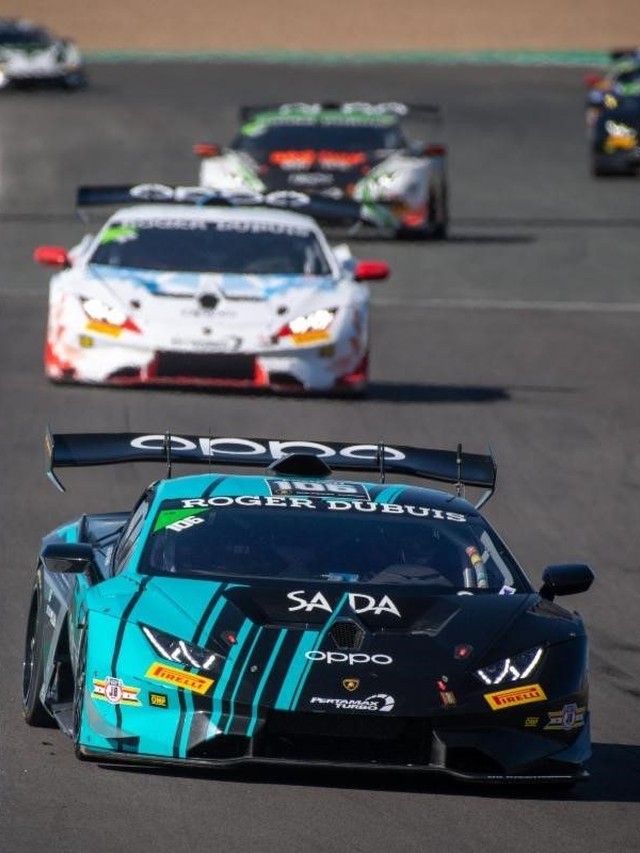
Six Factory Drivers Return, Three with Long-Term Deals
Lamborghini Squadra Corse confirmed its entire six-driver factory roster for the 2018 GT racing season, keeping the lineup unchanged from 2017 and extending long-term contracts with three of its leading names: Mirko Bortolotti, Andrea Caldarelli, and Christian Engelhart. Marco Mapelli and Giovanni Venturini were also retained, while Raffaele Giammaria continues in a dual capacity as both a factory driver and the division’s tester and youth program coordinator.
The decision to retain rather than reshuffle says something important about where Squadra Corse sits as a program. In GT racing, continuity between drivers and engineering teams compounds over seasons. Drivers who know the car’s behavior at the limit provide better development feedback, and teams that trust their lineups spend less time managing internal politics and more time chasing lap time. Giorgio Sanna, Lamborghini’s Head of Motorsport, framed the decision plainly: the 2017 results justified the roster. The Grasser Racing Team, with Bortolotti, Caldarelli, and Engelhart behind the wheel, secured three titles in the Blancpain GT Series. Venturini won the International GT Open with Imperiale Racing. Mapelli continued his role as the company’s benchmark test driver, the man responsible for Nürburgring Nordschleife records in both the Aventador SV and the Huracán Performante.
For a manufacturer running more than 40 Huracán GT3s in global championships, the factory drivers function as both competitive spearheads and development tools. Keeping all six signals that Lamborghini views its GT program as a long-cycle investment, not a year-to-year talent auction.
Where the Factory Drivers Will Race in 2018
Championship assignments reveal a deliberate geographic spread. Bortolotti, Caldarelli, and Engelhart will defend their Blancpain GT Series Endurance Cup title with Orange 1 Team GRT, the same Grasser Racing operation that delivered the 2017 championship. Bortolotti enters the season as the defending overall Blancpain GT Series champion and a 2018 24 Hours of Daytona winner, a credential that few GT drivers in any manufacturer’s stable can claim.
Caldarelli’s schedule branches further: the Blancpain GT Series Sprint Cup alongside Perez Companc and the ADAC GT Masters paired with Bortolotti. Engelhart also competes in the ADAC GT Masters, sharing duties with Rolf Ineichen. That double coverage of the German series by two factory drivers underlines how seriously Lamborghini treats the ADAC platform as a proving ground for customer teams and a visibility tool in central Europe.
Mapelli draws the most geographically ambitious assignment. His 2018 program includes both the Blancpain GT Asia Series with FFF Racing and the Super GT championship in Japan’s GT 300 category with JLOC. He will also co-drive with Caldarelli at the 10 Hours of Suzuka. Sending a Nürburgring record holder to Asia accomplishes two things: it gives Lamborghini factory-level representation in a region where GT3 customer car sales are growing, and it embeds a test driver’s expertise in a market where the Huracán GT3 competes directly against Porsche, Ferrari, and Mercedes-AMG machinery.
Venturini returns to the International GT Open with Imperiale Racing to defend his title. Giammaria balances his racing commitments with his role as Director of the ACI Sport Federal School and his supervisory duties over Lamborghini’s youth programs. That combination of racing, testing, and mentoring in a single contract is unusual in GT racing and worth watching as a model for how smaller factory programs extract maximum value from experienced drivers.
The Junior Pipeline: From Super Trofeo to GT3 Seats
Below the factory roster, Squadra Corse operates two structured development tiers. The Young Driver Program targets competitors under 26 racing in the Lamborghini Super Trofeo one-make series. The GT3 Junior Program supports drivers who graduate to international GT championships in the Huracán GT3. Lamborghini says the names of new Young Driver and GT3 Junior entrants for 2018 will be announced separately, but the returning junior talent already confirmed for the season illustrates how the pipeline works in practice.
Dennis Lind, the 2017 GT3 Junior Program winner, and Martin Kodric move to the Blancpain GT Asia Series with FFF Racing. Riccardo Agostini, the 2017 Super Trofeo World and North American champion, joins Jeroen Mul, Rik Breukers (2017 Super Trofeo Middle East champion), and Liang Jiatong in the International GT Open with Imperiale Racing. Michele Beretta, an Italian Super GT3 champion, steps up to the ADAC GT Masters with the Rosberg team. Patrick Kujala, the 2015 Super Trofeo World and European champion, races in the British GT Championship with Barwell Motorsport.
The Blancpain GT Series Silver Cup gets two junior entries: Fabrizio Crestani with the Lazarus team and Alex Frassineti with Ombra Racing. Loris Spinelli, the 2017 Super Trofeo European champion, races alongside Daniel Zampieri and Lorenzo Veglia in the Italian GT Championship with Antonelli Motorsport. Madison Snow continues his IMSA WeatherTech SportsCar Championship campaign with Paul Miller Racing.
| Driver | Program | 2018 Championship | Team |
|---|---|---|---|
| Dennis Lind | GT3 Junior | Blancpain GT Asia | FFF Racing |
| Martin Kodric | GT3 Junior | Blancpain GT Asia | FFF Racing |
| Riccardo Agostini | GT3 Junior | International GT Open | Imperiale Racing |
| Michele Beretta | GT3 Junior | ADAC GT Masters | Rosberg |
| Patrick Kujala | GT3 Junior | British GT | Barwell Motorsport |
| Fabrizio Crestani | GT3 Junior | Blancpain GT Silver Cup | Lazarus |
| Alex Frassineti | GT3 Junior | Blancpain GT Silver Cup | Ombra Racing |
| Loris Spinelli | GT3 Junior | Italian GT | Antonelli Motorsport |
| Madison Snow | GT3 Junior | IMSA WeatherTech | Paul Miller Racing |
The trajectory is consistent: Super Trofeo success earns a GT3 Junior seat, GT3 Junior results earn consideration for factory support or a professional career with customer teams. Sanna noted that junior drivers also serve as Accademia instructors, giving them exposure to the broader Lamborghini ecosystem beyond the racetrack.
A GT-Only Pipeline in a Formula One World
The obvious comparison point is Ferrari, whose Driver Academy was established in 2009 with a fundamentally different objective. Ferrari’s program funnels talent toward Formula One, producing graduates like Charles Leclerc and Mick Schumacher who stepped into single-seater seats at the highest level. Lamborghini’s pipeline operates entirely within GT racing, a deliberate choice that reflects both the company’s competitive focus and its business model.
Lamborghini does not race in Formula One. Its motorsport credibility depends entirely on GT championships and the Super Trofeo, which means the factory driver program serves a dual commercial purpose: winning races that validate the Huracán GT3 for customer teams, and developing drivers who can coach paying customers through the Accademia and Super Trofeo programs. Ferrari can afford to treat its driver academy as a feeder for its F1 operation because F1 is the company’s primary marketing engine. Lamborghini’s equivalent investment flows into a network of customer teams running GT3 cars across a dozen championships worldwide.
The practical implication for enthusiasts following these programs is straightforward. Lamborghini’s junior drivers are more likely to become long-term fixtures in GT racing, building careers within the Squadra Corse ecosystem, than to disappear into a different racing discipline. That makes the junior roster worth tracking: some of these names will end up in factory seats within a few seasons if the pipeline functions as designed.
What Driver Stability Actually Buys Lamborghini
Retaining an entire factory roster sounds like a conservative move, but in GT racing it functions as a competitive strategy. Experienced drivers who understand the Huracán GT3’s characteristics provide consistent setup data across different circuits and conditions. That data feeds back into the car’s ongoing development, benefiting every customer team running the platform. Mapelli’s dual role as a factory racer and the company’s primary test driver makes this connection explicit: the same person setting Nordschleife records in road cars is also racing the GT3 variant and feeding observations to the engineering team.
Giammaria’s position as both a factory driver and youth program coordinator adds another layer. Rather than outsourcing driver coaching to external consultants, Lamborghini embeds a racing veteran directly into the junior development structure. The institutional knowledge stays inside the program.
For buyers considering a Huracán GT3 customer car or a Super Trofeo entry, the stability of Lamborghini’s factory program matters because it signals ongoing manufacturer commitment. A manufacturer that churns through drivers and restructures its racing division annually creates uncertainty for customer teams that depend on factory support, spare parts supply, and Balance of Performance lobbying. Squadra Corse’s 2018 announcement, with its unchanged roster and long-term contracts, communicates the opposite: this program plans to be here for a while, and the people running it know what they are doing.
Whether that stability translates into championship results depends on execution, not announcements. But the foundation Lamborghini described for 2018, a proven factory core feeding a structured junior pipeline across global championships, represents the kind of institutional depth that wins over seasons rather than single weekends.
Gallery


