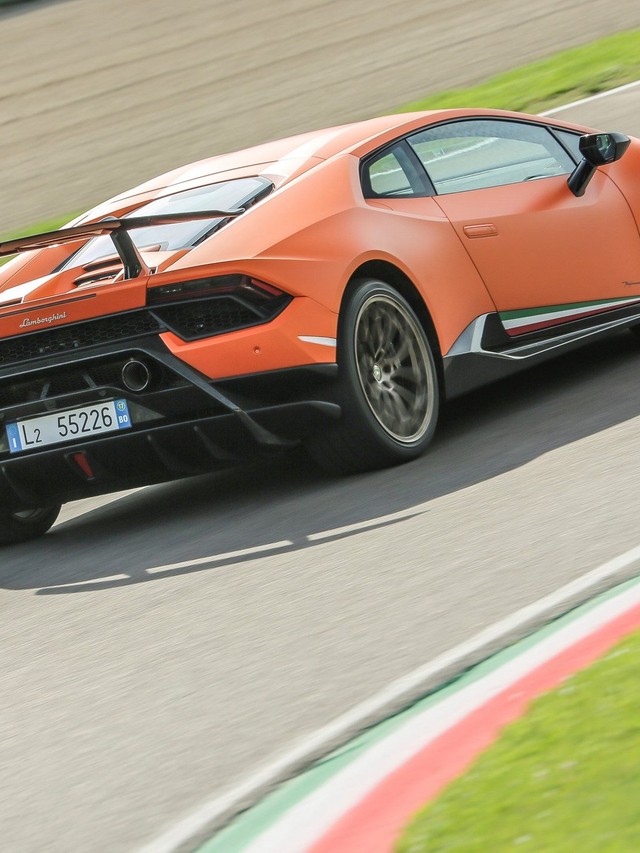
The Huracán Performante’s Global Track Blitz
Supercar lap records tend to arrive as isolated stunts: one car, one famous circuit, one number debated on forums for months. The Lamborghini Huracán Performante took a different approach. Within a single calendar year of its Geneva Motor Show debut, it collected production car lap records on eight circuits across Europe, not on manufacturer test tracks run in secret, but on reference circuits used by major automotive publications, with their own drivers behind the wheel and their own timing equipment on the ground.
| Date | Circuit | Publication | Lap Time |
|---|---|---|---|
| March 7, 2017 | Vairano | Quattroruote | 1:09.43 |
| March 8, 2017 | Balocco | Auto | 2:38.07 |
| August 29, 2017 | Contidrom | Auto Zeitung | 1:29.6 |
| September 25, 2017 | Mira | Autocar | 1:05.03 |
| September 28, 2017 | Wroughton | The Grand Tour | 1:16.8 |
| October 9, 2017 | Boxberg | Auto Motor und Sport | 42.3 |
| November 6, 2017 | Le Mans Bugatti | Sport Auto | 1:42.49 |
| November 14, 2017 | Anneau du Rhin | Sport Auto | 57.5 |
The variety is what makes this sweep genuinely telling. Vairano and Balocco are tight Italian handling circuits. Contidrom is a German proving ground. Le Mans Bugatti is a proper FIA-grade layout. Each track rewards a different balance of grip, braking stability, and straight-line speed, which means the Performante could not rely on a single aero trick or power advantage to dominate. It needed to be fast everywhere, and it was.
Why These Records Matter More Than a Single Headline Number
Sharp-eyed readers will notice the most famous circuit of all is absent from that list. The Performante‘s 6:52.01 Nürburgring Nordschleife lap, set in October 2016 before the car’s official reveal, remains a separate chapter in its story. That time, driven by Lamborghini test driver Marco Mapelli, initially drew skepticism until the company released onboard footage to substantiate the claim. The eight records announced here came later, from external media, and served a complementary purpose: proving the Nürburgring run was no outlier.
By accumulating records across eight independent publications, each applying its own methodology, Lamborghini effectively crowdsourced its validation. No single journalist or test could be dismissed as a fluke or a favorable tire choice. Lamborghini says these results confirm the Performante as one of the fastest production super sports cars in the world. When the validation comes from Quattroruote, Autocar, Sport Auto, and Auto Motor und Sport simultaneously, that claim carries weight no amount of factory marketing can replicate.
Engineering for Dominance: How ALA Actually Works
The technology at the center of the Performante’s record campaign is the ALA system, short for Aerodinamica Lamborghini Attiva. The concept sounds simple: active aerodynamics that adjust downforce and drag depending on what the car needs at any given moment. The execution is anything but.
Traditional active aero systems use mechanically actuated flaps or wings that move to preset positions. ALA takes a fundamentally different path. Channels built into the front splitter and rear wing allow airflow to be routed or blocked using electronically controlled flaps inside the aero elements themselves. When the flaps open on one side of the rear wing, they stall that half of the wing, reducing downforce on that corner. The result is aero-vectoring: the car uses aerodynamic load asymmetrically to help rotate into a corner, supplementing the mechanical grip from the tires and the torque split from the all-wheel drive system.
On a straight, both sides open to minimize drag. In a fast corner, one side closes to maximize downforce where it counts. The system reacts in fractions of a second, far faster than any driver could manually adjust a wing angle. The ALA system earned the Autocar Innovation Award, and the eight circuit records demonstrate why: it gave the Performante an intelligent, adaptive advantage that compounded lap after lap.
The wing and splitter elements are constructed from Forged Composite, a material Lamborghini co-developed with Callaway Golf and the University of Washington. Unlike traditional woven carbon fiber layup, Forged Composite uses chopped carbon fibers compressed in a mold under high heat and pressure. The process allows complex, hollow shapes that would be prohibitively expensive or structurally weak in conventional carbon fiber. For ALA, this means the internal air channels could be integrated directly into the wing structure without adding weight. Lighter aero components performing a more sophisticated aerodynamic job than any fixed wing could manage: that is where the Performante’s dry weight advantage begins.

The orange Lamborghini Huracan Performante demonstrates its track prowess with speed and precision on the circuit.
The Competitive Edge: A Different Philosophy
The Performante arrived in a segment where its closest rivals relied on fundamentally different engineering strategies. Ferrari’s contemporary track weapons leaned on turbocharged V8 power and sophisticated electronic differentials. Porsche’s GT division favored naturally aspirated flat-six engines paired with meticulous chassis tuning and, in the case of the 911 GT2 RS, a rear-engine turbo layout that prioritized raw power-to-weight.
Lamborghini’s answer was to keep the naturally aspirated 5.2-liter V10, producing 640 HP at 8,000 rpm and 600 Nm of torque at 6,500 rpm, and make the car smarter rather than simply more powerful. The dedicated chassis setup, revised all-wheel drive calibration, and ALA system worked as an integrated package. Where a rival might add 50 horsepower to chase a lap time, Lamborghini reduced drag on the straights and added downforce in the corners, letting the existing power do more useful work.
Acceleration from 0 to 100 km/h in 2.9 seconds and a top speed exceeding 325 km/h confirm the Performante holds its own in a straight line. But the eight records suggest its real advantage lives in the transitions: braking zones, corner entry, mid-corner commitment. Circuits like Vairano and Boxberg reward exactly that kind of composure.
From Performante to STO and Beyond
The Performante’s record-breaking year was not an endpoint. It established a template that Lamborghini would refine and intensify. The Huracán STO, which arrived later, pushed the track-focused formula further with rear-wheel drive, more aggressive aero, and an even more focused chassis. The lessons from ALA’s active aerodynamics also echo in the Revuelto’s design philosophy, where Lamborghini continues to treat aerodynamic intelligence as a core performance tool rather than an aftermarket accessory. Looking further ahead, the Temerario GT3 program carries the DNA of what the Performante proved on those eight circuits: that Lamborghini’s competitive identity in the track-focused segment rests on integrated engineering solutions, not brute-force horsepower alone.
For buyers considering a Performante today, the practical takeaway is straightforward. Used market values, which one source places in the range of roughly $290,000 to over $430,000 depending on specification and mileage, reflect a car that earned its reputation through verifiable, third-party validated performance. In a segment full of manufacturer claims, eight independent records from eight different publications remain a compelling answer to the question of what your money actually buys.


