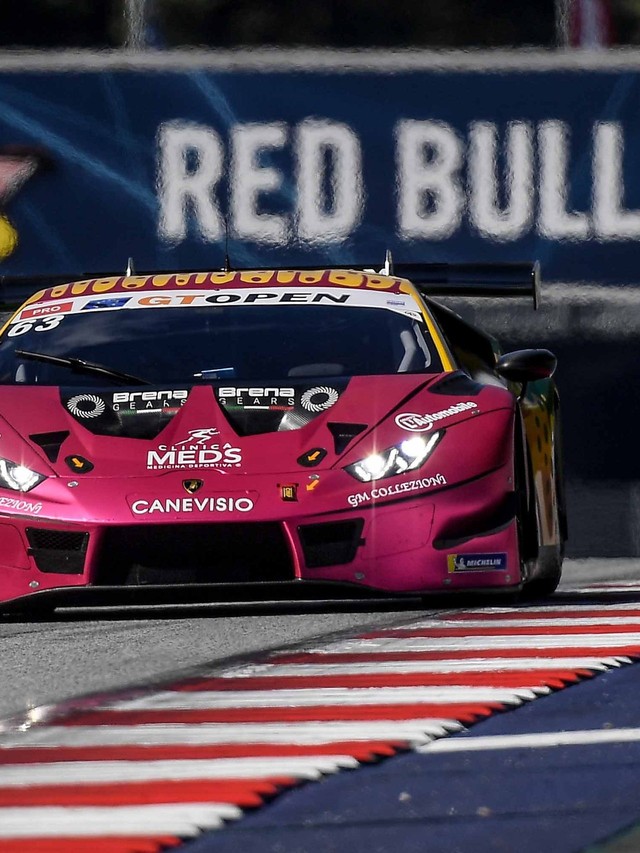
Two Lamborghinis, Two Wins, One Point Between Them
When Oregon Team’s pair of Lamborghini Huracán GT3 Evos won both races at the Red Bull Ring on September 11, 2022, the weekend looked like a coronation. Lamborghini had its second International GT Open clean sweep of the season and its third consecutive victory. The results were emphatic on paper but chaotic in execution: wet-to-dry conditions in Race 1, multiple safety car periods and a multi-car collision in Race 2, a final-lap margin of victory measured in tenths of a second.
Yet the real story was not the sweep itself but what it did to the championship table. Heading into the final two rounds, Kevin Gilardoni and Glenn van Berlo in the #19 held the drivers’ standings lead with 99 points. Leonardo Pulcini and Benjamin Hites in the #63 trailed by a single point. Both crews drove Huracán GT3 Evos. Both belonged to Oregon Team. Lamborghini owned the top two lines of the championship, and the question was no longer whether the marque could win the title but which of its own cars would claim it. Every point scored at the Red Bull Ring would prove essential in the rounds that followed, making this Austrian weekend the fulcrum of the entire 2022 title fight.
Race 1: A Wet Grid, a Dry Finish, and a Lamborghini Lockout
Saturday morning rain meant every car started on wet tires, but the track dried as the race progressed, turning tire management and pit-stop timing into the decisive variables. Van Berlo lined up sixth and immediately exploited grip problems ahead of him at the first corner, vaulting to third before the field reached turn two. By turn four he was running second, having survived a three-abreast moment that would have ended a less composed driver’s afternoon.
Hites, starting eighth in the #63, also gained ground on the opening lap despite running wide at turn two. An AF Corse Ferrari going off track helped his cause, and he reached fifth by the end of lap one. The mandatory driver-change pit stops reshuffled the order, and Gilardoni emerged from the #19 in a position to attack the leading Ferrari. He made the pass at the penultimate corner, a move that looked straightforward on timing screens but required precision on a surface still patchy with moisture.
Pulcini, now aboard the #63, drove a relentless second stint to climb to second, finishing just 1.594 seconds behind his teammate. A Lamborghini one-two, earned rather than inherited, on a day when conditions punished anyone without the right car balance and the nerve to exploit it. More importantly for the championship, both cars scored maximum points, reinforcing the buffer that would matter so much later in the season.

Two Lamborghini Huracán GT3 Evo race cars cross the finish line at the Red Bull Ring, with the lead car under the checkered flag.
Race 2: Safety Cars, Contact with a Ferrari, and Two Tenths at the Flag
If Race 1 rewarded composure, Race 2 rewarded survival instinct. The #63 started sixth and gained a position off the line, but the #19 had a rougher opening. Gilardoni, running in the lower reaches of the field, became entangled in contact with a Ferrari while disputing 13th. The incident triggered the first safety car.
Pulcini used the restart well, passing Axcil Jeffries for fourth. After the driver-change pit stops, the #63 moved into third, then inherited second when the two cars ahead made contact with each other and brought out a second safety car. A third neutralization followed almost immediately when the #19 was collected in a multi-car collision at turn one. Gilardoni and van Berlo’s championship leader survived, eventually finishing eighth, but the car’s race was effectively over as a competitive proposition.
Hites made the decisive move at the final restart, driving around the outside of the leading Audi on the approach to the second corner. It was a committed, aggressive pass, the kind that works once and looks reckless if it doesn’t. Rain began falling on the final lap, and the #63 held on to win by just over two-tenths of a second. Pulcini and Hites claimed their fourth victory of the season, closing the gap to a single championship point. The Red Bull Ring had delivered Lamborghini another sweep, but it had also set up an intra-team title battle that neither crew could afford to lose.

A Lamborghini Huracán GT3 Evo crosses the finish line under a waving checkered flag at the Red Bull Ring.
The Huracán GT3 Evo’s Adaptability Under Pressure
Winning in mixed conditions is one thing. Winning both races at the same event, with the same platform, while your two cars trade blows at the top of the championship standings, requires operational consistency that goes beyond the car itself. Oregon Team managed tire strategy, driver changes, and the chaos of multiple safety car restarts without a critical error across either entry. The #19’s contact in Race 2 was not a team mistake but the collateral damage of dense GT3 traffic, and even then the car was brought home in the points.
The Huracán GT3 Evo, by this stage of its competitive life, was a mature platform, and that maturity showed in its adaptability. Wet grip in the opening laps of Race 1, dry pace in the second stint, and the mechanical robustness to absorb a multi-car incident in Race 2 and still finish. For customer teams evaluating GT3 machinery, that kind of reliability under stress matters as much as outright lap time. GT3 racing is a war of attrition as much as speed, and the Huracán’s record in the 2022 GT Open season was building a compelling case for the platform’s durability.
As Road & Track observed when the Temerario GT3 was revealed, eleven rival brands introduced entirely new GT3 cars during the Huracán GT3 platform’s full decade in top-level GT racing, while Lamborghini continued to extract results from updated versions of the same fundamental design. The Red Bull Ring weekend was a late-career highlight for a machine that kept winning long after its rivals had moved on to successor platforms, and every point it banked in Austria fed directly into the championship fight that lay ahead.
From Austria to Monza: How the Championship Tightened
The Red Bull Ring sweep looked like a championship-clinching moment, but the International GT Open does not reward comfort. At the penultimate round at Monza, Oregon Team’s #63 (now driven by Maximilian Paul and Pierre-Louis Chovet) scored a win and a podium, but the championship deficit was narrowed to 16 points heading into the Barcelona finale. Oregon Team gambled on slick tires during a driver change at Monza as rain cleared, a strategic call that paid off when Paul displaced championship leader Sam de Haan for third in Race 2 by four hundredths of a second. The #63 carried a 20-second success penalty in that race, a regulatory handicap applied to recent winners that made the podium finish even more impressive.
The broader pattern was clear: Lamborghini’s dominance at the Red Bull Ring built a buffer that the team needed every point of as the season progressed. The championship concluded with a full weekend of racing at Barcelona, and the margin Oregon Team carried out of Austria proved to be the foundation of their title challenge. For anyone who watched only the final rounds, the Red Bull Ring results explained why Lamborghini entered the closing stages from a position of strength rather than desperation.
What the Red Bull Ring Sweep Meant for Lamborghini’s Racing Program
Customer racing success is the most tangible validation a manufacturer can offer to the teams and gentleman drivers who spend real money on its cars. Oregon Team’s 2022 GT Open campaign, anchored by the Red Bull Ring sweep, demonstrated that the Huracán GT3 Evo could compete at the front of a professional series against Ferraris, Audis, and Mercedes-AMGs without requiring a factory superteam budget. A car that wins in the hands of a well-run independent team is a car that can win for anyone with the right preparation, and that message resonates with prospective buyers of Lamborghini’s customer racing machinery.
For enthusiasts following Lamborghini’s broader motorsport trajectory, the 2022 season also served as a bridge. The Huracán GT3 platform was approaching the end of its competitive lifespan, and the Temerario GT3, revealed in 2025, would eventually replace it. Car and Driver reported that the Temerario GT3 became the first race car entirely designed and developed at Lamborghini’s Sant’Agata Bolognese facility, a significant shift from the Huracán era. The results Oregon Team extracted from the older platform in its final competitive seasons gave the Temerario program a high bar to clear.
Lamborghini’s GT3 program is built on a philosophy of platform longevity and customer accessibility rather than annual model churn. The Huracán proved that approach could deliver championships. The points Oregon Team stockpiled at the Red Bull Ring were the clearest evidence yet that a decade-old design philosophy still had the legs to fight for titles, and that the Temerario will inherit not just a racing program but a standard of sustained competitiveness.

The victorious team celebrates on the podium after a successful weekend at the Red Bull Ring.
Gallery


