A Win, a Podium, and 16 Points to Barcelona
Maximilian Paul and Pierre-Louis Chovet drove the #63 Lamborghini Huracán GT3 EVO2 to victory in Race 1 and a hard-fought third place in Race 2 at Monza, giving Oregon Team a double podium in the penultimate round of the International GT Open. The results mark the crew’s fourth win of the 2023 season and, more critically, narrow the championship deficit to 16 points heading into the Barcelona finale.
Lamborghini says Paul and Chovet now sit on 88 points. That gap is eminently closable with a full weekend of racing remaining, but the margin for error is razor-thin. What made Monza remarkable was not just the points haul but the way Oregon Team earned them: a bold mid-race tire switch in treacherous conditions on Saturday, and a photo-finish pass on the championship leader on Sunday. Both decisions reveal a team operating at the strategic edge of GT3 racing, extracting every advantage from a naturally aspirated V10 platform in the final chapter of its competitive life.
Race 1: The Slick Tire Call That Won the Day
Saturday’s race began behind the safety car as heavy rain drenched Monza. Once the field went green, Paul led from pole before Karol Basz’s Audi found a way past. The #63 Lamborghini did not fade. Paul chipped away at a two-second gap, halving it before the pit window opened, then forced Basz into a mistake. The overtake was decisive: Paul pulled alongside the Audi exiting the final corner, used the Huracán’s straightline composure down the main straight, and completed the move under braking for Turn 1.
The pivotal moment came at the driver change. Oregon Team elected to fit slick tires for Chovet’s stint as conditions began to improve. In a mixed-weather race, that call is a calculated gamble. Slicks on a damp surface offer virtually no grip until the track dries enough to bring them into their operating window, and the minutes spent waiting for temperature can cost positions. Chovet initially dropped behind the #6 Mercedes, confirming the risk. As the track surface evolved, though, the slicks came alive.
Chovet’s pass for the lead separated good GT3 drivers from title contenders. He went around the outside of the Mercedes at the first Lesmo corner, a commitment move on a circuit where the outside line offers almost no run-off margin. From there, the #63 sprinted clear, finishing more than seven seconds ahead.
“It was really tricky to overtake because there was only one line but, in the end, we made it so I am super happy,” Chovet said after the race.
The success-penalty system in the International GT Open meant that winning Race 1 carried a tangible cost: a mandatory time handicap at the Race 2 pit stop. Oregon Team knew the Saturday victory would make Sunday harder. They took the win anyway.

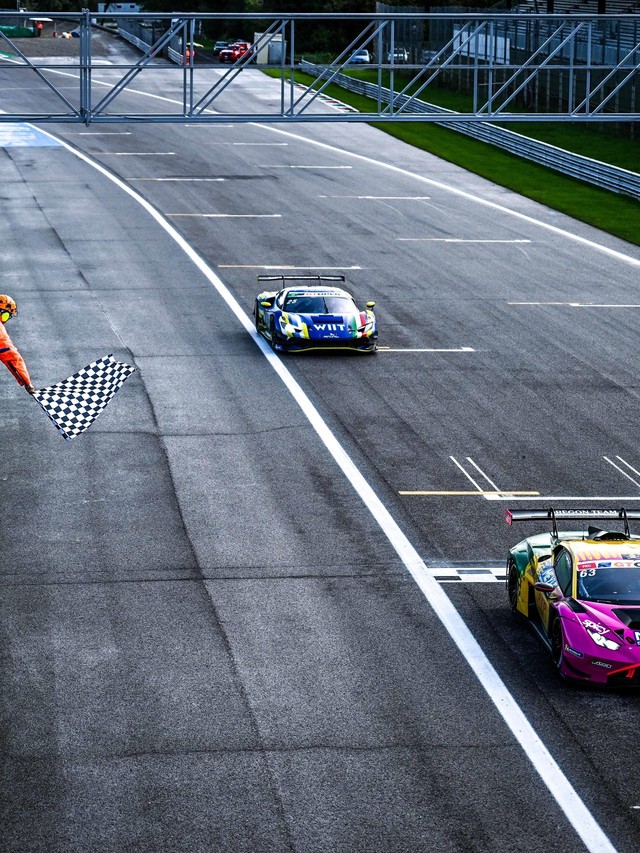
The Lamborghini Huracán GT3 EVO crosses the finish line, securing a victory at the GT Open race.
Race 2: Twenty Seconds of Handicap, Four Hundredths of Payoff
Sunday’s conditions were dry, removing the weather variable but not the difficulty. Chovet and Paul earned a second consecutive pole position, and Chovet led the early laps cleanly, including through an early safety car restart. The real pain came at the pit stop: a mandatory 20-second handicap, the penalty for Saturday’s win, dropped the #63 down the order when Paul climbed aboard.
Contact from another car then pushed Paul to fifth. At most circuits, recovering two positions in the closing stages of a GT3 race is a tall order. At Monza, where slipstreaming and late braking define the racing, it requires both bravery and precision. Paul clawed back to fourth, then set his sights on championship leader Sam de Haan for the final podium spot.
The margin at the line: four hundredths of a second. Roughly the time it takes to blink. In championship terms, the difference between third and fourth at this stage of the season could prove decisive. Lamborghini says Paul displaced de Haan right at the finish, and the psychological weight of that pass extends well beyond the points it delivered. Beating the championship leader on the line while carrying a 20-second handicap from your own earlier success is the kind of result that shifts momentum heading into a decider.

The victorious team celebrates on the podium with their trophies after a successful GT Open race.
Why the Huracán GT3 EVO2 Still Works This Well
The Huracán GT3 platform is, by GT3 standards, a veteran. Lamborghini Squadra Corse introduced the original Huracán GT3 a decade ago, and the EVO2 represents its third-generation evolution, built to comply with the FIA’s 2022 technical regulations. The car’s bodywork is constructed entirely from carbon fiber, and its naturally aspirated 5.2-liter V10 remains the defining engineering choice: no turbo lag to manage, linear throttle response, and a powerband that rewards driver precision rather than boost management.
Ten electronically actuated throttle bodies improve the V10’s efficiency, and the aerodynamic package borrows the hexagonal airscoop and rear fin design from the road-going Huracán STO. Those details matter in a race like Saturday’s, where changing grip levels demand a car that communicates clearly to the driver. A naturally aspirated engine with direct, predictable power delivery is an asset when you are switching from wet tires to slicks on a damp track and need to modulate throttle inputs with surgical care.
The broader record reinforces the platform’s competitiveness. Across all iterations, the Huracán GT3 family reportedly accumulated over 96 titles and 187 race victories globally, including class wins at the 24 Hours of Daytona and the 12 Hours of Sebring. The car also proved itself in the DTM, where SSR Performance and Mirko Bortolotti captured the 2024 championship. For customer teams like Oregon, the appeal is straightforward: a proven, well-understood car with factory support and a deep parts ecosystem.
Car and Driver tested the closely related Huracán Super Trofeo Evo2 at its Lightning Lap event, where the car recorded a 2:30.6 lap time. That one-make racer produces an estimated 612 horsepower at a curb weight of roughly 2,950 pounds, numbers that illustrate the platform’s raw capability even in a more restrictive spec-series configuration.

The Lamborghini Huracán GT3 EVO, number 63, races at high speed on the track.
Customer Racing as Brand Proof
Lamborghini’s customer racing program operates on a simple premise: if a privateer team can win with your car against factory-backed rivals, the engineering credibility flows upward to every road car in the showroom. Oregon Team’s Monza results fit that logic precisely. The team ran against Audis and Mercedes entries with full manufacturer support structures, and the Huracán EVO2 held its own in both wet and dry conditions, against both the clock and the success-penalty system designed to equalize the field.
Often overlooked in race reports is how the GT Open’s Balance of Performance system shapes these results. Oregon Team reportedly faced an unfavorable BoP at the previous round in Portimao, which makes the Monza rebound more significant. BoP adjustments can add weight, restrict air intake, or alter boost levels to keep different manufacturers competitive, and navigating those constraints is as much a part of the championship as driving skill. A team that can extract podium results across different BoP configurations demonstrates genuine depth, not just one-weekend speed.
The sister Oregon Team car, driven by Daan Arrow and Pietro Perolini, started third in Race 1, confirming that the team’s competitiveness extends beyond a single crew. Running two cars in a customer program multiplies the data available for setup optimization and signals the kind of operational scale that Lamborghini values in its supported teams.
Lamborghini’s investment in this tier of racing also feeds its driver development pipeline. Villorba Corse, another team in Lamborghini’s orbit, recently announced a multi-year partnership that will see it campaign a Huracán Evo2 GT3 in the 2026 International GT Open with two young drivers selected from Lamborghini’s GT3 Junior Driver Program. That kind of structured pathway, from junior program to supported customer team, mirrors what Ferrari and Porsche run in their own GT3 ecosystems.
The Temerario GT3 Looms, But the Huracán Earned Its Farewell
The Huracán GT3 EVO2’s successor is already public. The Temerario GT3, revealed at the 2025 Goodwood Festival of Speed, will replace it as Lamborghini’s factory-backed GT3 platform. According to Car and Driver, the Temerario GT3 is the first race car entirely designed and developed by Lamborghini at its Sant’Agata Bolognese facility, a meaningful distinction for a brand that previously relied more heavily on external motorsport partners for race car development.
The new car will use a modified version of the road car’s twin-turbocharged engine, stripped of its hybrid system as GT3 regulations require. That transition, from a naturally aspirated V10 to a forced-induction V8, represents a fundamental shift in how Lamborghini’s customer racing cars will feel and behave. Teams accustomed to the Huracán’s linear throttle response will need to adapt to turbo characteristics: different torque curves, heat management considerations, and the nuances of boost delivery in close racing.
Road and Track noted that Lamborghini stuck with updated versions of the same basic Huracán for a full decade while competitors like Porsche released three entirely new GT3 platforms in the same period. That longevity is both a testament to the original design’s soundness and a reminder that the Temerario arrives with considerable catching up to do in terms of chassis architecture modernity.
For teams currently campaigning the Huracán GT3 EVO2, the practical takeaway is clear: the car remains competitive right now, as Monza just proved. The transition to the Temerario will bring new capabilities but also the inevitable teething pains of a first-year platform. Oregon Team’s results suggest the Huracán still rewards investment and development, and the final rounds of its competitive life may produce some of its best results as teams extract every last tenth from a car they know intimately.
Barcelona Will Decide Everything
Sixteen points separate Paul and Chovet from the top of the International GT Open standings. With a full weekend of racing at Barcelona, the mathematics are straightforward: a victory and a strong supporting result could deliver the title. The complication, as Monza demonstrated, is the success-penalty system. If Oregon Team wins Race 1 in Barcelona, they will carry another handicap into Race 2, just as they did this weekend.
The strategic calculus becomes fascinating. Do you go all-out for the Race 1 win and accept the Race 2 penalty, or manage your pace to optimize total points across both races? Oregon Team’s Monza approach, taking every available point regardless of the consequences for the next race, suggests they will attack. Paul and Chovet have now proven they can absorb a 20-second handicap and still finish on the podium. That confidence changes the equation.
Lamborghini’s GT3 story in 2023 will be judged in part by whether this championship bid succeeds. Regardless of the Barcelona outcome, Oregon Team’s season, four wins, consistent podiums, and a title challenge carried on the back of a naturally aspirated V10 in its final competitive chapter, already stands as a fitting send-off for one of the most successful customer racing platforms in modern GT3 history.
Gallery


