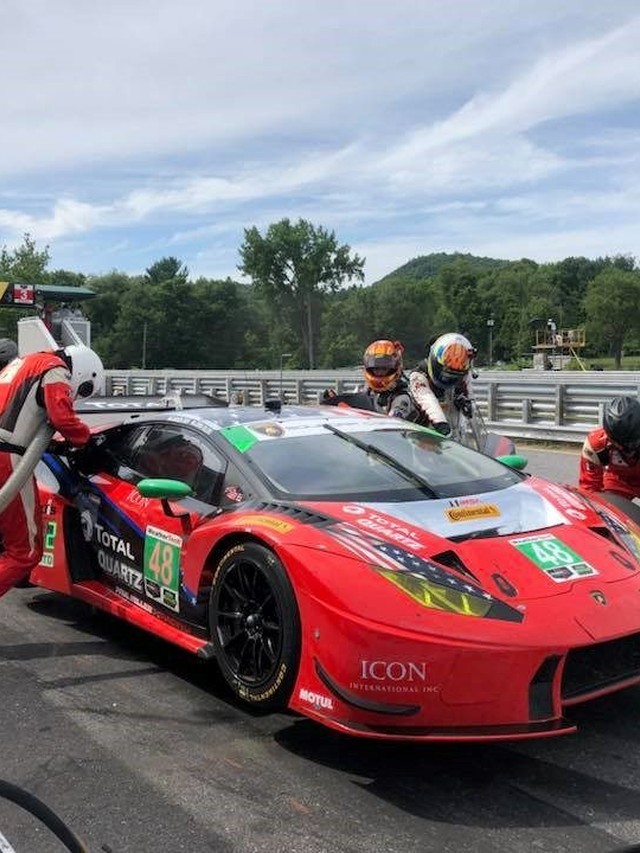
The 2018 Lime Rock Triumph: A Pivotal Victory for Lamborghini in IMSA
On a Saturday afternoon in July 2018, Bryan Sellers handed the #48 Lamborghini Huracán GT3 to Madison Snow with a clean lead at the Northeast Grand Prix. Snow, then a Lamborghini Squadra Corse GT3 Junior Driver, held the front for the final 63 laps of the two-hour, 40-minute race at Lime Rock Park, delivering Paul Miller Racing its second GTD class victory of the season. The first had come at the 12 Hours of Sebring in March.
The result carried weight well beyond a single trophy. Lamborghini says that with five podiums on the season at that point, Sellers and Snow widened their lead in the GTD drivers’ championship. Paul Miller Racing sat atop the teams’ standings, and Lamborghini led the manufacturers’ championship. Three simultaneous title leads, in a single season, for a marque that had only entered the WeatherTech Championship with the Huracán GT3 two years earlier.
Lime Rock is a deceptive circuit. At just over 1.5 miles, it punishes mistakes more than it rewards outright speed, making consistent execution the currency of victory. For a customer racing program still proving itself against entrenched GT3 rivals from Porsche, Ferrari, Mercedes-AMG, and BMW, controlling a race from the front for over an hour was a statement of operational maturity, not just raw pace. That maturity would prove to be the thread connecting every championship that followed.
Building a Championship Foundation: The Huracán GT3’s Early Dominance
The Huracán GT3 debuted in the WeatherTech Championship in 2016 and secured its first victory from pole position at Virginia International Raceway that August. By 2018, the platform was no longer a newcomer. It was the car to beat in GTD.
Lime Rock confirmed a pattern that would define the next several seasons. The Huracán GT3 went on to claim three consecutive Rolex 24 at Daytona victories from 2018 through 2020, a streak no other GT3 manufacturer matched in that era. Lamborghini earned back-to-back manufacturer championships in 2018 and 2019, while also collecting the driver and team titles in 2018. By 2021, the platform added the WeatherTech Sprint Cup manufacturer championship to its collection.
This level of sustained dominance in a Balance of Performance regulated series is unusual. BoP regulations exist specifically to prevent any single manufacturer from running away with results season after season. That Lamborghini managed it anyway speaks to something beyond raw horsepower: the Huracán GT3 proved to be a car that customer teams could extract consistent performance from across wildly different circuits, weather conditions, and race formats. Endurance events like Daytona and Sebring test reliability and pit strategy. Sprint races like Lime Rock reward qualifying pace and tire management. Winning across both formats requires a fundamentally well-sorted platform, and the operational discipline visible at Lime Rock in 2018 was the earliest public proof that Squadra Corse had built one.
Beyond the Track: What IMSA Success Means for Lamborghini’s Brand and Road Cars
Few competitors in the luxury performance market explain the connection between their racing programs and their showroom cars as directly as Lamborghini does with the Huracán. The GT3 race car shared its naturally aspirated 5.2-liter V10 with the road-going lineup, and the later EVO2 evolution drew its visual identity and engineering cues from the Huracán STO. According to IMSA.com, the EVO2 shares design elements, rear-wheel drive, and a naturally aspirated V10 producing 640 horsepower with the STO, right down to the hexagonal air scoop and rear fin.
That race-to-road pipeline is not just marketing language. The EVO2’s snorkel air intake, which replaced conventional side intakes and channeled airflow directly to the engine, originated in Squadra Corse’s development work at Sant’Agata Bolognese. The braking system used calipers and pads designed in-house by Squadra Corse. Ten electronically actuated throttle bodies, paired with titanium valves, refined the 5.2-liter engine’s response under racing loads. Factory driver Andrea Caldarelli contributed to the EVO2’s development, bridging the gap between what works on a data logger and what a customer team can replicate on a race weekend.
For Lamborghini owners who will never enter a race, this matters in a less obvious way. Consistent GT3 success elevates a brand’s engineering credibility in the eyes of collectors, insurers, and the broader enthusiast community. When a Huracán STO owner mentions that the car’s aero philosophy was validated by three consecutive Daytona wins, that is not idle boasting. It is a verifiable claim backed by results against factory-supported programs from much larger manufacturers. The dynasty that began crystallizing at Lime Rock gave Lamborghini something no advertising budget can buy: proof under pressure.

A red Lamborghini Huracan GT3 race car receives attention from its pit crew during a race day stop.
Competitive Edge: The Naturally Aspirated Outlier in GT3 Racing
One detail that often gets lost in championship tallies is how unusual Lamborghini’s engineering approach was in the GT3 field. The Huracán GT3 ran a naturally aspirated V10 in a class increasingly populated by turbocharged rivals. Porsche’s 911 GT3 R, Ferrari’s 488 and later 296 GT3, and Mercedes-AMG’s GT3 all relied on forced induction. Lamborghini’s V10 delivered its power with a linear, high-revving character that rewarded driver sensitivity, particularly in corner exit and partial-throttle situations where turbo lag can unsettle a car.
Balance of Performance adjustments ensured no manufacturer held an outright horsepower advantage, but the naturally aspirated engine’s throttle response and predictable torque delivery gave Lamborghini teams a qualitative edge difficult to quantify on a spec sheet. Multiple enthusiast communities and racing observers noted over the years that the Huracán GT3 was particularly strong in driver confidence, a trait that paid dividends in the amateur-professional pairings common in GTD. That confidence factor helps explain why the same operational consistency on display at Lime Rock could be replicated by different customer teams at circuits with entirely different demands.
This philosophy now faces a generational shift. Car and Driver reports that the Temerario GT3, which replaces the Huracán GT3 EVO2, will use a modified version of the road car’s twin-turbocharged V8. The transition marks the end of naturally aspirated Lamborghini GT3 racing and opens a chapter where Squadra Corse must prove it can deliver the same consistency with a fundamentally different powertrain architecture.
From 2018 Momentum to the Future of Lamborghini Motorsport
The 2018 season was the inflection point where Lamborghini’s customer racing program graduated from competitive entrant to championship force. The Lime Rock win, combined with the Sebring victory and the triple championship lead, gave Squadra Corse a foundation of credibility that sustained the Huracán GT3 through multiple evolutions and half a decade of front-running results.
The broader motorsport picture is more complicated now. Road & Track reports that Lamborghini is pausing its SC63 LMDh prototype program for 2026, choosing to refocus resources on the Temerario GT3. That decision suggests the company views customer GT3 racing, the category where the Huracán built its legacy, as the higher strategic priority over factory prototype competition, at least in the near term.
Whether the Temerario GT3 can replicate the Huracán’s dominance remains an open question. The turbocharged V8 will behave differently, the competitive landscape includes newer and more aggressive entries from Ferrari, Porsche, and BMW, and Balance of Performance regulations will ensure no car arrives with a built-in advantage. What Lamborghini does carry forward is institutional knowledge. The operational lessons from seasons like 2018, where Paul Miller Racing could hand a car off mid-race and trust the lead would hold, represent the kind of organizational capability that does not appear on a dyno chart. Sellers and Snow won at Lime Rock because the car, the team, and the strategy all functioned as a unit. Replicating that cohesion with new hardware is the real test ahead for Squadra Corse, and the real measure of whether the dynasty born in 2018 endures.


