A Royal Return to the Same Monaco Tarmac
Fifty-one years after Prince Rainier III and Princess Grace completed a lap of honor in the Lamborghini Marzal before the 1967 Monaco Grand Prix, Prince Albert of Monaco climbed into the same silver concept car and drove it through the principality’s streets at the Grand Prix de Monaco Historique. His nephew Andrea Casiraghi rode alongside him. The Marzal opened the qualifiers and races for 1966 to 1972 Formula 1 cars, reprising the exact ceremonial role it played more than half a century earlier.
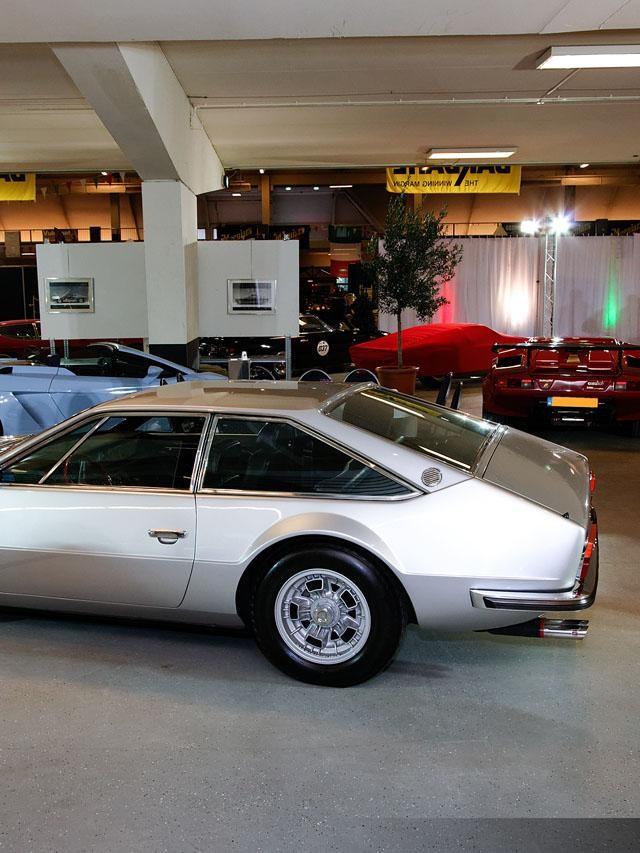
This was the Marzal’s first public appearance since that original 1967 outing, and Lamborghini staged it as a dual celebration: the return of one of the most radical concept cars in automotive history, and the 50th anniversary of the Espada, the production grand tourer the Marzal directly inspired. A freshly restored 1976 Espada, chassis #9090, sat alongside the concept as proof of the lineage.
The royal connection matters because it was never planned. In 1967, Prince Rainier III spotted the Marzal and decided on the spot that it would be his parade car. The resulting photographs of Monaco’s royal couple inside a glass-doored, silver-upholstered spaceship became some of the most iconic automotive images of the decade. Lamborghini could not have bought that kind of publicity. That Prince Albert chose to recreate the moment speaks to how deeply the Marzal embedded itself in Monaco’s own cultural memory, and it frames the larger story of this car: a single prototype so visionary that it shaped both a royal tradition and an entire production lineage.

The futuristic Lamborghini Marzal concept car makes an appearance on the track, showcasing its unique design.
Marcello Gandini’s Glass Spaceship: What Made the Marzal So Radical
The Marzal debuted at the 1967 Geneva Motor Show as a Carrozzeria Bertone project, penned by Marcello Gandini, the same designer responsible for the Miura. Where the Miura was a mid-engine two-seater built for speed, the Marzal explored a completely different question: what would a four-seat Lamborghini look like if you threw away every convention about how a grand tourer should be packaged?
Gandini’s answer involved nearly 4.5 square meters of glass. The gullwing doors stretch the full length of the cabin, constructed almost entirely from transparent panels. The roof is glass. The interior sits completely exposed to the outside world, upholstered in silver leather that Gandini clearly intended to be seen. The car offers zero privacy, which is either a bold design statement or a dealbreaker depending on your temperament.
Beyond the glasswork, the Marzal introduced a hexagonal design motif across its dashboard, seats, rear louvers, and steering wheel. That hexagonal language became a Lamborghini signature that persists in the brand’s modern interiors, a thread running directly from this 1967 show car to today’s cockpits. The engine layout was equally unconventional. Lamborghini says the Marzal used a rear transverse engine, and web research identifies this as a 2.0-liter inline-six, essentially one bank of Lamborghini’s 4.0-liter V12, designed by Giampaolo Dallara. Mounting the engine behind the rear axle freed up cabin space for genuine four-passenger seating, making the Marzal the only rear-engined Lamborghini ever built.
Ferruccio Lamborghini reportedly viewed the Marzal as an advertising tool rather than a production candidate. The car was fully operational, but its purpose was to demonstrate what Lamborghini’s design thinking could achieve when freed from the constraints of a production budget. In that sense, it worked spectacularly, and the proof arrived just one year later.
From Concept to Production: How the Marzal Became the Espada
The Espada, which arrived in 1968, was the practical answer to the question the Marzal had raised. Lamborghini says it became one of the company’s most successful historic cars and one of the first series-production four-seater GTs with genuine luggage space. Where the Marzal’s glass doors and rear-mounted six-cylinder were too extreme for the road, the Espada retained the concept’s fundamental ambition: a full four-seat Lamborghini with real grand touring capability.
Gandini carried the Marzal’s low, wide proportions into the Espada’s production design, trading the transparent gullwings for conventional doors but keeping the dramatic greenhouse and the sense of interior space that made the concept so striking. The engine moved to the front, using Lamborghini’s full V12 rather than the halved prototype unit, and the car stayed in production until 1978. Over that decade, it proved that Lamborghini could sell something other than a two-seat exotic, a lesson the company would revisit decades later with the Urus.
The Marzal-to-Espada arc illustrates a pattern that defines how Lamborghini operates. The company builds extreme concepts that test the boundaries of what the brand can mean, then distills the viable ideas into production cars. The Marzal did precisely that in 1967, and the Espada was the payoff. Understanding this lineage is what made the Monaco pairing of the two cars so resonant: the concept and its offspring, side by side on the same tarmac where the whole story began.
Polo Storico’s Ten-Month Revival of Espada Chassis #9090
The Espada that appeared alongside the Marzal at Monaco was not a random example pulled from a collector’s garage. Chassis #9090 is a 1976 model that Lamborghini says has remained the company’s property since new. It served as a development and type-approval car for the American market, which means it spent its working life being tested rather than pampered. That history makes it an unusual candidate for a concours-quality restoration, but Polo Storico treated it as a demonstration of what the heritage division can achieve.
The restoration took ten months and covered mechanics, electrics, bodywork, and interior, though Lamborghini notes the original upholstery survived and was retained. Polo Storico used exclusively original Lamborghini spare parts and followed the specifications recorded in the car’s production file, held in the division’s archives at Sant’Agata Bolognese.
This archive-driven methodology, where every restoration decision traces back to original production documentation, positions Polo Storico as a guarantor of authenticity rather than a customization shop. For Espada owners considering a factory restoration, the #9090 project signals that the division treats even development mules with the same archival rigor it would apply to a low-mileage collector car. Lamborghini has not published pricing for restorations of this scope, but the ten-month timeline and parts-only-from-Lamborghini policy give a sense of the commitment involved. Bringing this particular car to Monaco, fully restored and standing beside the concept that inspired it, was Polo Storico’s way of closing a circle that began in 1967.
Why the Marzal and Espada Still Shape Lamborghini’s Identity
The Marzal’s hexagonal interior motif is the detail that resonates most directly with the modern lineup. What began as a decorative flourish on a 1967 show car became a design language that Lamborghini still references in its current cockpits. But the broader lesson is about ambition: the Marzal proved that Lamborghini’s identity could stretch beyond mid-engine two-seaters without losing its capacity to shock.
The Espada proved the commercial case. A four-seat Lamborghini with a V12 and real luggage space sold well enough to remain in production for a decade. When Lamborghini launched the Urus in 2018, the same year as this Monaco celebration, the underlying argument was identical: the brand can credibly build vehicles outside its supercar core, and buyers will come. The Espada was the first proof of that thesis.
Multiple enthusiast communities continue to discuss the Marzal with genuine affection, often citing its appearance in video games and its status as a childhood Matchbox car as entry points into Lamborghini fandom. That kind of cultural persistence, where a one-off concept from 1967 still generates conversation, is exactly the heritage equity that Polo Storico exists to protect, and exactly what the Monaco return was designed to celebrate.
The Espada and Islero Owners’ Rally: 650 Kilometers Through Umbria
The Monaco appearance was the public spectacle. The quieter announcement concerns the owners themselves. Lamborghini confirmed that the 50th-anniversary celebrations for the Espada and Islero (both designed in 1968) will conclude with an exclusive rally from September 7 to 11, 2018. The 650-kilometer route starts in Perugia, winds through Umbria’s scenic roads, and finishes at Lamborghini’s headquarters in Sant’Agata Bolognese.
The rally is restricted to owners of Espada and Islero models, making it a genuinely exclusive gathering rather than a generic brand experience. The route itself, ending at the factory, reinforces the connection between the cars and their origin. Lamborghini’s decision to organize a model-specific tour for two of its less celebrated 1960s GTs suggests a heritage strategy that extends beyond the Miura and Countach. The Espada and Islero occupy a quieter corner of the brand’s history, and events like this ensure they stay visible.
Taken together with the Monaco ceremony, the rally completes a year-long narrative arc: the Marzal’s return reminded the world what Lamborghini dared to imagine in 1967, the restored Espada showed what that imagination became, and the September tour invites the people who live with these cars every day to drive them home.


