
A Car Designed to Stop You in Your Tracks
Marcello Gandini drew a car in the early 1970s that broke every rule about what an automobile was supposed to look like. Penned at Bertone and engineered by Paolo Stanzani, the Lamborghini Countach arrived as a concept in 1971 and entered production in 1974 with a shape so alien, so flat, so aggressively angular that it redefined the word “supercar” for people who had never sat in one. The wedge profile, the scissor doors that swung upward instead of outward, the cockpit set so far forward the driver practically sat on the front axle: none of it looked like anything else on any road, anywhere.
Ferruccio Lamborghini had built his company on the idea that a grand touring car could outclass Ferrari without the racing pretension. The Countach pushed that philosophy to its most extreme visual conclusion. It was not a refined cruiser. It was a provocation, a machine that looked fast bolted to the floor of a motor show, and it became the single most recognizable sports car silhouette of the twentieth century.
Before social media, before YouTube, the Countach spread through a different network entirely: the bedroom wall. Poster companies printed millions of copies. Kids who would never see a Lamborghini in person, let alone hear a V12 at full song, grew up staring at that shape every night before they fell asleep. The Countach did not need Instagram. It colonized an entire generation’s imagination through glossy paper and Blu Tack. That cultural reach, far more than any spec sheet, is what made the Countach the car that wrote the rules for every supercar that followed.
Gandini’s Wedge and the Engineering Behind It
The poster would have meant nothing if the object itself had not been genuinely radical. Stanzani placed the V12 longitudinally behind the cockpit, a layout that gave the Countach its proportions: a long rear deck, a short nose, and a driving position that felt like sitting in the bow of a very fast, very loud boat. The earliest production LP400 models used a 4.0-liter V12, fed by Weber twin-barrel carburetors, producing enough power to push the car toward a claimed 300 km/h top speed.
Bob Wallace, Lamborghini’s legendary test driver and development engineer, played a critical role in sorting the Countach for real-world use. Wallace drove prototypes until they broke, then told the engineers what needed fixing. His fingerprints are on the car’s behavior at the limit, the way it communicated grip through the steering, the way the rear end responded under hard braking. Without his relentless development work, the Countach might have remained a motor show sculpture rather than a functioning supercar.
Construction relied on a tubular steel spaceframe, with body panels shaped by the Lamborghini Upholstery Department, a name that undersells the craftsmanship involved. Every panel was hand-fitted. Gaps varied. Paint quality depended on the day of the week. This was Italian manufacturing in the 1970s and 1980s, and the imperfections became part of the car’s character. Collectors today often prize original, unrestored examples precisely because those inconsistencies tell the story of how the car was made, reinforcing the handbuilt mystique that no factory photograph could replicate.

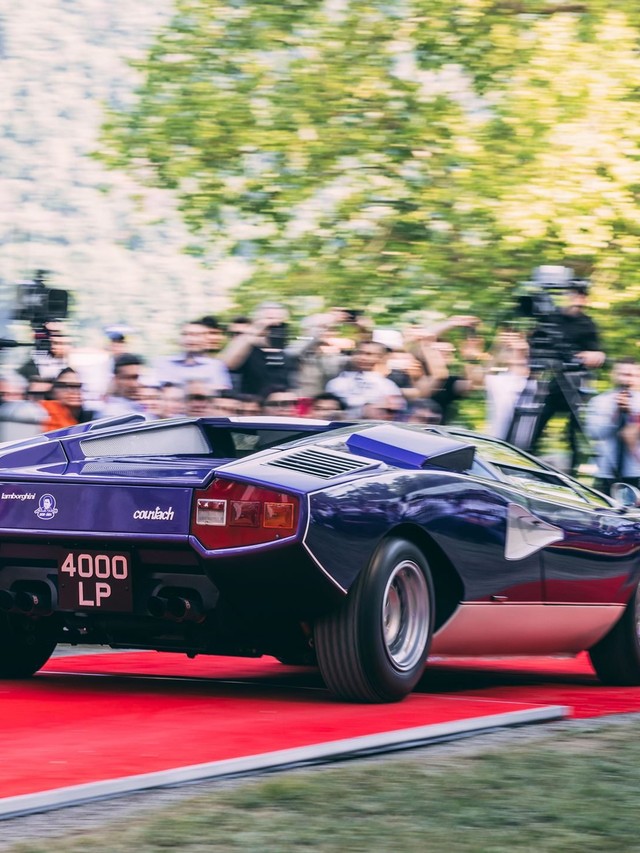
A blue Lamborghini Countach LP400 drives away on a red carpet at an outdoor event, with a blurred audience and trees in the background.
From LP400 to 25th Anniversary: A Car That Kept Evolving
Lamborghini produced the Countach from 1974 to 1990, and the car changed substantially across that span, yet every evolution only deepened its visual authority. The original LP400 was the purest expression of Gandini’s design: clean surfaces, minimal ornamentation, no rear wing. As the model progressed through the LP400 S, LP500 S, and the Countach QV (Quattrovalvole, meaning four valves per cylinder), the car gained wider fenders, larger wheels, and increasingly dramatic aerodynamic additions. The QV variant marked a significant mechanical upgrade, with a revised cylinder head design that improved breathing and power delivery.
The 25th Anniversary edition, which appeared in 1988, served as both a send-off and a statement. It was the final evolution of the line, featuring restyled bodywork and updated details while retaining the essential silhouette Gandini had established nearly two decades earlier. Because it coincided with the late 1980s supercar boom, the 25th Anniversary became one of the most widely seen versions, the Countach many people encountered in showrooms and at events.
One of the most fascinating chapters involves the Countach Wolf, a special variant commissioned by Canadian oil magnate Walter Wolf. Engineered by Gian Paolo Dallara and reportedly powered by a 5-liter 12-cylinder engine, a displacement figure that predated the later production upgrades, the Wolf cars were essentially factory-backed specials built to one wealthy customer’s specifications. They served as rolling development mules, and several innovations tested on Wolf’s cars eventually filtered into the production Countach. Think of Walter Wolf as an early prototype of the modern hypercar customer who pays for bespoke engineering access.
Across all variants, Lamborghini built approximately 1,999 to 2,000 Countach units during the model’s entire production run at Sant’Agata Bolognese. That number, spread over sixteen years, means the Countach was always rare, even at its peak, and its scarcity only amplified the poster’s power: most people would never see one in the metal.

An orange Lamborghini Countach 25th Anniversary with its scissor door open is presented on a red carpet at an outdoor event, with an audience and trees in the background.
Why the Poster Mattered More Than the Performance
The Countach was never the fastest car of its era in a straight line, and it was certainly not the easiest to drive. Rearward visibility was essentially nonexistent. The clutch was heavy enough to qualify as a leg workout. Air conditioning, when fitted, struggled against the heat radiating from a V12 mounted inches behind the cabin. Automotive journalists frequently noted that the driving experience was physically demanding, sometimes frustrating, and always unforgettable.
None of that diminished the car’s cultural impact. The Countach succeeded because it looked like nothing else, and because that look arrived at precisely the right moment. The 1970s and 1980s were the golden age of the car poster, a period when visual culture moved through print media and a single striking image could embed itself in millions of minds. Typically photographed in red or white against a backdrop of palm trees or mountain roads, the Countach became the default image of automotive aspiration for a generation that had no other way to access it.
For collectors and buyers today, the practical takeaway is straightforward: condition and originality drive Countach values more than variant or color. A well-documented, numbers-matching LP400 in original paint will command a significant premium over a restored 25th Anniversary, regardless of which one looks better in photos. The market rewards provenance because so many Countachs have been modified, repainted, or “updated” over the decades. If you are considering a purchase, the paper trail matters as much as the paint.
Mitja Borkert and Centro Stile Lamborghini later drew on the Countach’s visual language when designing the modern Countach LPI 800-4, a hybrid reinterpretation that debuted decades after the original. The fact that Lamborghini returned to this well says everything about how deeply the original design penetrated automotive culture. No other car from the 1970s has been revived so directly by its own manufacturer.

A line of Lamborghini Countach models, including a yellow LP400, a white 25th Anniversary, and a red LPI 800-4, displayed on platforms in a large event hall with dining tables.
The Shape That Wrote the Rules
Ferrari had the racing pedigree. Porsche had the engineering consistency. Lamborghini had the Countach, and the Countach had something neither rival could manufacture: the ability to make a ten-year-old who had never heard an engine decide, on the spot, that this was the most important object in the world.
That power has not faded. At concours events today, crowds still cluster around Countachs with a density that newer, faster, more technically sophisticated cars rarely generate. The roughly 2,000 examples built between 1974 and 1990 at Sant’Agata Bolognese remain the visual foundation on which every subsequent Lamborghini supercar has been judged. The Diablo inherited the scissor doors. The Murcielago inherited the drama. The Aventador inherited the sense that a Lamborghini should look like it arrived from somewhere slightly more dangerous than the present.
All of that started with Gandini’s wedge, Stanzani’s engineering, Wallace’s testing, and a generation of poster companies who understood that one image of a low, wide, impossible car could sell more dreams than any advertisement.

An orange Lamborghini Countach parked on a gravel path at an outdoor event, with lush greenery and classical architecture in the background.


