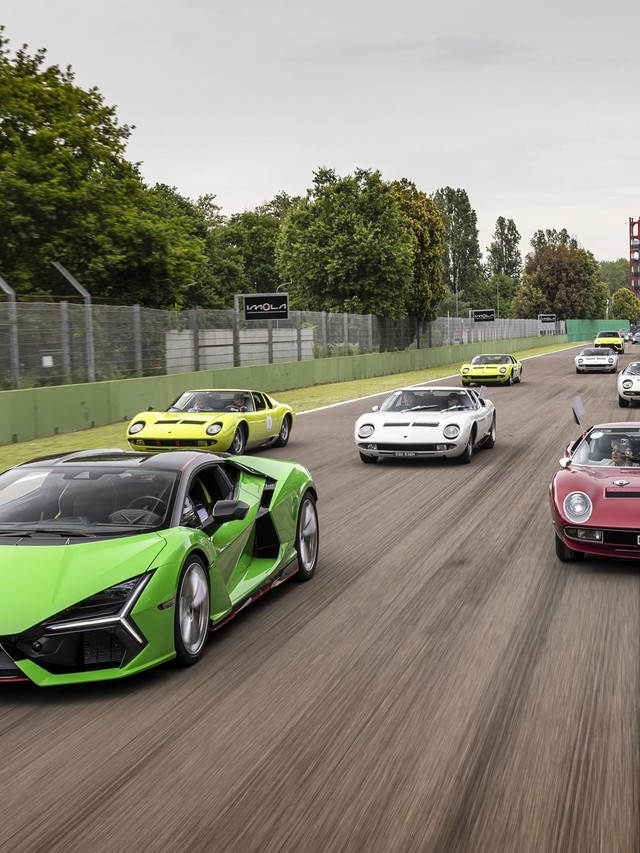
Miuras, Aventadors, and a Closed Alpine Pass: Lamborghini’s Cinematic Anniversary Drive
In May 2016, Lamborghini loaded two museum Miuras and a fleet of current Aventador variants onto a multi-day road trip from Sant’Agata Bolognese through the Pianura Padana, with stopovers in Vigevano and Aosta, before climbing the hairpin curves of state road 27 on the Grand St. Bernard Pass. The destination was a full reenactment of the opening sequence from Peter Collinson’s 1969 film The Italian Job, the one where a Miura threads through alpine switchbacks to a Quincy Jones soundtrack before meeting an untimely end in a tunnel.
The pass was opened on a one-time basis exclusively for the event, with vehicles from Anas (Italy’s national road company) and the Polizia Stradale providing an official escort. The contemporary V12 lineup joined the Miuras for the climb: the Aventador Coupe, Roadster, Superveloce, and Superveloce Roadster all participated. The visual effect was deliberate. Two generations of mid-engine V12 Lamborghinis, separated by half a century of engineering, sharing the same stretch of road that embedded the Miura in popular culture.
Closing an international alpine pass for a car company’s birthday is not a routine concession from Italian authorities. It signals the kind of institutional goodwill and brand weight that Lamborghini can leverage when it wants to stage something memorable, and it sets the event apart from the typical concours lawn or hotel ballroom anniversary.
Two V12 Eras on One Road: Why the Aventador Lineup Was the Real Message
Most manufacturers celebrate milestone anniversaries with a static display, a commemorative badge, or a limited edition. Lamborghini chose to put its entire current V12 range alongside the car that started the lineage, on the exact road that made the Miura a cinematic icon.
The Miura debuted in 1966 with a mid-mounted 4.0-litre V12, a layout borrowed from racing prototypes and considered radical for a road car. By 2016, the Aventador carried a 6.5-litre naturally aspirated V12 in the same fundamental position. The architecture evolved enormously, through carbon-fiber monocoques, pushrod suspension, and single-clutch automated manuals, but the philosophical commitment to a large-displacement, naturally aspirated twelve-cylinder engine behind the cabin remained intact. Placing the Aventador Superveloce next to a 1966 Miura on an alpine pass made the continuity visceral rather than theoretical.
For owners and prospective buyers, the message was pointed: this company treats its V12 as a through-line, not a museum piece. At a time when turbocharging and hybridization were already reshaping the supercar landscape, Lamborghini was publicly doubling down on its naturally aspirated identity. The Aventador SV, with 750 horsepower from atmospheric induction, served as the living proof.
The Architects of an Icon: Dallara, Stanzani, and Gandini Reunited
Beyond the spectacle on the pass, the event brought together the three men most directly responsible for the Miura’s existence: engineers Gian Paolo Dallara and Paolo Stanzani, who led the car’s technical development, and Marcello Gandini, who designed the body at Carrozzeria Bertone. The three participated in a roundtable discussion with Lamborghini’s current design and engineering leadership.
Dallara, widely acknowledged as the Miura’s primary engineering architect, conceived the chassis with a racing car’s architecture in mind. By 1965, Lamborghini’s engineers completed detailed drawings for the innovative mid-engine layout, a configuration inspired by the Ford GT40 but intended from the outset as a road car. Gandini entered the picture after Dallara and Stanzani established the mechanical package, producing sketches that reportedly won immediate enthusiasm from Ferruccio Lamborghini himself.
The reunion’s significance extends well beyond nostalgia. Having all three creators in the same room, willing to discuss the car’s development in the context of Lamborghini’s current direction, underscored the coherence of a lineage that runs from Miura to Countach to Diablo to Murcielago to Aventador. Stanzani, in various interviews over the years, explained that the Countach was born from taking the Miura’s features to an extreme level. Few manufacturers can trace a single architectural idea through five decades of production cars and point to the specific people who started it.
Lamborghini did not release detailed transcripts from the roundtable, so the specific insights shared between the Miura’s creators and the company’s current team remain undisclosed. The company’s account positions the discussion as a bridge between past and present development philosophy, though enthusiasts hoping for candid technical revelations will need to look to independent interviews with Dallara and Gandini conducted elsewhere over the years.
PoloStorico’s First Miura: Chassis #4846 and the Business of Authenticity
Among the cars on the anniversary drive was chassis #4846, described by Lamborghini as the first Miura restored by its PoloStorico heritage division. The car had already earned recognition at the Concorso di Eleganza Villa D’Este, winning the Trofeo BMW Group Italia award, a distinction decided by public vote at one of the world’s most prestigious concours events.
PoloStorico’s inclusion in the anniversary was strategic, not sentimental. Lamborghini established the division to handle restoration, certification, and parts supply for classic models, and putting its first completed Miura restoration on the same road as the museum cars and current Aventadors positioned the program as an active participant in the brand’s living heritage rather than a back-office archive.
For collectors and prospective classic Lamborghini buyers, PoloStorico certification carries real commercial weight. A factory-restored Miura with documented provenance occupies a different tier in the market than a car restored by an independent specialist, however talented. Lamborghini controls the original tooling, paint codes, material specifications, and engineering documentation, giving PoloStorico an authenticity advantage that independent restorers cannot replicate. The company did not disclose the cost or detailed process involved in the #4846 restoration, but the Villa D’Este recognition suggests the result met the standards of international concours judges.
This matters practically for anyone considering a classic Lamborghini purchase. A PoloStorico-certified car is, in effect, a factory-backed asset, and the anniversary event served as a public endorsement of that program’s credibility. The thread connecting the Miura’s original engineering, the Aventador’s continuation of it, and PoloStorico’s preservation of the physical cars is the same thread: Lamborghini treating its V12 heritage as something worth investing in, not merely referencing.
Heritage as Competitive Strategy: Lamborghini vs. the Rest of the Field
Ferrari operates its Classiche department with a similar mandate: factory certification, restoration, and heritage events for classic models. Ferrari Classiche is older, larger, and benefits from a racing history that Lamborghini never pursued with the same institutional commitment, extending to track days with vintage Formula 1 cars that Lamborghini simply cannot match.
Yet Lamborghini’s approach carries a different kind of weight. Where Ferrari’s heritage story is diffuse, spanning dozens of racing programs, GT cars, and road models across seven decades, Lamborghini’s V12 lineage is remarkably focused. The Miura invented the mid-engine supercar template. Every V12 flagship since then refined it. The anniversary event on the Grand St. Bernard Pass distilled that story into a single visual: old Miuras and new Aventadors on the same alpine road, escorted by Italian police, with the car’s original creators watching from the sidelines.
Porsche, McLaren, and Pagani each handle heritage differently. Porsche leans on motorsport continuity and the 911’s unbroken production run. McLaren, founded in the modern era, lacks the deep archive. Pagani operates at too small a scale for institutional heritage programs. Lamborghini occupies a middle ground: young enough that the Miura’s creators are still alive to participate, old enough that the V12 lineage carries genuine historical gravity.
The practical implication for enthusiasts is that Lamborghini treats heritage not as a passive brand exercise but as an active ownership proposition. PoloStorico restorations, curated driving events, and reunions with original designers all reinforce the idea that buying a Lamborghini, classic or current, connects you to a specific, traceable engineering philosophy. Whether that resonates more than Ferrari’s broader heritage narrative depends on what kind of story you want your car to tell.
Why the Miura Still Defines What Lamborghini Means
The Miura was produced between 1966 and 1973, a run of roughly 764 cars across the P400, S, and SV variants. It is widely regarded as one of the original supercars, a designation it earned by doing something no production road car had done before: packaging a race-derived mid-engine V12 layout in a body so beautiful that it redefined what a sports car could look like.
Ferruccio Lamborghini founded his company in 1963, famously after a dispute with Enzo Ferrari over the clutch of a 250 GT. The brand’s first production models, the 350 GT in 1964 and the 400 GT in 1966, were refined front-engine grand tourers. The Miura represented a radical departure, conceived by young engineers who wanted to build a race car for the road. That tension between Ferruccio’s preference for refined GTs and his engineers’ ambition for something wilder is part of what gives the Miura its enduring mystique.
According to Jalopnik, Lamborghini’s current leadership has stated plainly that the company will never produce a new interpretation of the Miura. The Countach received a modern limited-edition tribute; the Miura will not. The reasoning, as reported, centers on the idea that the Miura occupies a singular place in the brand’s history that a retro-styled successor would diminish rather than honor.
That decision reinforces the significance of events like the 50th anniversary drive. If Lamborghini will not build a new Miura, the original cars become the only physical connection to the model’s legacy. PoloStorico restorations, museum preservation, and curated anniversary events become the mechanisms through which the Miura’s story continues to reach new generations of enthusiasts.
The 2016 celebration on the Grand St. Bernard Pass was, in that light, less a birthday party and more a strategic declaration. The V12 lives on. The car that started it all remains untouchable. And the company that built it still knows how to stage a moment that makes the connection between past and present feel earned rather than manufactured.


