Eurofighters Over Sant’Agata: The Museum Opens, the Miuras Roll Out
CEO Stefano Domenicali chose a single morning in June 2016 to inaugurate Lamborghini’s completely renovated headquarters museum and send twenty owner-driven Miuras on a 500-kilometer rally through Emilia, Liguria, and Tuscany. The sendoff was anything but understated. Four Eurofighter jets from the 36th Stormo Caccia, based at Gioia del Colle near Bari, screamed over the assembled cars as they lined up inside the Sant’Agata Bolognese compound. Lt. Gen. Enzo Vecciarelli, the new Chief of Staff of the Italian Air Force, stood alongside Domenicali to watch the departure.
The staging was calculated. By timing the museum’s reopening to coincide with the Miura’s 50th anniversary, Lamborghini bound its most celebrated design to a physical space that now tells the full arc of the company’s history. Domenicali framed the pairing as a statement about where the company puts its money: heritage, he argued, deserves the same investment as future product. That conviction, visible in every detail of the day, is the thread connecting the renovated galleries, the owners’ rally, and the broader direction of the brand.
Why Lamborghini Staged This as a Single Event
A museum renovation and an owners’ rally are routine calendar items for any luxury automaker. Running them simultaneously is a brand strategy decision. Lamborghini wanted one visual narrative: the cars that defined the company’s identity rolling out of the building that now houses their story, under military escort, in front of an international audience.
The Miura earns that spotlight. Commentators routinely call it the prettiest car ever made and credit it as the first true supercar. Its transverse mid-mounted V12 layout, penned by Gian Paolo Dallara and styled by Marcello Gandini, established the template that every mid-engine Lamborghini since has followed. Celebrating its half-century alongside a museum reopening connects the Miura’s engineering legacy to the company’s present and, critically, to whatever comes next.
For current owners, the subtext was unmistakable: the brand treats its community as participants in the story, not just customers. Twenty Miura owners drove their own cars on this rally, through some of Italy’s finest roads. That kind of access, combined with the spectacle overhead, builds loyalty in a way that a press conference or a static display simply cannot.
Inside the Renovated Museum: What Actually Changed
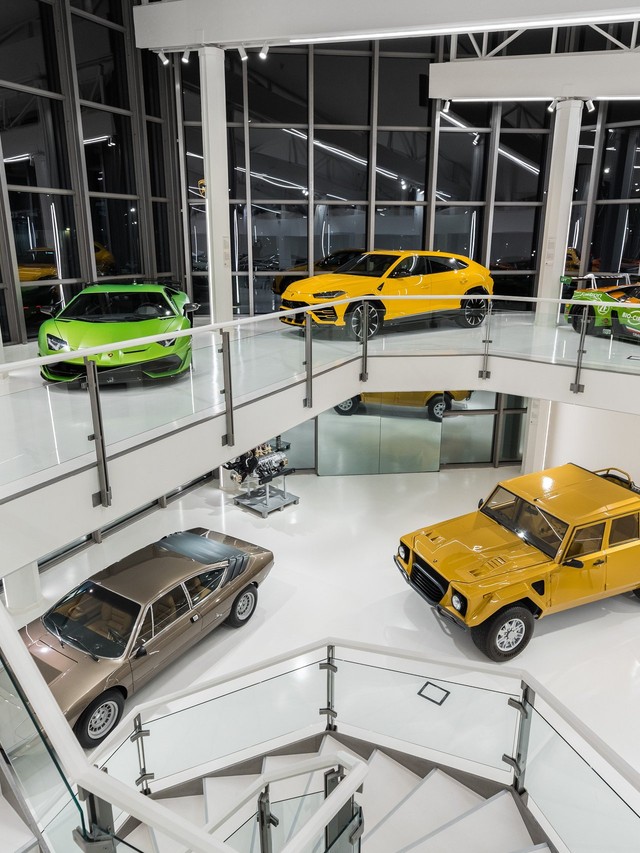
Lamborghini says the museum’s layout and displays were completely overhauled, with new multimedia elements and interactive activities designed to move the experience beyond rows of static cars behind ropes. White floors and grey walls let the vehicles themselves dominate the visual space, a design choice that multiple visitor accounts describe as giving the museum a modern, almost showroom-like quality.
The collection spans the full breadth of the company’s output. Visitors encounter the 350 GT (the brand’s first production car, which debuted at the 1963 Turin Motor Show), the Miura, the Countach, the LM002, and concept vehicles that point toward future directions. An area dedicated to Lamborghini tractors nods to Ferruccio Lamborghini’s industrial origins, grounding the supercar mythology in something tangible.
Sitting at Via Modena 12 in Sant’Agata Bolognese, directly adjacent to the production facility, the museum draws its real differentiator from that proximity. Multiple visitor reviews emphasize that the factory tour, which must be arranged through a Lamborghini dealer, transforms the visit from a pleasant hour into something genuinely memorable. Seeing a Countach behind glass and then watching current models being hand-assembled a few hundred meters away gives the experience what one account calls a “living industrial dimension.” Booking well in advance is strongly recommended, as factory tour slots fill quickly.

A multi-level display of iconic Lamborghini vehicles, from classic models to modern concepts, fills a brightly lit museum space. Image: Automobili Lamborghini.
Sant’Agata vs. Maranello: Two Approaches to Heritage
Ferrari’s museum complex in Maranello and the Enzo Ferrari Museum in Modena represent the most obvious comparison point. Ferrari leans heavily into its Formula 1 pedigree, rotating themed exhibitions around racing history and championship seasons. The experience is polished, well-funded, and unapologetically focused on competition.
Lamborghini’s approach differs by necessity and, arguably, by philosophy. The company never raced in Formula 1 as a constructor in the way Ferrari did. Its heritage argument rests on design, on the visceral impact of cars like the Miura and Countach, and on a founding mythology rooted in Ferruccio’s famous dispute with Enzo Ferrari over clutch quality. The renovated museum leans into this distinction, presenting the full spectrum of Lamborghini’s industrial and creative output rather than showcasing trophies and championship cars.
Factory adjacency gives Lamborghini something Ferrari’s standalone museums lack: the sense that you are standing inside a working company, not visiting a monument to past glory. For enthusiasts planning an Emilia-Romagna pilgrimage, the practical advice from the ownership community is consistent. Visit both, but understand that the Lamborghini experience rewards those who book the factory tour. The museum alone, while worthwhile, is compact. Combined with the production line walkthrough, it becomes one of the more compelling automotive experiences in Italy.
The Ferruccio Lamborghini Museum, a separate institution inaugurated in 2014 in Funo di Argelato, focuses on the founder’s broader industrial legacy. Enthusiasts with a particular interest in Lamborghini’s pre-supercar history will find it a worthwhile detour.
What This Signals for Lamborghini’s Brand Direction
Investing in a museum renovation and a curated owners’ rally may seem like soft brand-building compared to launching a new model. For a company navigating the transition from naturally aspirated engines to hybrid powertrains, though, anchoring identity in heritage is a strategic necessity. The Miura’s mid-engine V12 layout is the genetic code that runs through the Countach, the Diablo, the Murciélago, the Aventador, and now the Revuelto. By celebrating that lineage in a physical space visitors can walk through, Lamborghini reinforces the argument that its future cars are extensions of a coherent philosophy, not departures from it.
The practical infrastructure follows the same logic. Polo Storico handles restoration and certification, the museum serves public engagement, and curated rallies like the Miura Tour sustain the ownership community. Together, these programs protect residual values and deepen the emotional connection that separates a Lamborghini purchase from a mere transaction. The 2016 renovation was the first major step in that direction; the company would expand the space again in 2019, renaming it MUDETEC to reflect its broader role.
Domenicali’s framing of the museum as a destination for “an ever-increasing number of arrivals from around the world” was not idle boasting. It was a declaration about where Lamborghini sees itself in the competitive landscape: a brand whose history is a living asset, not a liability to be managed during a technological transition.


