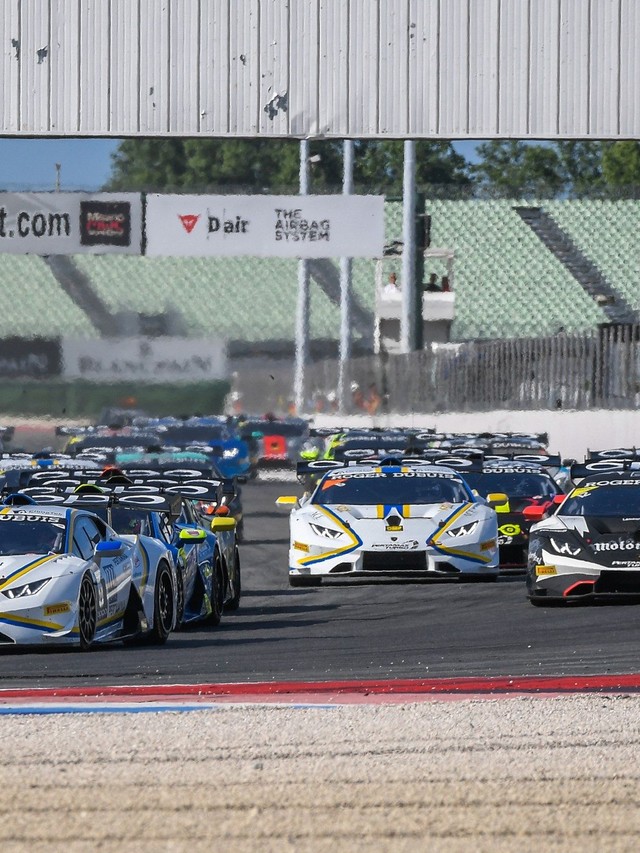
Misano’s Third Round: Penalties, Lead Swaps, and a Weekend Nobody Controlled
Eight different crews stood on the top step of the podium across two races and four classes when the 2018 Lamborghini Super Trofeo Europe visited Misano for its third round. That kind of parity is nearly impossible to manufacture. In a series where every car runs the same naturally aspirated V10 Huracán Super Trofeo, results come down to driver skill, pit strategy, and the occasional steward’s decision. Misano delivered all three in concentrated doses.
The weekend’s defining quality was instability. Post-race penalties reshuffled podiums in both the AM category and the Lamborghini Cup. Lead changes stacked up in nearly every class. The PRO championship tightened to a three-point margin. For a one-make series sometimes dismissed as a gentleman-driver exhibition, Misano offered a useful corrective: the racing was genuinely unpredictable, and the outcomes carried real championship weight heading into the second half of the season.
What makes this particular round worth revisiting is what it reveals about the format Lamborghini built around the Huracán. The multi-class structure, spanning PRO, PRO-AM, AM, and Lamborghini Cup, created four distinct narratives running simultaneously on the same circuit, each with its own drama. That architecture remains the template for Lamborghini’s customer racing philosophy today, even as the cars themselves prepare to change.
Class by Class: Where the Battles Were Won and Lost
PRO: Karol Basz and Vito Postiglione, racing for Imperiale Racing, collected their third victory of the season in Race 2. The win came after what Lamborghini described as an intense final sprint against the Antonelli Motorsport pairing of Giacomo Altoè and Daniel Zampieri, who finished second. Altoè and Zampieri held onto the championship lead, but only by three points. Basz was characteristically blunt after the race:
“It’s a shame that yesterday we lost points in Race 1. But in any case, we’re always very fast. In the next round, we hope to score not just one but two wins.”
That kind of confidence, backed by pace, kept the PRO title fight alive heading into Spa.
PRO-AM: Juan Perez and Loris Spinelli extended their dominance with a fourth consecutive Race 1 victory, maintaining their class lead. Race 2, though, belonged to Emanuele Zonzini and Lorenzo Bontempelli of Iron Lynx, who broke through for their first win of the season. Zonzini, racing on his home circuit, played a patient opening stint before handing over to Bontempelli. The result narrowed the gap to Perez and Spinelli, injecting genuine uncertainty into a class that had looked settled.
AM: This was the weekend’s most chaotic category. Four different drivers held the lead during Race 2 alone. Andrej Lewandowski led from pole before Cedric Leimer overtook him on lap two, only for a contact incident to force Leimer into the pits and earn him a drive-through penalty. Glauco Solieri of Antonelli Motorsport then inherited the lead and held it until nine minutes remained, when Lauck capitalized on a small mistake to take first. Lauck crossed the line ahead of everyone, but a 10-second penalty for an unsafe pit release dropped the German pair to third, handing Solieri his first AM victory. His reaction was measured: “I drove in the lead for most of the race. I’m happy that I finally took this victory.” The understatement suited a result that arrived through persistence rather than raw speed.
Lamborghini Cup: Gerard Van der Horst of Van der Horst Motorsport repeated his Silverstone win and consolidated his championship lead. Joseph Collado, who won Race 1 on Saturday night, was denied a second consecutive victory by a pit-stop time penalty. Supachai Weeraborwornpong (Team Lazarus) and Hans Fabri (Imperiale Racing) completed the podium. Van der Horst’s post-race comment captured the weekend’s physical toll:
“I’m really pleased with this victory that came at the end of a very difficult weekend. After yesterday night’s race and with only four hours of sleep, I managed to get to the top step of the podium again.”
The Huracán Super Trofeo: Why Identical Cars Produce Different Racing
One-make series live or die on the quality of their control car, and the Huracán Super Trofeo proved its worth at Misano by delivering close racing across wildly different skill levels. The car shares its 5.2-liter naturally aspirated V10 with the road-going Huracán, but the similarities thin out quickly beyond that. A rear-wheel-drive layout, sequential gearbox, stripped interior, full roll cage, and a carbon fiber aerodynamic package designed for sustained track abuse make it a fundamentally different machine from anything wearing Huracán badges on public roads.
Identical machinery forces the competition to separate on driver ability, team strategy, and pit execution. Misano proved that last point vividly: two separate penalties for pit-stop infractions, one unsafe release in AM and one timing violation in the Lamborghini Cup, directly altered the final results. When the car removes the equipment variable, the human element becomes the entire story.
The multi-class structure also serves as a genuine differentiator against rival one-make championships. The PRO class attracts young professionals building careers toward GT3 and beyond. The AM and Lamborghini Cup classes give gentleman drivers real wheel-to-wheel competition in serious machinery, with the same stewards, the same regulations, and the same consequences for mistakes. Lamborghini does not soften the experience for paying amateurs, and Misano’s penalty-reshuffled podiums are proof of that.
From Huracán to Temerario GT3: Tracing Lamborghini’s Motorsport Thread
Viewed through a contemporary lens, Misano 2018 sits at an interesting point in Lamborghini’s motorsport evolution. The Huracán Super Trofeo served as the backbone of customer racing for a decade, building a global infrastructure of teams, drivers, and regional championships that gave Lamborghini a credible motorsport presence independent of its GT3 program.
That infrastructure is now preparing for a generational shift. According to Autoblog, the Temerario GT3 debuted at the 2025 Goodwood Festival of Speed as Lamborghini’s first competition car to be fully designed, developed, and built entirely in-house by Squadra Corse. The transition from the naturally aspirated V10 Huracán to the twin-turbocharged V8 Temerario represents a philosophical pivot: Lamborghini is moving from adapting road car platforms for racing to engineering dedicated competition machines from the ground up.
What Misano 2018 demonstrated, and what remains relevant for the Temerario era, is that Lamborghini’s customer racing model works because it prioritizes competitive depth over spectacle. Eight winning crews in a single weekend, penalties that reshuffle results, and championship margins measured in single-digit points are the product of a format that treats amateur and professional classes with equal seriousness. Whether the next generation of Super Trofeo cars will carry a version of the Temerario’s powertrain remains unconfirmed, but the organizational template that made the Huracán era successful is clearly the foundation Squadra Corse intends to build on.
For teams and drivers who built their programs around the Huracán’s characteristics, the transition will mean adapting to an entirely new powerband, different weight distribution, and the complexities of turbo management in wheel-to-wheel racing. The naturally aspirated V10’s linear throttle response rewarded precision; a turbocharged V8 will demand different skills. Whether that produces racing as close as Misano’s AM category, with its four lead changes and post-race penalties, is the open question Lamborghini’s motorsport division will need to answer.
What Misano Meant for the 2018 Season and Beyond
The subsequent round of the 2018 Lamborghini Super Trofeo Europe was set for July 27-28 at Spa-Francorchamps, running alongside the 24 Hours of Spa. That pairing gave the Super Trofeo grid an audience and a backdrop few one-make series can match, and it meant the championship battles tightened at Misano would play out on one of Europe’s most demanding circuits.
In the PRO class, the three-point gap between Altoè/Zampieri and Basz/Postiglione guaranteed the title fight would extend deep into the calendar. PRO-AM looked more settled with Perez and Spinelli holding four wins, but Iron Lynx’s breakthrough at Misano suggested the gap could close. Van der Horst’s consistent Lamborghini Cup form made him the clear favorite, though Collado’s pace, when penalties did not intervene, kept the pressure real.
Collector interest in Huracán Super Trofeo cars has grown considerably since 2018. Autoblog recently reported on a near-zero-mileage 2020 Huracán Super Trofeo EVO Collector appearing on Bring a Trailer, and a Michigan dealer listing a road-titled example underscores how these cars are transitioning from active competition tools to sought-after collectibles. The end of the Huracán production era and the shift to the Temerario platform only accelerates that trajectory.
Misano 2018 was one weekend in a season that produced many, but it captured something essential about what makes Lamborghini’s one-make series work: identical cars, enforced rules, real consequences, and a class structure that gives everyone from aspiring professionals to weekend warriors a legitimate competitive framework. That formula proved durable enough to sustain a decade of Huracán racing. The test now is whether it translates to whatever comes next.
Gallery


