Lamborghini’s Dual Assault on the 24 Hours of Spa Weekend
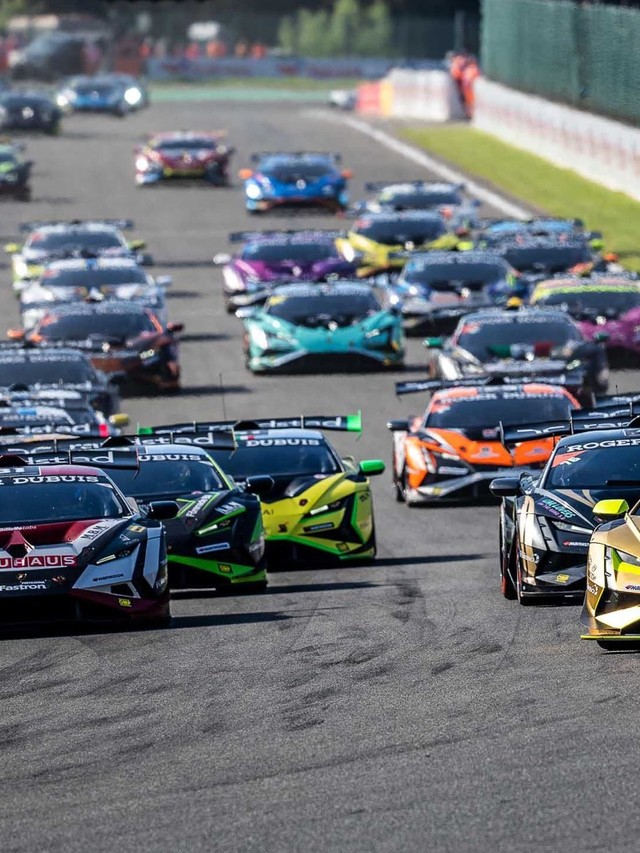
Spa-Francorchamps will host the largest Lamborghini Blancpain Super Trofeo grid in the series’ history this weekend, with up to 35 cars lining up for the fourth round of the 2015 European championship. Twenty-nine of those entries will be Huracán LP 620-2 Super Trofeos, the rear-wheel-drive race car derived from the road-going Huracán LP 610-4. The one-make series, though, is only half of Lamborghini’s Spa agenda.
Running alongside the Super Trofeo on the same weekend, two Huracán GT3s fielded by Grasser Racing Team will contest the full 24 Hours of Spa endurance race for the first time, both carrying official Squadra Corse drivers. For a brand that spent decades on the periphery of professional endurance racing, fielding factory-backed machinery at one of GT racing’s crown-jewel events represents a deliberate escalation. The record Super Trofeo grid and the GT3 debut are not coincidental scheduling. They are two prongs of the same strategy: Lamborghini building a credible, vertically integrated motorsport program from customer racing all the way to top-tier endurance competition.
Why the Huracán GT3’s Spa Debut Matters Beyond a Single Race
Lamborghini says the #19 Huracán GT3 will be shared by Italian Fabio Babini, Dutchman Jeroen Mul, and American Andrew Palmer, while the #63 car pairs Italians Mirko Bortolotti and Giovanni Venturini with South African Adrian Zaugg. The #63 entry arrives at Spa with form: Lamborghini confirmed it secured pole position at Paul Ricard and recorded an eighth-place finish at Silverstone and a sixth at Paul Ricard. Those results are respectable for a car still in its competitive infancy, but the real significance of the Spa entry is strategic rather than statistical.
The 24 Hours of Spa sits alongside the Nürburgring 24 Hours and the Bathurst 12 Hour as one of the most demanding GT endurance events on the calendar. Showing up with two properly crewed GT3 cars signals to prospective customer teams that Lamborghini is serious about supporting the Huracán GT3 at the highest level, not just selling it. For a manufacturer trying to convince privateer outfits to invest in its platform, results at Spa carry outsized weight. A clean 24-hour run, even without a podium, would validate the Huracán GT3’s durability and the depth of Squadra Corse‘s engineering support. It of Spa starts Saturday at 16:30 CET.
What a Record Grid Means for Customer Racing
A 35-car grid is more than a nice round number. The Lamborghini Blancpain Super Trofeo was established in 2009 with Gallardo-based machinery, and the series expanded to Asia in 2012 and North America in 2013. Reaching a record European grid in just the second season of the Huracán-based car confirms that Lamborghini’s customer racing pipeline is healthy and growing. The Blancpain partnership itself originated from an unusual source: Blancpain CEO Marc Hayek reportedly drove in the inaugural Super Trofeo season, a personal connection that transformed a sponsorship deal into something more organic.
The Huracán LP 620-2 Super Trofeo is powered by a naturally aspirated 5.2-liter V10 producing 620 horsepower, running in a rear-wheel-drive configuration. That RWD layout is a deliberate engineering choice. The road-going Huracán LP 610-4 sends power to all four wheels, but stripping the front axle for the race car forces drivers to manage traction, rotation, and throttle application with greater precision. For gentleman drivers learning racecraft and for young professionals building their careers, the rear-drive Super Trofeo teaches skills that translate directly to GT3 competition. It functions as a feeder system, even if Lamborghini does not explicitly market it that way.
One source indicates the Super Trofeo weighs 335 pounds less than its road-legal counterpart, bringing dry weight to approximately 1,270 kg. Combined with adjustable racing ABS (12 positions), traction control (9 positions), and Brembo/PFC braking hardware, the car offers a sophisticated but accessible package for teams operating at varying budget levels. The hybrid carbon/aluminum frame uses modified geometries for improved cooling and gearbox accommodation, a detail that underscores how far removed this machine is from a simple track-day conversion.
Championship Battle: The Drivers Leading Lamborghini’s Charge
Patrick Kujala of Bonaldi Motorsport leads the 2015 Lamborghini Blancpain Super Trofeo Europe championship with five victories from the opening rounds at Monza, Silverstone, and Paul Ricard. Lamborghini says Team Lazarus pairing Sergio Campana and Fabrizio Crestani trail by 20 points despite five podium finishes, making them the most consistent threat to Kujala’s title bid. The Antonelli Motorsport duo of Roman Mavlanov and Daniel Zampieri broke Kujala’s winning streak with a Race Two victory in France and sit third in the PRO Class.
The PRO-AM category features its own tight contest, with Mikko Eskelinen and Kelvin Snoeks (Leipert Motorsport) holding a nine-point advantage over Adrian Amstutz of Konrad Motorsport. In the AM Class, Shota Abkhazava leads Mark Ineichen by just three points. These close margins across every class suggest the Huracán Super Trofeo is delivering competitive parity, exactly what a healthy one-make series needs to attract and retain paying customers.
Qualifying runs Saturday morning at 10:40 CET, with Race One on Friday at 14:55 CET and Race Two on Saturday at 11:35 CET. Both races will stream on the official Squadra Corse website.
From Track to Showroom: Why This Weekend Shapes Lamborghini’s Future
Every manufacturer in GT racing uses competition as a proving ground for technology, a marketing platform, and a recruitment tool for engineering talent. The specific path from race car to road car is rarely a straight line, but the principles transfer: lightweight construction techniques, aerodynamic development, brake system optimization, and engine calibration all benefit from the relentless feedback loop of competitive racing.
The broader context for LamboCars readers is that this 2015 Spa weekend represents a pivot point. Before the Huracán GT3 program, Lamborghini’s modern racing efforts were largely confined to the Super Trofeo one-make series, a controlled environment. Stepping into the open GT3 arena means competing directly against manufacturers who have refined their customer racing operations over many seasons. The record Super Trofeo grid proves Lamborghini can sell race cars to customers. The GT3 program will determine whether the brand can compete for overall victories against the best in the business. Both questions get tested at Spa this weekend, on the same 7-kilometer circuit, in front of the same audience.
Gallery


