Super Trofeo North America at VIR: Four Seasons and Counting
When Lamborghini’s Super Trofeo North America grid lined up at VIRginia International Raceway on August 27, 2016, the series was doing something no other circuit on its calendar could claim. VIR, a 17-turn, 3.27-mile road course carved into the rolling hills outside Danville, Virginia, was the only track to host the championship in each of its first four North American seasons. For a one-make series built as much around community as competition, that kind of continuity tells you where Lamborghini’s priorities lie.
The weekend followed the established Super Trofeo template: two 50-minute sprint races, the first at 10:45 a.m. Saturday and the second at 9:50 a.m. Sunday, preceded by Friday practice and a double qualifying session. Both races were available via live stream. Separate podiums for overall, Pro-Am, Amateur, and Lamborghini Cup divisions kept the field competitive across experience levels, ensuring gentleman drivers shared the grid with professionals without being rendered invisible.
VIR is not the most glamorous venue on the American motorsport calendar. It does not carry the prestige of Laguna Seca or the spectacle of Circuit of the Americas. What it offers instead is a demanding, old-school layout that rewards car control: tight elevation changes, a mix of fast sweepers and slow technical corners, limited runoff that punishes mistakes more than raw straight-line speed. Lamborghini’s decision to anchor the series here from the start reveals how the company thinks about its racing programs. When the goal is to develop drivers and prove the Huracán‘s chassis in unforgiving conditions, a circuit that forgives nothing is exactly the right classroom.
Points Battles and the Change Racing Home Advantage
Heading into VIR, Lamborghini said Shinya Michimi led the Pro points standings, though the weekend promised the stiffest competition he had faced all season. The Pro division’s depth was growing, and VIR’s technical character tends to compress the field. A circuit that punishes overambition more than it rewards outright pace puts a premium on consistency, which is precisely the quality a points leader least wants to see neutralized.
The weekend also carried particular significance for Change Racing, the North Carolina-based team with direct ties to the Lamborghini Carolinas dealership. VIR sits roughly two hours from the team’s home base, making this the closest thing to a home grand prix on the Super Trofeo calendar. That dealer-to-race-team pipeline deserves attention. Lamborghini’s customer racing structure deliberately integrates its retail network into the competitive ecosystem. A buyer walks into Lamborghini Carolinas, perhaps purchases a Huracán for the road, and discovers that the same dealership fields cars in a professional racing series. The brand experience extends from the showroom floor to the pit lane, and for a company selling exclusivity and performance credibility, that connection carries real weight.
The approach distinguishes Lamborghini from its rivals. Ferrari Challenge, which predates Super Trofeo by more than a decade, leans heavily on hospitality and the ownership experience, creating what amounts to an exclusive club with racing as the backdrop. Porsche Carrera Cup emphasizes scale and cost control, positioning itself as the world’s largest one-make series and a clear ladder into professional GT racing. Lamborghini splits the difference: smaller and more exclusive than Porsche’s operation, more performance-focused than Ferrari’s, and deeply tied to the dealer network in a way that keeps the brand’s regional presence visible even outside major metropolitan markets.
The Huracán Super Trofeo: A V10 in Its Natural Habitat
Every car on the Super Trofeo grid is identical, which is the entire point. The series utilizes the Lamborghini Huracán Super Trofeo, a purpose-built race car powered by a 5.2-liter naturally aspirated V10 producing 620 horsepower. Rear-wheel drive only, it strips away the all-wheel-drive safety net of the road-going Huracán and places the emphasis squarely on throttle management and driver skill.
Revealed in 2014, the Huracán Super Trofeo LP 620-2 succeeded the Gallardo Super Trofeo that launched the series in 2009. Compared to its road-car sibling, the race version sheds significant weight through carbon fiber bodywork and aluminum construction, runs on competition suspension and brakes, and locks the transmission into its most aggressive mode. At a circuit like VIR, where the consequences of a mistake arrive quickly, the car rewards precision and punishes overconfidence in equal measure.
Within the broader Lamborghini lineup, the Super Trofeo car occupies a specific and important position. It sits above the road-going Huracán Performante and STO in terms of pure track focus, but below the GT3 machinery that competes in international endurance racing. It functions as both a competitive racing platform and a proving ground where Lamborghini’s Squadra Corse division refines engineering that eventually filters into road cars. The STO’s aerodynamic philosophy, for instance, drew directly from lessons learned in Super Trofeo and GT3 development.
Anyone considering entry into the series should understand what the commitment looks like. Lamborghini has not publicly detailed a fixed entry cost for Super Trofeo competition, and real-world expenses vary considerably depending on team support, travel, and consumables. What the series does offer is a structured environment where the car is equalized and the variable is the driver. For aspiring professionals, it represents a credible step toward GT3 competition. For gentleman drivers, it provides genuine wheel-to-wheel racing in machinery that carries serious performance credentials.

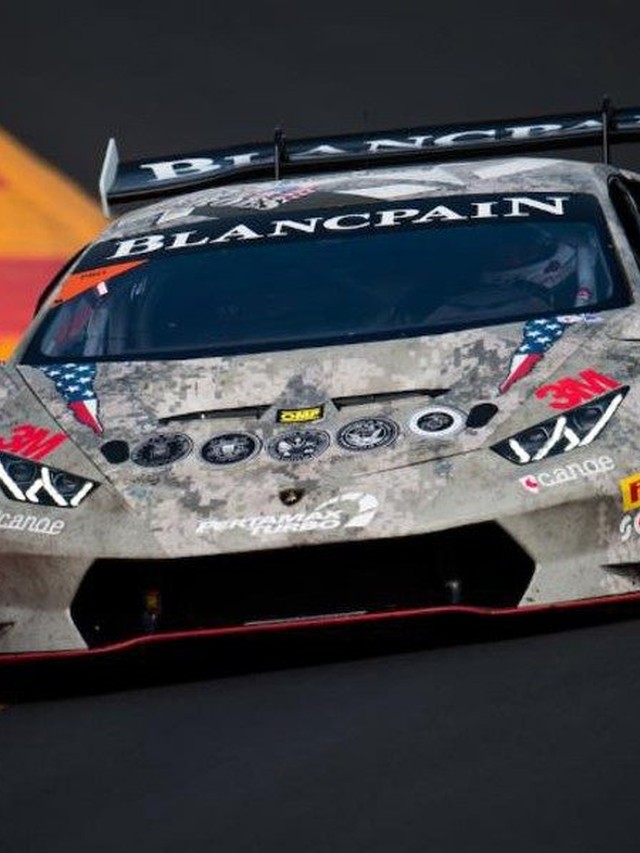
The camouflage-liveried Lamborghini Huracan GT3 navigates a sharp turn on the racetrack during a Blancpain Super Trofeo event.
From Super Trofeo to Temerario GT3: The Ladder Lamborghini Built
The Super Trofeo series was never intended to exist in isolation. From its inception, Lamborghini positioned it as the entry point of a motorsport ladder that climbs through GT3 competition and, for the most accomplished drivers, into factory-supported endurance racing programs. The 2016 VIR weekend represented one step on that continuum, a moment when the next generation of Lamborghini racing talent was being sorted on a circuit that demanded everything the Huracán could deliver.
Where Lamborghini’s motorsport ambitions have traveled since makes the significance of that foundation clearer. Lamborghini says the Temerario GT3, unveiled at the 2025 Goodwood Festival of Speed, represents the company’s first competition car to be fully designed, developed, and built in-house. Previous GT3 efforts relied on external partners for significant portions of the engineering. The Temerario GT3 marks a philosophical shift: Squadra Corse now controls the entire process from concept to competition, a capability that the years of running the Super Trofeo series helped build.
The transition also raises an interesting question about the character of Lamborghini’s customer racing future. The Super Trofeo Huracán is a naturally aspirated V10, a powertrain that defines itself through linear throttle response and an exhaust note that announces its presence from half a circuit away. The Temerario road car, which underpins the new GT3, uses a twin-turbocharged V8 with hybrid assistance. For teams and drivers who built their programs around the Huracán’s characteristics, adapting to an entirely new powerband, different weight distribution, and the complexities of turbo management in wheel-to-wheel racing will be a meaningful adjustment.
Whether Lamborghini eventually transitions the Super Trofeo series itself to a Temerario-based platform remains unconfirmed. What the company’s trajectory suggests is that the one-make series will continue to serve as the first rung of its racing ladder, regardless of which engine sits behind the driver. The principle matters more than the specific displacement.
Why One-Make Racing Still Matters for Lamborghini’s Brand
One-make series occupy a peculiar space in motorsport. They lack the technical variety of GT3 or prototype racing, and the cars are, by design, identical. The appeal lies entirely in the competition between drivers and teams, the accessibility of the platform, and the brand experience that surrounds the paddock. For manufacturers, they serve a dual purpose: developing future racing talent and keeping the brand visible in a competitive context that reinforces performance credibility.
Lamborghini’s Super Trofeo accomplishes both. The division structure ensures that a successful dealership owner can race on the same weekend as a young driver angling for a GT3 seat, and both leave feeling that the series served their ambitions. That breadth is deliberate, and VIR’s recurring presence on the calendar, season after season, underscored something Lamborghini understood early: consistency builds community, and community sustains a racing series long after the checkered flag drops on any single weekend.
The collector market has noticed the cars themselves. Autoblog reported on a 2020 Huracán Super Trofeo EVO with just 84 miles appearing for sale, a reminder that these track-only machines carry their own collectibility. As Lamborghini’s lineup moves entirely to hybrid powertrains with the Revuelto and Temerario, the naturally aspirated V10 Super Trofeo cars represent the final chapter of a specific era in the company’s racing history. For collectors who value mechanical purity, low-mileage examples could become increasingly desirable.
The practical takeaway for anyone following Lamborghini’s motorsport trajectory is straightforward. The Super Trofeo series functions as a competitive championship and a brand-building exercise that connects dealerships, owners, aspiring racers, and professional drivers into a single ecosystem. VIR, with its four consecutive seasons on the calendar, was never just another stop. It was proof that Lamborghini understood the value of putting down roots at a circuit tough enough to mean something.


