Five Rounds, One New Venue, and a World Final in Spain
Lamborghini’s Squadra Corse motorsport division confirmed the full 2019 Lamborghini Super Trofeo North America calendar in late November 2018, revealing a five-round season built around a clear strategic arc: open at a fresh venue, embed the championship alongside IMSA’s biggest weekends, then funnel the continent’s best into a global showdown at Spain’s Circuito de Jerez. The headline addition was Barber Motorsports Park in Leeds, Alabama, a new stop for the championship, hosting the season opener from April 5 through 7.
From Barber, the schedule moved to four established circuits. Watkins Glen International took Round 2 from June 27 to 30. Road America in Elkhart Lake, Wisconsin, followed with Round 3 on August 2 through 4. VIRginia International Raceway filled the August 23 to 25 slot, and WeatherTech Raceway Laguna Seca in Monterey, California, closed the North American portion from September 13 to 15. Lamborghini indicated that those final four rounds would run in conjunction with the IMSA WeatherTech Championship, giving Super Trofeo competitors and fans direct exposure to one of North America’s premier sportscar series.
The season then converged on the 2019 World Final at Circuito de Jerez from October 24 to 27. According to Lamborghini, those final rounds concluded all of the brand’s regional one-make championships, including Europe, the Middle East, and Asia, crowning a single global Super Trofeo champion.
| Round | Dates | Venue | Location |
|---|---|---|---|
| 1 | Apr. 5-7 | Barber Motorsports Park | Leeds, Ala. |
| 2 | June 27-30 | Watkins Glen International | Watkins Glen, N.Y. |
| 3 | Aug. 2-4 | Road America | Elkhart Lake, Wis. |
| 4 | Aug. 23-25 | VIRginia International Raceway | Alton, Va. |
| 5 | Sept. 13-15 | WeatherTech Raceway Laguna Seca | Monterey, Calif. |
| World Final | Oct. 24-27 | Circuito de Jerez | Jerez de la Frontera, Spain |
Why Super Trofeo Matters More Than Its Grid Size Suggests
A one-make racing series can look, from the outside, like a hospitality exercise with helmets: identical cars, gentleman drivers, champagne on the podium. The Lamborghini Super Trofeo includes all of those elements, but its strategic value to Sant’Agata runs considerably deeper, and the 2019 calendar was shaped to maximize that value.
The Super Trofeo marked Lamborghini’s return to organized one-make racing, and by 2019 the series operated across three continental championships feeding into the annual World Final. That structure created a global competitive ladder few rival programs matched in geographic reach. For Lamborghini, the payoff was threefold: it kept the Huracán platform visible in motorsport paddocks worldwide, it built a pipeline of customer racers whose loyalty tends to extend into road-car purchases, and it generated real-world engineering data under sustained competitive stress.
The North American arm, launched in 2013, occupied a particularly important market position. The United States and Canada represent Lamborghini’s largest sales region, and embedding the Super Trofeo alongside IMSA WeatherTech Championship weekends placed the brand in front of a broader, deeply engaged motorsport audience. A Lamborghini owner watching support races at Watkins Glen or Laguna Seca encountered the brand in a context no showroom experience can replicate. The 2019 calendar, with four of five rounds co-billed with IMSA, leaned into that exposure more deliberately than ever.
The Huracán Super Trofeo Evo: What Makes the Race Car Tick
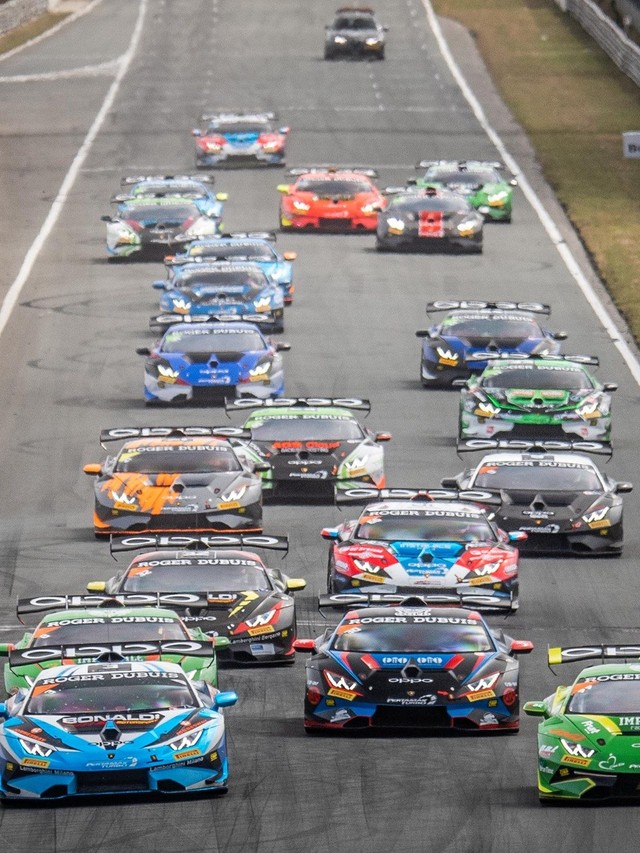
Every car on the Super Trofeo grid is technically identical, which is the entire point. The Huracán Super Trofeo Evo strips away the road car’s creature comforts and replaces them with a purpose-built racing architecture: a hybrid carbon and aluminum frame, aggressive aerodynamic bodywork with a prominent rear wing sized for genuine downforce, a sequential six-speed X-Trac gearbox, and racing-specification suspension. Powering the package is Lamborghini’s naturally aspirated 5.2-liter V10, producing 620 horsepower and delivering the kind of high-rpm throttle response that makes the car a visceral experience even from the grandstands.
Because every Evo on the grid runs the same hardware, results come down to driver skill, team preparation, and race-weekend strategy rather than the engineering arms race that dominates open-class racing. Lamborghini segments its field into Pro, Pro-Am, Am, and LB Cup categories, creating competitive classes within the grid that keep experienced semi-professionals and ambitious amateurs racing against peers of comparable ability.
The Huracán LP 620-2 Super Trofeo, the Evo’s predecessor, was first revealed in 2014, and the platform evolved steadily through aerodynamic and chassis refinements. By 2019, the Evo represented the most developed version of Lamborghini’s customer racing weapon. In a one-make series the car’s personality matters enormously because every driver experiences the same machine, and forum discussion among Super Trofeo enthusiasts consistently highlights the V10’s throttle response and the car’s mechanical directness as core attractions of the platform.
Barber to Laguna Seca: Reading the Track Selection
Adding Barber Motorsports Park to the 2019 calendar was a deliberate choice. Lamborghini described the circuit as a 2.38-mile, 15-turn course just outside Birmingham, Alabama, and the venue’s reputation among racing drivers centers on its elevation changes, technical corners, and immaculate surface quality. For a season opener featuring two 50-minute races, Barber offered a compact, demanding layout that rewards precision over raw straight-line speed.
The remaining four venues read like a greatest-hits list of American road racing. Watkins Glen’s fast, flowing layout in upstate New York rewards commitment and late-braking confidence. Road America’s four-mile ribbon through the Wisconsin countryside is one of the longest and most demanding circuits in North America, with high-speed kinks and heavy braking zones that punish sloppy technique. VIR, tucked into Virginia’s rural landscape, combines technical sections with fast sweepers that test car setup and driver adaptability. Laguna Seca, with its iconic Corkscrew and Monterey backdrop, provides the kind of dramatic season finale that looks spectacular on camera and in person.
Running alongside IMSA WeatherTech Championship events at four of these five venues gave Super Trofeo competitors and spectators access to a full weekend of professional sportscar racing. The practical takeaway for anyone considering attending was clear: a single ticket to an IMSA weekend at Watkins Glen or Laguna Seca included Super Trofeo races as part of the support program, making it one of the most accessible ways to watch Lamborghini race cars compete in person.
Jerez and the World Final: Where Continental Champions Collide
The World Final at Circuito de Jerez from October 24 to 27 served as the season’s climax, and its significance extended well beyond the North American championship. Lamborghini’s three continental Super Trofeo series all converged at Jerez, pooling their respective champions and top contenders into a single grid to determine the overall world champion. That convergence gave every round from Barber onward a second layer of meaning: each result shaped not just the regional standings but a driver’s case for the global stage.
Jerez itself carries considerable motorsport pedigree, having hosted Formula One and MotoGP events. Selecting a European venue for the World Final reinforced Lamborghini’s Italian and European identity while creating a destination event that drew teams and fans from across the globe. The format gave North American competitors something concrete to race toward all season: a chance to represent their region against the best from circuits on the European and Asian calendars.
Lamborghini confirmed that the full 2019 broadcast schedule would be announced separately, which left fans without immediate clarity on how to follow the action remotely. For a series building its audience, broadcast accessibility remains a practical concern, and enthusiasts planning to follow the championship from home would need to watch for that announcement.
Super Trofeo’s Place in Lamborghini’s Motorsport Ladder
Viewed in isolation, the 2019 schedule looks like a straightforward calendar update. Viewed in context, it represents a critical rung on a motorsport ladder that Lamborghini was actively extending.
The Super Trofeo series gave Lamborghini a decade of continuous one-make racing experience, building institutional knowledge within Squadra Corse about everything from race logistics to customer team management to the engineering demands of sustained competitive use. That accumulated expertise directly informed the development of Lamborghini’s more ambitious GT3 programs. Independent reports indicate that the Temerario GT3, which debuted years later, became Lamborghini’s first competition car fully designed, developed, and built entirely in-house. The organizational capability to execute that kind of program did not materialize overnight; it grew through seasons of managing the Super Trofeo worldwide.
For prospective participants, the cost of entry into the Super Trofeo remains a question Lamborghini does not publicly detail in schedule announcements. What the series does offer is a structured, factory-supported racing environment where the car is a known quantity and the competitive emphasis falls on driving and preparation rather than engineering budgets. That proposition appeals to a specific buyer: someone who owns Lamborghini road cars, wants genuine wheel-to-wheel competition, and values the community that forms around a factory-backed championship.
The collector market validates the Super Trofeo’s significance from a different angle. Autoblog reported on a Michigan dealer selling a Huracán Super Trofeo titled for road use, a curiosity that underscores how desirable these track-only machines become once their racing careers end. Low-mileage examples occasionally surface at auction, commanding attention precisely because they represent the purest expression of the Huracán platform.
How Super Trofeo Stacks Up Against Rival One-Make Series
Lamborghini’s Super Trofeo does not operate in a vacuum. Ferrari Challenge and Porsche’s various one-make cup series target a similar audience: wealthy enthusiasts and semi-professional drivers who want factory-supported competition in identical machinery. The competitive landscape among these programs centers less on which car is objectively fastest (since they never race each other) and more on which series delivers the most compelling combination of racing quality, global reach, community, and brand prestige.
Lamborghini’s structural advantage in 2019 was the three-continent championship format feeding into a single World Final. That global funnel created a narrative arc across the season and gave regional competitors a tangible international stage. The IMSA co-billing for four of five North American rounds also provided visibility that standalone events cannot match, placing the Huracán Super Trofeo Evo in front of audiences already invested in professional endurance racing.
The V10’s naturally aspirated character distinguished the Super Trofeo from competitors whose one-make cars relied on turbocharged engines. In a paddock where sound and mechanical drama contribute to spectator experience and driver satisfaction, the Evo’s high-revving ten-cylinder engine remained a genuine differentiator. Whether that advantage persists as Lamborghini transitions its customer racing platforms toward newer powertrains is a question the brand will eventually need to answer. For the 2019 season, though, the formula was clear: identical V10 race cars, five iconic American circuits, and a World Final in southern Spain. The combination represented one of the most complete customer racing programs in the supercar world.
Gallery


