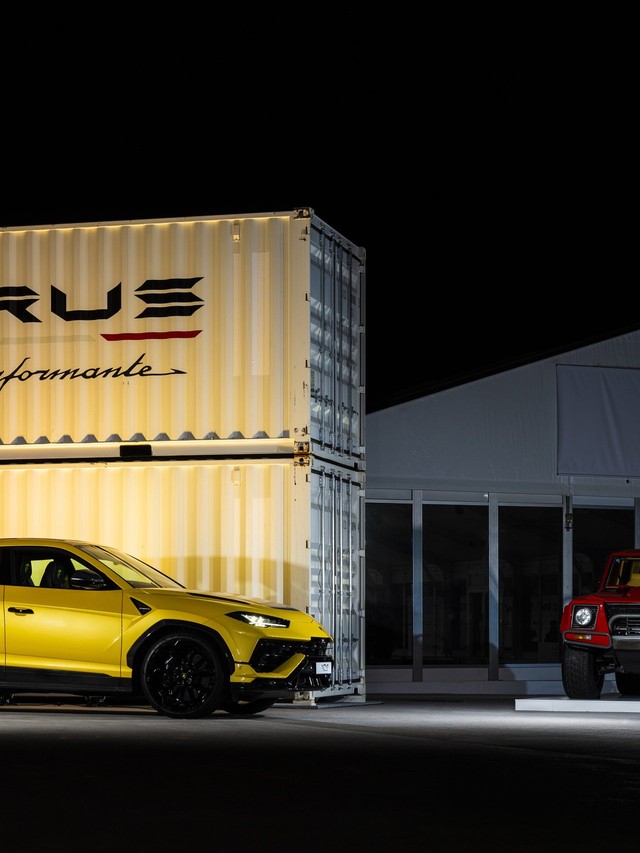
A Lamborghini That Carries Groceries: The Design Challenge
When Lamborghini pulled the sheet off the Urus in late 2017, the company faced a problem no amount of horsepower could solve. It needed to convince enthusiasts, collectors, and skeptics that a vehicle tall enough to accommodate child seats and ski bags was a legitimate Lamborghini. The answer, as Mitja Borkert’s design team framed it, lay not in powertrain numbers or lap times but in visual DNA: specific proportions, surface treatments, and heritage callbacks that would make the Urus recognizable as a product of Sant’Agata Bolognese from any angle, at any distance.
The single most important design decision in the entire vehicle is a proportion borrowed directly from the supercar side of the house. Lamborghini says the Urus adopts the two-thirds body, one-third window ratio found on its super sports cars. On a Huracán or Aventador, that ratio communicates speed and aggression almost subliminally, pressing the glasshouse down into a muscular body. Translating it to an SUV, where passengers expect headroom and outward visibility, required compressing the greenhouse in ways that make the Urus look nothing like a conventional luxury truck. The roofline sweeps downward toward the rear with a coupe-like urgency that, in 2017, few competitors attempted at this price point.
The front hood starts low and climbs toward a prominent dome that houses the V8 twin-turbo engine, a sculptural gesture Lamborghini describes as conveying power before the key is even turned. A dynamic character line runs along the flanks, linking angular side windows and diagonal creases in both the front bonnet and rear glass. Lamborghini explicitly credits the Countach for those diagonal lines, and the reference is more than marketing. The Countach’s origami-fold surfacing defined what a Lamborghini looked like for an entire generation, and embedding that geometry into an SUV profile was a deliberate attempt to anchor the Urus in the brand’s most recognizable silhouette. Every surface, in other words, exists to answer the same question: does this look like it came from the same factory as the Aventador?
The LM002 Connection: More Than a Footnote
Most coverage of the Urus mentions the LM002 in passing, a nod to the fact that Lamborghini built an SUV once before. The design relationship runs deeper than a casual tip of the hat. Two specific elements carry over almost directly: hexagonal wheel arches and a small triangular air outlet on the side panel, adorned with an Italian flag.
The hexagonal wheel arches deserve particular attention. On the LM002, the oversized arches were a functional necessity, accommodating enormous off-road tires on a vehicle that weighed well over two tons. On the Urus, Borkert’s team reinterpreted those arches as a stylistic signature, flaring them outward to give the body a planted, wide-track stance. The shape itself, six-sided and angular rather than rounded, ties the Urus to a broader Lamborghini obsession with hexagons that shows up everywhere from air intakes to tailpipe surrounds.
The triangular side vent is a subtler gesture. On the LM002, a similar element served cooling duties for the massive V12 engine bay. On the Urus, Lamborghini says the detail functions partly as a heritage marker and partly as a visual anchor for the Italian flag motif, reinforcing the car’s identity as born and made in Italy. Assembly takes place at the company’s headquarters in Sant’Agata Bolognese, a point Lamborghini underscores in every communication about the Urus, and one that matters when the vehicle rides on the Volkswagen Group‘s MLB Evo platform, shared with the Audi Q7, Audi Q8, Bentley Bentayga, and Porsche Cayenne.
That platform reality is the elephant in the showroom. Lamborghini’s design team knew the Urus would be compared, structurally and mechanically, to its corporate siblings. The LM002 cues and supercar proportions serve a strategic purpose beyond aesthetics: they create visual separation from every other SUV on the same architecture. A Cayenne looks like a Porsche. A Bentayga looks like a Bentley. The Urus, at its best, looks like nothing else in the segment, precisely because its designers reached back to a heritage no platform-mate can claim.
The Cockpit as Fighter Jet: Inside the Urus
Lamborghini describes the Urus interior as a space where the driver should feel like a pilot, and the company backs that claim with deliberate ergonomic choices that reinforce the same supercar-in-an-SUV thesis the exterior establishes. The seat position sits lower than most luxury SUVs, pulling the driver down into the cabin rather than perching them above it. An encompassing dashboard wraps around the cockpit, angling controls toward the driver in a way that echoes the Huracán‘s interior philosophy more than any conventional SUV layout.
The hexagonal design theme carries inside with the same commitment (some would say stubbornness) as the exterior. Air vents, speaker grilles, and trim panels repeat the six-sided motif until it becomes a kind of geometric wallpaper. Some reviewers find this cohesive. Others note the hexagons can feel overused, a concern that surfaces in multiple independent assessments of the cabin.
What matters more for prospective buyers is the practical consequence of that low seating position. It genuinely changes the driving sensation, narrowing the gap between the Urus experience and a grand tourer, which is precisely the point. The trade-off, as owners quickly discover, is that the coupe-like roofline and narrow rear window limit rearward visibility. Parking cameras become less of a convenience feature and more of a necessity. The wide, floating center console also eats into the sense of openness that buyers of more conventional luxury SUVs take for granted.
For Lamborghini, those compromises are features, not bugs. Every design decision that pulls the Urus closer to a sports car experience and further from a Range Rover reinforces the brand argument the exterior already makes. Whether individual buyers agree depends on how much they value the theatrical over the practical, and Lamborghini buyers, as a rule, tend to favor theater.
Did It Work? A Design Verdict from the Enthusiast Side
The honest answer, seven years into the Urus’s production life, is complicated. The vehicle became Lamborghini’s best-selling model almost immediately, doubling the company’s annual output and funding the development of successors like the Revuelto and Temerario. By any commercial measure, the design worked spectacularly.
Among enthusiasts, the reception splits along a predictable fault line. Forum discussion on communities like Reddit reveals a recurring complaint: the Urus looks “only 70 percent Lamborghini” to some owners and fans, with details like non-flush door handles and certain proportions reading as too conventional. Others describe it as the least remarkable-looking Lamborghini in the lineup, a vehicle that can blend into traffic in muted colors, which is either a failure of design ambition or a welcome change depending on your perspective. A few commenters confess to mistaking it for an Audi Q8 at a glance, a comparison that cuts directly at the design team’s core objective of visual separation from its platform-mates.
The counterargument is that in a bold color, the Urus is instantly identifiable. That aggressive front fascia, the sharp profile, and the compressed greenhouse create a silhouette no Cayenne or Bentayga replicates. Lamborghini’s design team was not trying to make a subtle car. They were trying to make a car that could be subtle when its owner wanted it to be, and loud when the moment called for it. That flexibility, unusual for a brand built on visual excess, may be the Urus’s most sophisticated design achievement.
From a buyer’s standpoint, the practical takeaway is straightforward: spec matters enormously on this car. A Urus in Grigio Lynx with black wheels can genuinely disappear in a valet line. The same car in Verde Mantis with the carbon fiber exterior package becomes the most conspicuous vehicle in any parking structure. Few cars in this segment offer that range of visual personality through configuration alone, and that range itself is a product of how deeply the supercar proportions and heritage cues are baked into the underlying form.
The Competitive Landscape: Design as Differentiator
When the Urus launched, the luxury performance SUV segment was already crowded, but no competitor had attempted anything this visually aggressive. The Bentley Bentayga leaned into traditional British luxury. The Porsche Cayenne prioritized understated athleticism. The Maserati Levante offered Italian elegance without the sharp edges. None of them looked like they belonged on the same poster as a Countach.
Ferrari’s Purosangue, which arrived years later, took a notably different approach: softer curves, a more organic silhouette, and a deliberate effort to avoid looking like a conventional SUV at all. Aston Martin’s DBX similarly chose flowing lines over angular drama. Both vehicles implicitly acknowledged that Lamborghini had already claimed the aggressive end of the design spectrum, leaving competitors to differentiate through restraint rather than confrontation.
The Urus’s design strategy forced every subsequent entrant to answer a question Lamborghini had already resolved: how do you make a tall, heavy vehicle look like it belongs to a supercar brand? Lamborghini’s answer, borrowing proportions from its mid-engine cars and heritage cues from the LM002, was blunt and effective. Whether competitors’ more refined approaches ultimately prove more timeless is a question that will take another decade to answer, but the terms of the debate were set in Sant’Agata Bolognese in 2017.
What the Urus Design Taught Lamborghini About Its Own Future
The Urus was, in many ways, a proof of concept for something larger than a single vehicle. It demonstrated that Lamborghini’s design language, those hexagons, sharp creases, and aggressive proportions, could stretch beyond two-door supercars without losing coherence. That lesson directly informed the design direction of the Revuelto and the Temerario, both of which carry forward the same geometric vocabulary in more traditional Lamborghini packaging.
More broadly, the Urus proved that Lamborghini could build a vehicle on a shared platform and still create something visually distinct enough to justify a significant price premium over its corporate siblings. That skill becomes increasingly important as the brand moves toward hybrid and eventually electrified powertrains, where shared components and platform strategies are likely to intensify across the Volkswagen Group.
The design blueprint Borkert’s team established in 2017 set a precedent: Lamborghini’s identity lives in its surfaces, proportions, and visual aggression, not solely in the configuration of its engines. For a brand navigating the transition from naturally aspirated V12s to hybrid V8s and beyond, that principle may prove to be the Urus’s most lasting contribution to the marque. The Countach lines and LM002 shoulders were never just about making an SUV look exciting. They were about proving that Lamborghini’s visual identity could survive any body style the market demanded.


