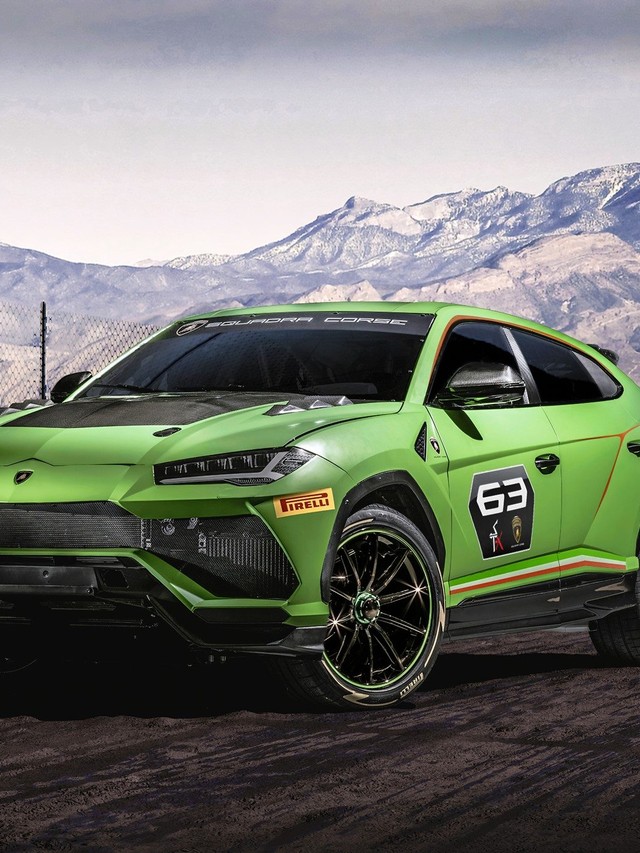
A Turnkey Racing Series Built Around the Super SUV
When Lamborghini Squadra Corse pulled the covers off the Urus ST-X Concept at the 2018 World Finals, the car itself was only half the story. The other half was the program wrapped around it: a single-brand championship combining circuit and off-road racing, delivered as a complete “arrive and drive” package for customer drivers and scheduled to debut in 2020 across Europe and the Middle East on specially prepared FIA-approved circuits.
Under the “arrive and drive” formula, participants show up, strap in, and race. Lamborghini provides the car and full technical support during race weekends. No private team infrastructure required. No hauling spare parts across continents. For ultra-high-net-worth buyers who already own a Urus, and possibly a Huracán Super Trofeo car, this compresses the barrier to competitive motorsport into something closer to a curated experience than a full-time racing commitment.
That compression is the concept’s real significance. Lamborghini’s existing Super Trofeo series had already proved the brand could sustain a credible customer racing ecosystem with Huracán-based race cars running in regional championships worldwide. The Urus ST-X extended that ecosystem into entirely new territory: a purpose-built racing SUV designed to handle both tarmac and loose surfaces in the same event, aimed at a clientele that traditional single-make supercar series would never reach.
Why Lamborghini Built a Racing Program Around an SUV
The strategic logic becomes clear once you consider who buys a Urus. The model transformed Lamborghini’s business, roughly doubling the company’s annual production volume after its 2018 launch. A huge portion of the current customer base bought an SUV, not a mid-engine supercar. Many of those buyers care about performance but would never enter a traditional GT3 or single-make supercar series.
A dedicated Urus racing program gives Lamborghini a way to keep those customers engaged at a deeper level than track day events or factory tours. It also reinforces the Urus’s “Super SUV” positioning in a way that no Nürburgring lap time or drag strip video can replicate. Racing validates durability, engineering integrity, and performance under sustained stress. If the Urus can survive a weekend of mixed-surface competition built to FIA safety standards, the road car’s capabilities become harder to dismiss as marketing language.
Few competitors were attempting anything similar at the time. Porsche runs the Cayenne in endurance rally events and offers extensive customer racing programs, but those center on the 911 and 718 platforms. Ferrari’s customer racing ladder focuses exclusively on its mid-engine cars. By creating a dedicated single-make SUV championship, Lamborghini carved out a niche that no rival occupied.
Race-Ready Engineering: What Squadra Corse Changed
Lamborghini says the racing configuration achieved a 25% weight reduction compared to the production Urus. On a vehicle that weighs roughly 2,200 kg in road trim, that figure represents a substantial transformation, stripping out hundreds of kilograms of interior trim, sound deadening, and comfort-oriented hardware.
The ST-X retains the production car’s 4.0-liter twin-turbocharged V8, which Lamborghini says delivers 650 CV and 850 Nm of torque. Larger air intakes optimize cooling for sustained track use, a critical modification given that turbocharged engines generate enormous heat under continuous high-load conditions. The car rides on 21-inch single-nut aluminum alloy wheels fitted with Pirelli tires, and the raised suspension setup reflects the dual-surface racing concept.
FIA-approved safety elements include a steel roll cage integrated into the frame, a fire suppression system, and an FT3 fuel tank. Beyond occupant protection, the roll cage adds torsional stiffness to the body structure, improving handling precision. Combined with the weight reduction and raised ride height, the result is a vehicle engineered to transition from circuit sections to off-road segments without requiring mechanical changes between surfaces.
| Modification | Detail |
|---|---|
| Weight reduction | 25% vs. production Urus |
| Engine | 4.0L twin-turbo V8, 650 CV, 850 Nm |
| Safety | FIA-approved roll cage, fire suppression, FT3 fuel tank |
| Wheels | 21″ single-nut alloy with Pirelli tires |
| Cooling | Enlarged air intakes for sustained track use |
| Aerodynamics | Rear wing, lateral racing exhausts with hexagonal design |
How the Urus ST-X Fits Into Lamborghini’s Motorsport Ladder
Squadra Corse already operated one of the most successful single-make championships in GT racing through the Super Trofeo series, running Huracán-based race cars across three regional championships (Europe, Asia, North America) and culminating in annual World Finals. Unveiling the ST-X Concept at exactly that event positioned the SUV racing program as a natural extension of an established ladder.
The key difference is accessibility. Super Trofeo demands a meaningful commitment: purchasing or leasing a dedicated race car, securing a team, managing logistics across a multi-round season. The Urus ST-X’s “arrive and drive” model compresses all of that into a single package. For a Urus owner who wants competitive wheel-to-wheel racing without building a full privateer operation, this is the on-ramp.
One detail worth watching: the ST-X Concept’s track debut was scheduled for the 2019 Lamborghini World Finals, giving Squadra Corse roughly a year to develop the car from concept to running prototype before the championship’s planned 2020 launch. Lamborghini did not announce participation costs, grid sizes, or the exact race calendar. For prospective participants, those details would determine whether the program attracted serious amateur racers or functioned primarily as a high-end brand experience with competitive elements.
What the ST-X Signals for the Urus Platform
The matt Verde Mantis livery, visible carbon fiber hood, and prominent number 63 are pure theater, and effective theater at that. Lamborghini understands that a racing SUV concept generates attention in a way that incremental road car updates cannot. More than a show car, though, the ST-X served as a statement of intent about where Lamborghini believed the Urus could go.
For current owners, the practical takeaway is that Lamborghini views the platform as capable of far more than luxury commuting. Engineering validated by the ST-X program, from cooling improvements to structural reinforcement and weight optimization, tends to filter into road-going performance variants over time. The Urus Performante, which arrived several years later with its own weight reduction and power gains, followed a trajectory that the ST-X Concept helped establish.
Multiple enthusiast forum discussions reflect a persistent tension around the Urus: some purists view it as a platform-sharing exercise with other VW Group SUVs, while others recognize it as the vehicle that funded Lamborghini’s ability to develop cars like the Revuelto. The ST-X Concept addressed that tension directly, pushing the Urus into territory where shared-platform criticism becomes irrelevant. No Audi Q8 or Porsche Cayenne was being prepared for a dedicated mixed-surface racing championship.
Lamborghini did not confirm whether a road-legal ST-X variant would follow, or whether the racing program would expand beyond Europe and the Middle East. What the concept did confirm is that Squadra Corse saw the Urus as a legitimate motorsport platform, not merely a revenue generator subsidizing the supercar lineup.
Gallery


