A Lamborghini on the Roof of the World
On October 8 and 9, 2021, a yellow Lamborghini Urus twice traversed the Umling La Pass in India’s Ladakh region of Jammu and Kashmir, a road that sits 19,300 feet above sea level. Built by the Border Roads Organisation (BRO), Umling La is recognized as the highest drivable road in the world. The expedition, conducted in partnership with Autocar India and BRO, marked the highest point ever reached by a Lamborghini in India.
The altitude alone is striking, but the number only becomes meaningful when you consider what it does to a combustion engine. At 19,300 feet, the atmosphere contains roughly half the oxygen available at sea level. For a naturally aspirated engine, that would translate into catastrophic power loss. For the Urus’s 4.0-liter twin-turbo V8, the physics are kinder but still punishing, and the fact that Lamborghini chose this particular challenge to validate the Urus reveals what the company wants the car to represent: not just a fast SUV, but a machine with genuine extreme-environment capability. Sharad Agarwal, Head of Lamborghini India, framed the achievement in human terms:
“When we reached Umling La Pass, even standing for 30 minutes was extremely difficult, and how the team completed the road in such extreme weather conditions is unimaginable.”
What 19,300 Feet Actually Means for a Car
Altitude challenges are not created equal. Plenty of luxury SUVs can handle a well-paved mountain pass at 10,000 or 12,000 feet. Umling La is a different proposition entirely. The road surface combines gravel, rough patches, and concrete sections across an 87.5-kilometer stretch from Hanle to the summit. Wind speeds range from 40 to 80 km/h, and minimum temperatures on the pass fall between -20 and -10 degrees Celsius.
For the humans involved, the thin air makes simple physical activity exhausting. For the machine, the problems are more specific. Cold air thickens lubricants, stresses battery chemistry, and contracts rubber compounds in tires and seals. The drastically reduced oxygen density forces the engine’s turbochargers to work harder to compress enough air for combustion, increasing thermal loads on the intercoolers and exhaust system at the exact moment when the cooling system’s efficiency drops because the ambient air is so thin.
Reddit discussions from travelers who drove the pass in conventional vehicles describe a mix of smooth, recently laid tarmac and genuine off-road sections requiring careful navigation, with temperatures cold enough to make altitude sickness a real concern for drivers and passengers alike. One user on r/ladakh described conditions at Umling La in early January as “-24, it was fun though. Too windy.” The Urus, of course, was expected to do more than just survive.

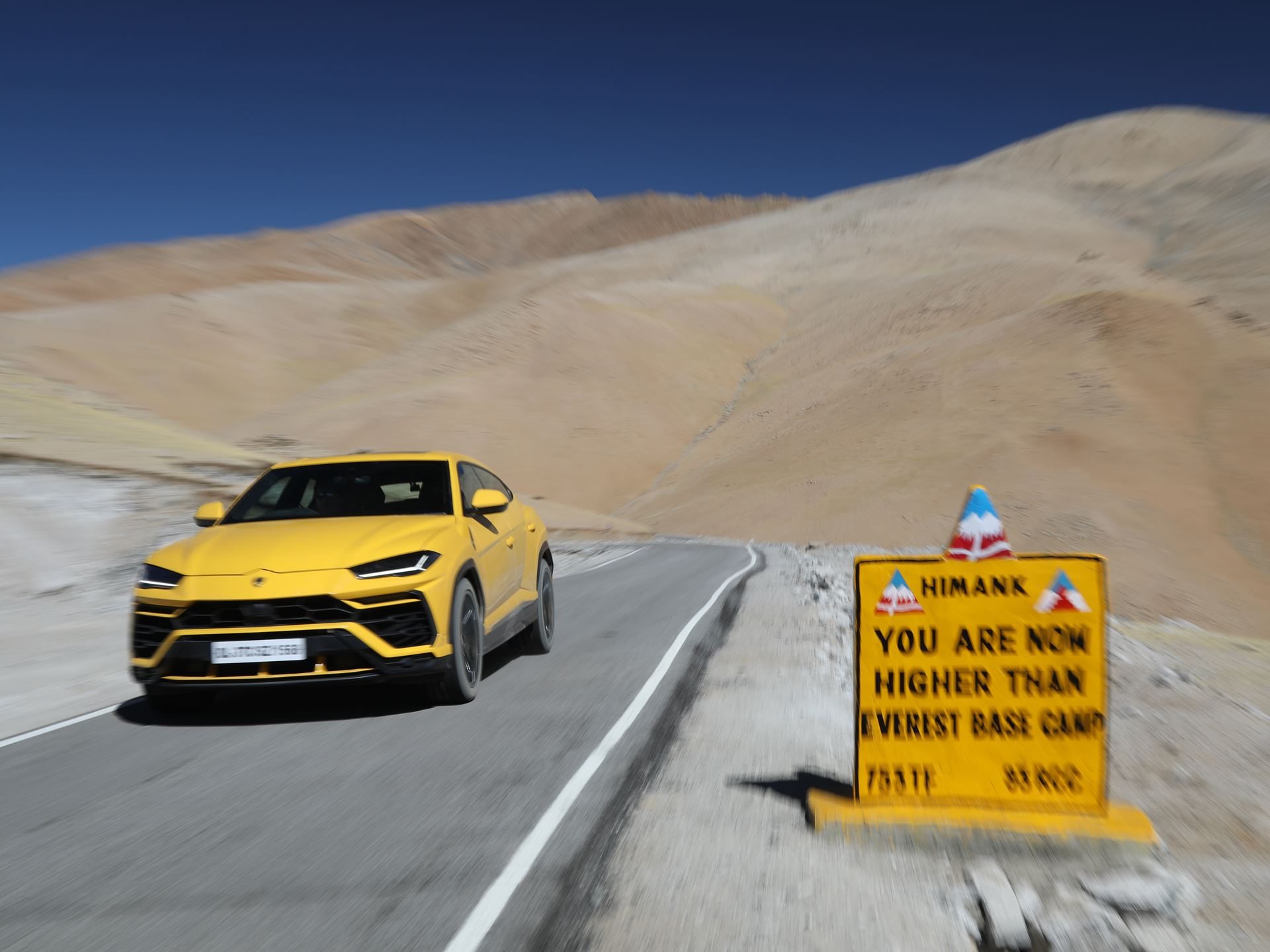
The Lamborghini Urus kicks up dust while traversing a rugged, high-altitude desert landscape under a brilliant sun.
Why Forced Induction Matters at This Altitude
The Urus’s twin-turbocharged V8 is the key to understanding why this expedition carries engineering credibility rather than just marketing flair. Lamborghini says the 4.0-liter unit produces 650 CV and 850 Nm of torque at standard conditions, with a claimed 0-100 km/h time of 3.6 seconds and a top speed of 305 km/h. None of those figures apply at 19,300 feet, and Lamborghini, notably, did not publish any altitude-adjusted performance numbers.
A naturally aspirated engine at this altitude would lose roughly 40 to 50 percent of its sea-level power output, because it can only ingest whatever air the atmosphere provides. A turbocharged engine compensates by spinning its compressor harder to force more air into the cylinders. The turbos cannot fully recover the deficit at extreme altitude, but they dramatically narrow the gap. The engine management system also adjusts fuel mapping and ignition timing to account for the reduced air density and lower ambient pressure.
What Lamborghini did not disclose, and what enthusiasts would genuinely want to know, is how much power the Urus actually made at the summit. The company confirmed the car used its Terra and Sport driving modes during the expedition. Terra mode, designed for loose and uneven surfaces, adjusts throttle response, transmission behavior, and the all-wheel-drive torque split to prioritize traction over outright speed. Sport mode sharpens everything for more aggressive driving where conditions allow. The combination suggests the team encountered enough variety in terrain to need both approaches across the 87.5-kilometer route.
The deeper engineering story is thermal management. At extreme altitude, the intercoolers that cool compressed intake air become less efficient because the ambient air itself is thinner and carries less thermal energy away. Simultaneously, exhaust gas temperatures rise because the engine works harder to produce the same output. Keeping everything within safe operating parameters while maintaining usable power is a systems-level challenge, not just an engine-tuning exercise. That the Urus completed the route twice, rather than limping over the summit once, speaks to the robustness of the entire thermal architecture.

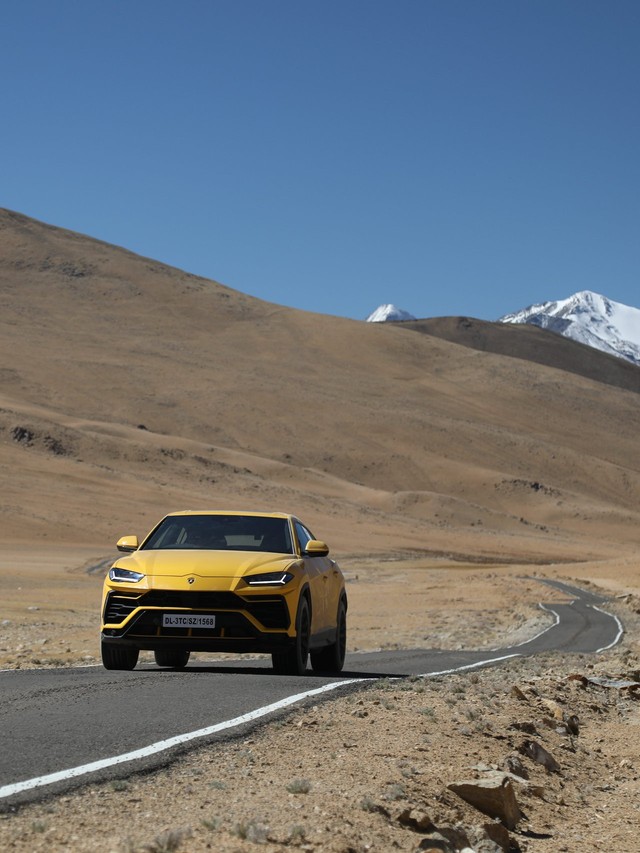
The Lamborghini Urus drives confidently on a high-altitude road, framed by majestic snow-capped mountains.
Earning the Badge: Why Lamborghini Needed This Proof Point
When the Urus launched in late 2017, the skeptics were loud. As CarBuzz reported, early critics called it “a re-badged Audi RS Q8,” questioning whether sharing the Volkswagen Group’s MLB Evo platform with the Audi Q7, Bentley Bentayga, and Porsche Cayenne disqualified it from genuine Lamborghini status. The sales numbers silenced much of that criticism. Commentators widely credit the Urus with transforming Lamborghini’s profitability, and many consider it the car that defined the modern performance SUV category.
Sales volume and profitability, though, do not settle the identity question for enthusiasts. A Lamborghini needs to do something extraordinary, something that feels slightly unhinged, to earn its badge in the court of enthusiast opinion. The LM002, the Urus’s spiritual predecessor produced between 1986 and 1993, earned its reputation by being absurdly powerful and genuinely capable in environments no supercar brand would normally touch. Driving the world’s highest drivable road serves a similar narrative function for the Urus.
The expedition also reinforces a practical point that prospective Urus buyers care about: this car can actually go places. Lamborghini’s earlier demonstration in Iceland’s volcanic terrain made a similar argument, but Umling La adds the dimension of extreme altitude, which tests the powertrain in ways that no off-road course or frozen landscape can replicate. For owners who buy the Urus because they want a vehicle that can handle a ski resort access road in January or a gravel track in Patagonia, the Umling La feat provides genuine reassurance about the engineering underneath the dramatic styling.

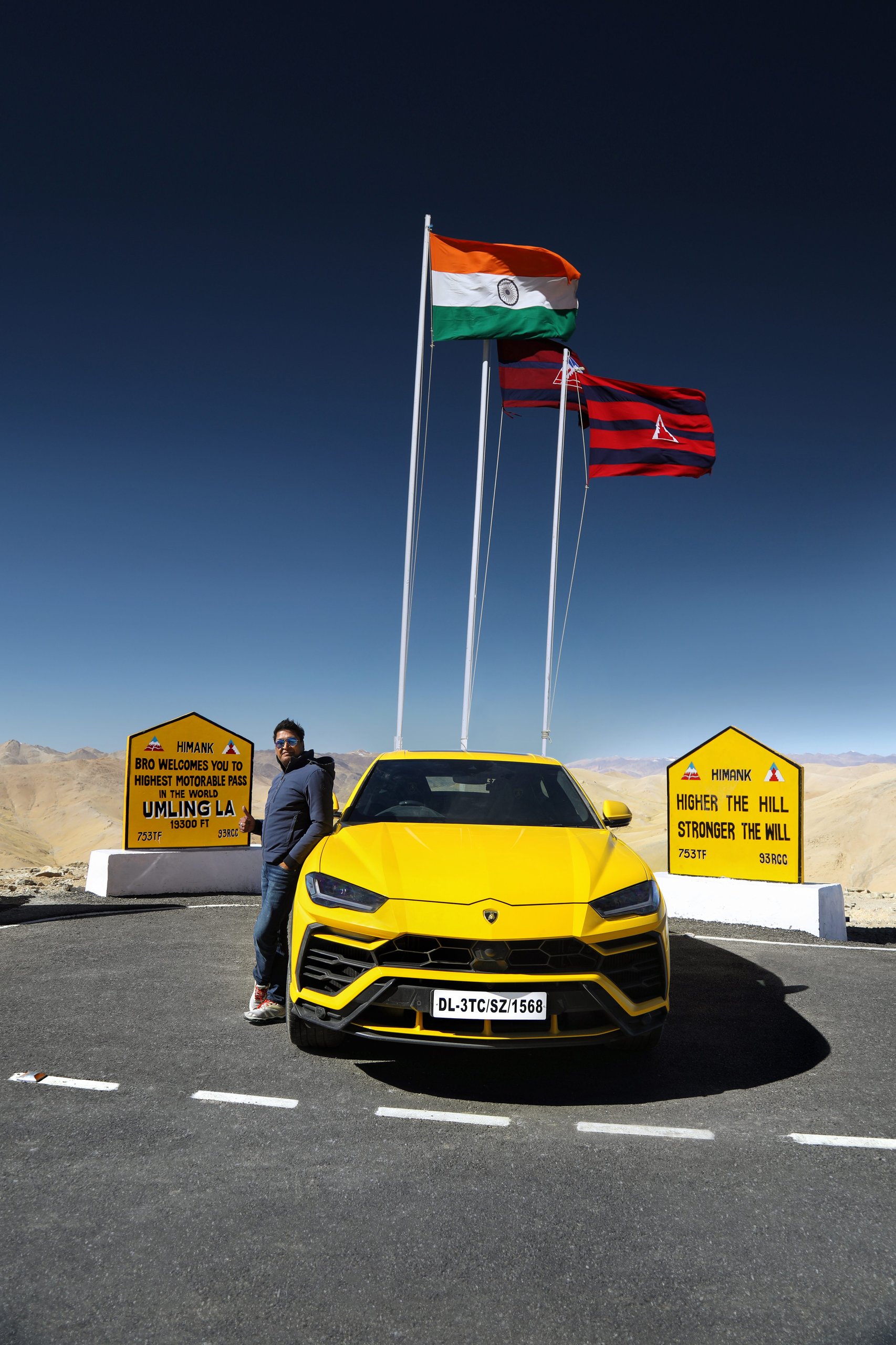
The Lamborghini Urus proudly stands at Umling La, the world's highest motorable pass, marked by flags and informational signs.
Where the Rivals Stand
No direct competitor in the performance SUV segment, including the Aston Martin DBX707, Porsche Cayenne Turbo GT, or Mercedes-AMG G63, can publicly point to a comparable high-altitude demonstration. That does not mean those vehicles could not complete a similar run; it means none of their manufacturers chose to prove it. The distinction matters. Lamborghini’s willingness to put the Urus in an environment where failure would be public and embarrassing is itself a competitive statement.
The Porsche Cayenne Turbo GT and Aston Martin DBX707 both compete on track times and straight-line performance, and both are formidable machines. The Cayenne Turbo GT, in particular, holds Nürburgring records that the Urus does not challenge. But circuit performance and extreme-environment capability are different conversations entirely. The Umling La expedition positions the Urus in a space where its rivals simply do not have a counter-argument, at least not yet.
For prospective buyers cross-shopping these vehicles, the practical takeaway is straightforward: if you intend to use your performance SUV as something more than a fast highway cruiser, the Urus is the only one whose manufacturer went to 19,300 feet to prove the powertrain and chassis can handle conditions that most owners will never encounter. That kind of engineering margin is exactly what separates a capable vehicle from a merely fast one.

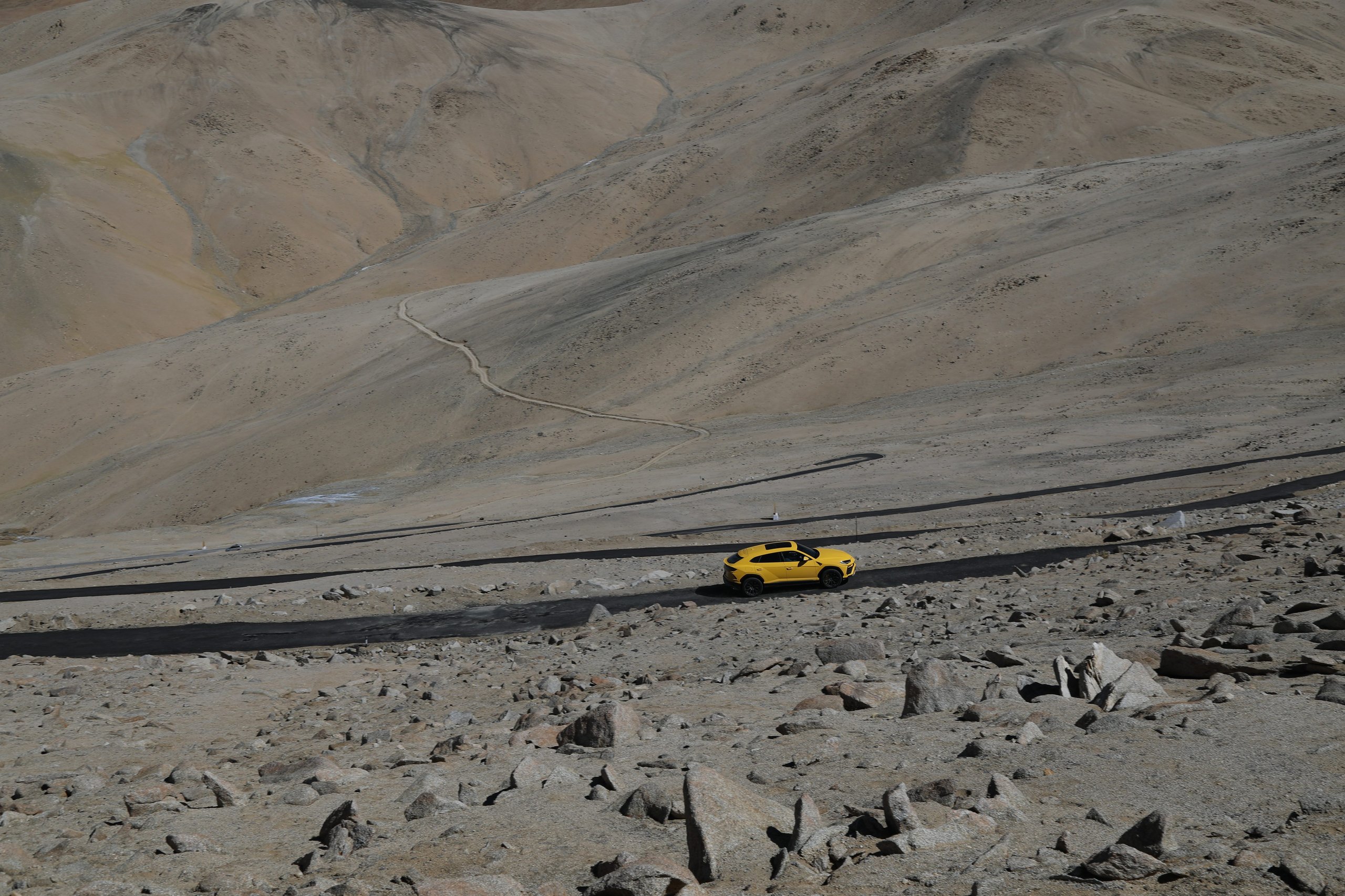
The Lamborghini Urus departs from the 'First View of Umlingla' sign, continuing its journey through the mountains.
What Umling La Signals for Lamborghini’s Electrified Future
The Urus that climbed Umling La was a purely combustion-powered vehicle. Lamborghini’s product roadmap now points toward hybridization across the lineup, with the Revuelto already pairing a V12 with electric motors and the Urus SE introducing plug-in hybrid technology to the SUV line. The question this expedition raises for the future is whether a hybridized Urus can replicate the same kind of extreme-environment credibility.
Battery packs add weight and introduce their own temperature sensitivities. Lithium-ion cells lose capacity in extreme cold and require active thermal management systems that consume energy, adding another layer of complexity at altitude. The electric motors themselves are unaffected by thin air, which is an advantage, but the combustion half of the powertrain still faces the same oxygen-deficit challenges. Lamborghini has not announced any plans to repeat the Umling La expedition with the Urus SE, and it would be genuinely interesting to see whether the company considers it.
For now, the Umling La traversal stands as a clear marker of what the combustion-era Urus can do when pushed to an environment that most vehicles, let alone luxury SUVs, would never be asked to endure. Whether Lamborghini’s electrified successors can match this particular proof point remains an open and fascinating question.

The Lamborghini Urus cruises along a winding road through a desolate mountain range, with a snow-capped peak in the background.
Gallery