Lamborghini’s 2015 Driving Calendar: From Frozen Lakes to Formula 1 Circuits
Lamborghini mapped out one of its most ambitious experiential calendars for 2015, stretching the Winter Accademia and Esperienza driving programs across four continents for the first time. The Winter Accademia alone expanded to three new continental stops: a frozen lake track in Nagano, Japan (January 15 through 19), followed by Aspen, Colorado (February 6 through 8), and Livigno, Italy (February 21 through 26). Once the ice melted, the track-focused Accademia moved to Barcelona, then Imola, the Yas Marina Formula 1 circuit in Abu Dhabi, Sepang in Malaysia, and the Circuit of the Americas in Austin, Texas.
The Esperienza program, which Lamborghini positions as the entry point for anyone curious about the brand’s performance world, grew to more than 20 fixtures across Europe, the United States, Asia, and Australia. Both programs put participants behind the wheel of the Aventador and Huracán, the two pillars of the lineup at the time, under the supervision of Lamborghini’s own Squadra Corse instructors.
The individual venues are not what makes this calendar remarkable. Plenty of supercar manufacturers hold track days. The scale and geographic diversity signal something more deliberate: Lamborghini was building a global infrastructure for customer engagement that went well beyond handing someone a helmet and wishing them luck. Each stop, whether on alpine ice or a Grand Prix circuit, served the same purpose: letting the cars speak for themselves in settings dramatic enough to leave a permanent impression.
Why Lamborghini Invests in Rolling Showrooms
A brochure cannot replicate the sensation of 600-plus horsepower breaking traction on ice. Lamborghini’s experiential programs function as rolling showrooms, environments where prospective buyers form an emotional bond with the product in a controlled, high-adrenaline setting. For existing owners, these events reinforce the decision they already made and create a social ecosystem around the brand.
The commercial logic is straightforward. A customer who spends a weekend sliding an Aventador sideways on a frozen Japanese lake, coached by professional racing drivers, develops a relationship with the brand that no dealership visit can replicate. That relationship translates into repeat purchases, higher Ad Personam (customization) spend, and word-of-mouth marketing that money cannot buy. Lamborghini confirmed as much by positioning the Esperienza as the deliberate “first step” into its world, a funnel designed to convert enthusiasts into owners and owners into collectors.
The 2015 expansion coincided with the global rollout of the Huracán LP 610-4, which was still a relatively fresh model. Putting the car into participants’ hands at circuits from Abu Dhabi to Austin served a dual purpose: it generated organic social media content from every continent, and it let prospective buyers experience the car’s all-wheel-drive composure in conditions that ranged from desert heat to alpine snow. Few marketing campaigns deliver that kind of versatility.

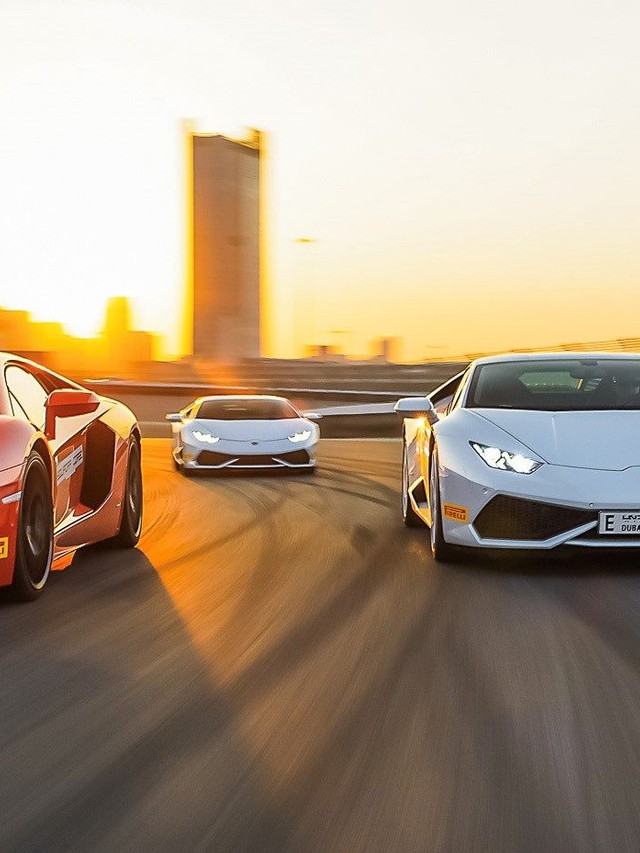
A fleet of Lamborghini supercars, including an orange Aventador and white and green Huracans, races on a track at sunset. Image: Automobili Lamborghini.
Intensivo and Avanzato: What the Programs Actually Involve
The Winter Accademia offered two tiers, each designed to deepen the participant’s connection to the car rather than simply accumulate laps. The Intensivo is a single-day course where instructors divide participants into small groups matched by skill level, then spend the day refining winter driving technique through slaloms, braking drills, and controlled oversteer exercises. The Avanzato builds on that foundation over two days: the first mirrors the Intensivo curriculum, while the second pairs each participant one-on-one with a professional driver for personalized coaching on brake control, weight transfer, and reading a racing line on snow.
That one-on-one element in the Avanzato deserves attention. Most manufacturer track days operate on a group instruction model because it scales efficiently. Dedicating a professional racing driver to a single participant for an entire day is expensive, and it signals that Lamborghini treated the Accademia as a premium product in its own right, not a loss-leader for car sales.
One participant who attended the Aspen Winter Accademia described the all-wheel-drive system as feeling particularly composed on snow and ice, which aligns with the engineering rationale for holding winter events in the first place. Lamborghini’s permanent all-wheel-drive architecture in both the Huracán and Aventador gives the brand a natural advantage in this format. Ferrari, by contrast, offered rear-wheel-drive as the default configuration on most of its lineup during this period, which limits the appeal of ice-driving programs.
The Esperienza, meanwhile, operated as a broader, more accessible offering. One account of a two-day Esperienza event described a factory visit in Sant’Agata Bolognese on the first day, followed by track driving with a Huracán at Imola on the second. That combination of heritage tourism and seat time illustrates how Lamborghini layered the experience: you see where the car is born, then you learn what it can do. Every tier, from the introductory Esperienza to the advanced Avanzato, funneled participants toward the same realization: these cars reward drivers who invest in understanding them.
The Cost of Entry and What You Actually Get
Lamborghini did not publish a single global price list for these programs, and costs varied by location and tier. One source indicates the Aspen Winter Accademia was priced at $5,995, a figure that included the ice-driving program with both the Huracán and Aventador, a three-day, two-night stay at the Viceroy Snowmass luxury hotel, meals, beverages, and insurance coverage. For context, that is roughly what you might spend on a long weekend at a top ski resort without the privilege of drifting a V12 supercar on a frozen track.
Broader reporting suggests official Lamborghini Accademia two-day programs ran approximately $12,000, while the snow-focused Esperienza Neve could reach around $20,000 per driver. These figures should not be confused with third-party “Lamborghini driving experiences” offered by independent operators, which typically cost a few hundred dollars for a handful of laps and involve none of the factory-backed instruction, hospitality, or vehicle variety.
The practical takeaway is that these programs occupy a middle ground between a casual supercar rental experience and the six-figure commitment of Lamborghini’s Squadra Corse customer racing programs. For someone considering a Huracán purchase (which started around $240,000 at the time), spending $6,000 to $12,000 on a structured driving experience with factory instructors is a rounding error on the total cost of ownership. Lamborghini priced the programs to be accessible to the target buyer, not to generate standalone profit. The real return came later, at the dealership.
How Lamborghini’s Programs Compare to the Competition
Every major supercar manufacturer runs some version of a customer driving program, but the approaches differ in ways that reveal each brand’s priorities. Ferrari’s Corse Clienti and Corso Pilota programs carry enormous prestige and deep racing heritage, yet they tend to be more exclusive and harder to access, often requiring an existing ownership relationship or dealer introduction. Porsche takes the opposite approach with its permanent Experience Centers in Atlanta, Los Angeles, and other locations, offering a lower barrier to entry but a less exotic, more repeatable format.
Lamborghini’s 2015 expansion carved out a distinct position. The geographic diversity of the calendar (frozen lakes in Japan, F1 circuits in Abu Dhabi, ski resorts in Colorado) created a travel-and-lifestyle proposition that neither Ferrari’s track-centric model nor Porsche’s fixed-location approach could easily replicate. Mercedes-AMG also operates its own Driving Academy with sessions that include racing license preparation, but the AMG brand occupies a different market segment and lacks the aspirational exoticism that makes a Lamborghini ice-driving weekend feel like an event rather than a training course.
The competitive insight is that Lamborghini was using these programs to punch above its production volume. In 2015, Lamborghini delivered roughly 3,200 cars globally, a fraction of Porsche’s output. By staging 20-plus experiential events across four continents, the brand created touchpoints with potential customers and media that far exceeded what its sales numbers alone would justify. According to one report, 130 enthusiasts from 25 countries participated in just the Aspen and Livigno Winter Accademia events. That is a concentrated dose of brand immersion aimed at exactly the demographic most likely to write a check for a Huracán.
Building Loyalty One Frozen Lake at a Time
The deeper strategic play behind Lamborghini’s experiential expansion becomes clearer when you trace the customer journey the brand was constructing. The Esperienza served as the gateway: accessible, relatively affordable, designed to introduce the uninitiated to what a Lamborghini feels like from the driver’s seat. The Accademia represented the next step, a more intensive and exclusive commitment that rewarded returning participants with advanced instruction and more exotic locations. Beyond that, Lamborghini’s Squadra Corse customer racing programs (the Super Trofeo series, in particular) offered the ultimate escalation for owners who caught the competitive bug.
This layered funnel mirrors what luxury brands in fashion, hospitality, and watchmaking have refined over decades: create multiple entry points, reward engagement at each level, and make the next step feel both aspirational and attainable. The genius of doing it with supercars is that the product itself becomes the experience. You do not need to imagine what ownership feels like when you have spent two days learning oversteer correction in an Aventador at 9,000 feet in the Colorado Rockies.
Lamborghini’s approach also addressed a practical ownership reality that the brand rarely discusses publicly. Many supercar owners never explore the full capabilities of their cars. Track days and ice-driving courses give owners permission, and the skills, to use their vehicles the way they were engineered to be used. That deeper understanding of the car’s behavior creates a more satisfied owner, one who appreciates the engineering rather than treating the car as a static investment.
The 2015 calendar represented a turning point in how aggressively Lamborghini pursued this strategy. The brand had offered driving programs before, but the simultaneous expansion to four continents with more than 20 events signaled a corporate commitment to experiential marketing as a core pillar, not an afterthought. Lamborghini was betting that the most effective way to sell a supercar was to let people drive one in the most memorable settings imaginable. Given the brand’s subsequent sales trajectory (deliveries more than tripled over the following decade), that bet appears to have paid off.
What Prospective Participants Should Know
For anyone considering a Lamborghini driving experience today, the 2015 expansion set the template that the brand continues to build on. The programs have evolved, the car lineup now includes the Revuelto and Temerario, and the locations rotate, but the fundamental structure remains: Esperienza as the accessible introduction, Accademia as the intensive deep dive, and Squadra Corse customer racing as the apex.
Lamborghini does not publish a centralized booking portal with transparent pricing for all events. Enrollment typically runs through regional Lamborghini dealers or the brand’s motorsport division, and availability can be limited. If you are serious about attending, the practical advice is to contact your local dealer early. Popular locations and winter programs fill quickly, and the Avanzato tier (with its one-on-one instruction) tends to have the smallest capacity.
The value proposition depends entirely on what you want from the experience. As a pure driving instruction investment, the cost per hour exceeds what you would pay at a general performance driving school. As an immersive brand experience that combines luxury hospitality, factory-backed instruction, and seat time in current-model supercars, it occupies a category that very few competitors match in scope. For prospective Lamborghini buyers, it may be the most cost-effective way to confirm that the car, and the brand, matches the expectation before committing to a purchase that starts well north of $200,000.


