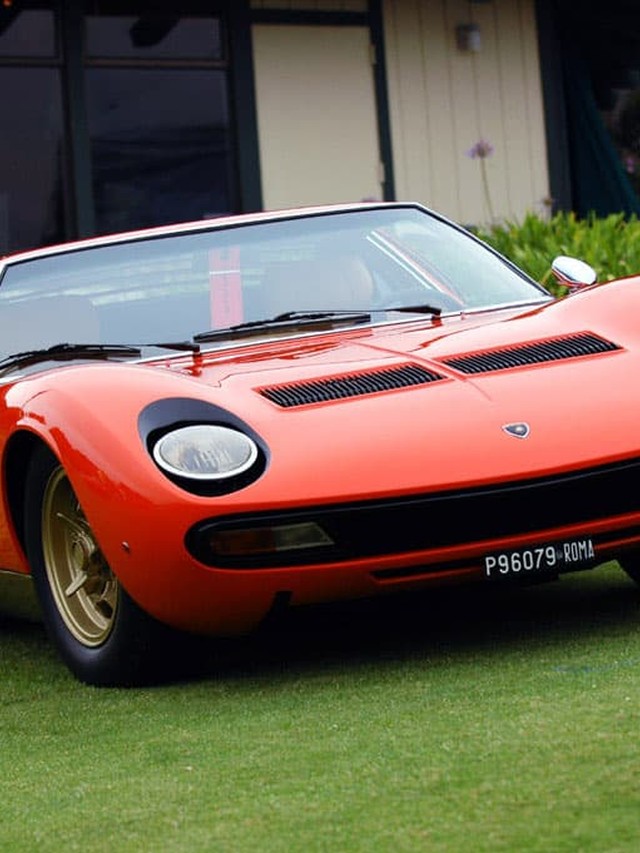
A Miura with a Famous First Owner and an Exceptionally Rare Color
Chassis #4797 is a 1971 Lamborghini Miura P400 S that Lamborghini says was delivered on 2 March 1971 to Antonio Ciacci, the Italian pop singer better known as Little Tony. The car was registered in the Republic of San Marino, where Ciacci held citizenship, before moving to Italian plates with a Rome registration in May 1973. What elevates this particular P400 S beyond its celebrity provenance is its paint: Azzurro Mexico, a vivid blue that Lamborghini confirms was applied to just six Miuras from the factory.
Six cars out of roughly 763 total Miuras. In a model whose color palette was extensive, certain hues were ordered so infrequently that they became defining characteristics of individual chassis. For a collector, owning one of six examples in a specific factory color transforms the car from a rare model into an essentially unique artifact.
Now in the hands of an Italian collector, the car competed at the 2019 Concorso d’Eleganza Villa d’Este in the “Baby You Can Drive My Car: Cars of the Music Stars” class. Before it rolled onto the lawns of Lake Como, Lamborghini’s Polo Storico heritage department completed a full certification, confirming the car’s authenticity and original specification after an extensive, factory-supervised restoration. That certification is the real story here, because it illustrates exactly how Lamborghini is protecting the provenance and long-term viability of its most important classic models.
How Polo Storico Guided the Restoration
Polo Storico‘s involvement went well beyond stamping a certificate. Lamborghini says the department opened its factory archives to supply the car’s complete original production specifications, then advised on correct working methods so that every phase of the rebuild reflected the techniques used in Sant’Agata Bolognese during the early 1970s. Original spare parts were sourced through an official Lamborghini dealer, and the goal was to retain as much of the original car as possible rather than replace components wholesale.
The department, inaugurated in 2015, handles restoration and certification for all Lamborghinis produced up to 2001. It also manages the company’s historical archives and manufactures reproduction spare parts for classic models. Lamborghini says more than 200 new part numbers were introduced in 2018 alone, a figure that signals serious investment in keeping cars like this Miura mechanically viable for decades to come.
For collectors and prospective buyers, the distinction between a Polo Storico-certified Miura and one restored independently is substantial. Factory certification confirms original color, specification, and build details against archival records. In a market where Miura provenance directly influences value, that paper trail from Sant’Agata is the closest thing to a factory guarantee of authenticity.
The Miura P400 S in Context
The P400 S represented the middle chapter of the Miura’s evolution. One widely cited source describes the original P400 as producing 350 PS from its transverse-mounted 3.9-liter V12, while the S variant, introduced in late 1968, bumped output to 370 PS through revised intake manifolds and different camshaft profiles. Interior refinements, including power windows, also distinguished the S from the base car. Approximately 338 P400 S units were built between December 1968 and March 1971, placing chassis #4797 near the very end of that production window.
The car’s place in automotive history is well established: the engineering team of Giampaolo Dallara, Paolo Stanzani, and Bob Wallace developed the mid-engine layout in their spare time, initially without the blessing of Ferruccio Lamborghini himself. Marcello Gandini at Bertone penned the body. The result redefined what a road car could be and created the template every mid-engine supercar since has followed.
Enthusiast forums continue to discuss the Miura’s real-world driving character with a mix of reverence and candor. The car’s front-mounted fuel tank, which shifts weight distribution as the level drops, and its acknowledged front-end lift at speed are well-known quirks. Cramped interiors and demanding handling keep the Miura firmly in the category of cars that reward skilled, attentive drivers. These are rolling pieces of engineering history that demand respect every time the V12 fires.
What Chassis #4797 Tells Us About Lamborghini’s Heritage Strategy
Combine Azzurro Mexico rarity with a documented celebrity first owner, a Polo Storico-certified restoration, and a public showing at Villa d’Este, and the provenance file on chassis #4797 is about as complete as any Miura collector could hope for. Lamborghini did not disclose pricing or the current owner’s identity, which is standard practice for heritage certifications.
The practical takeaway for anyone tracking the Miura market: factory-certified examples with unusual colors and documented ownership histories occupy the very top tier of collectibility, and Polo Storico’s growing parts catalog makes preserving them increasingly feasible. A Countach owner who needs a specific gasket or trim piece benefits from the same archival infrastructure that certified Little Tony’s Miura. As the collector market continues to reward documented provenance and factory-correct restorations, Polo Storico’s role will only grow in importance.
Lamborghini confirmed no additional details about future Polo Storico projects or upcoming concours appearances in connection with this certification. What the story of chassis #4797 does confirm is that the department’s process works: archive research, period-correct methods, original parts supply, and formal certification, all channeled through the official dealer network. For anyone considering a classic Lamborghini purchase or restoration, understanding that pipeline is as important as understanding the car itself.
Gallery


