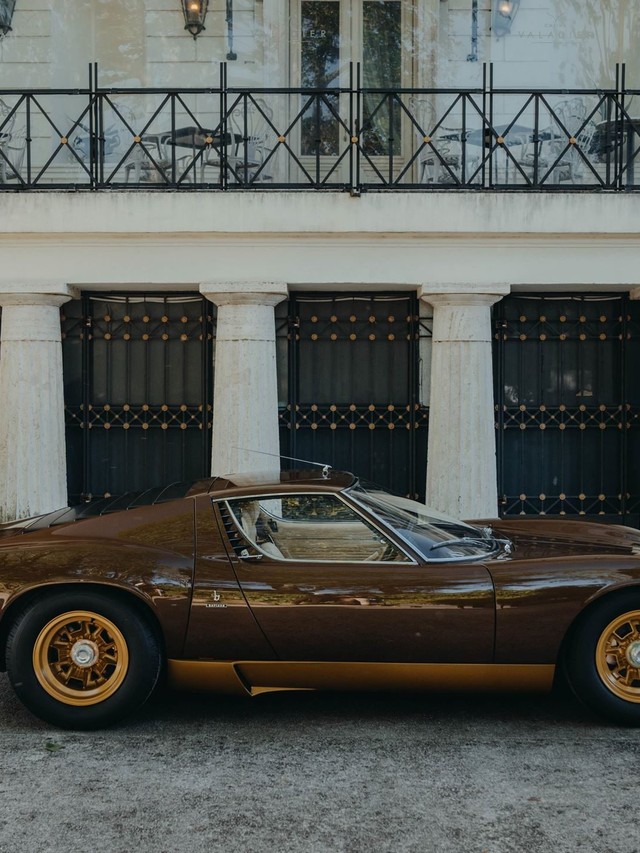

A 1972 Miura SV Returns to Factory Spec After Three Years in Sant’Agata
A Miura SV that arrived in Sant’Agata Bolognese at the end of 2023 in a configuration that did not match its original factory build has now been returned to original configuration after three years of work by Polo Storico, the brand’s dedicated heritage department. The car made its public debut at the Anantara Concorso Roma, held April 16 through 19, and it carries full Polo Storico certification of its authenticity and historical accuracy.
For collectors tracking the Miura market, that last detail is the one that matters most. Factory certification from Polo Storico is not merely a stamp of approval. It represents a documented chain of provenance, materials sourcing, and research that independent restoration shops, however skilled, simply cannot replicate. In an era where Miura values are stratospheric and the difference between a correct car and a nearly correct car can represent six figures at auction, the Polo Storico seal carries real financial weight.
Lamborghini says the Miura celebrates its 60th anniversary this year, making the timing of this restoration particularly significant. The SV, as the final evolution of the Miura lineage, occupies a special position: it is widely credited with defining the modern supercar thanks to its revolutionary mid-engine layout.

Why Factory Certification Changes the Equation for Collectors
The collector car world has a hierarchy of trust, and factory heritage programs sit at the top. Lamborghini Polo Storico serves the fundamental purpose of authenticating and restoring vehicles using historical and documentary research and production-sheet verification.
The practical takeaway for anyone considering a classic Lamborghini purchase: always ask whether the car has been through Polo Storico, and if not, whether it could be. For this restoration, research began from the production sheet confirming the car’s original characteristics. That level of scrutiny is precisely what makes the resulting certificate meaningful.

The Details That Separate a Correct Miura SV From a Close Approximation
The exterior reconstruction addressed components that only a deep Miura specialist would notice are wrong on a non-original car, and that is precisely the point. Front fender grilles, fins above the door handles with period-correct rounded edges, and rear louvers compliant with regulations of the era were all returned to their proper configuration. The octagonal center-lock hubs were restored, and the correct “Bob-type” exhaust tips were installed.

Those exhaust tips deserve a moment of explanation, because most coverage simply notes they are “named after Bob Wallace” and moves on. Wallace was the historic test driver Bob Wallace. The exhaust tip design associated with his name is a specific, identifiable component that distinguishes a correctly specified SV from one that has been fitted with generic replacements over the decades. Getting this detail right is not cosmetic vanity. It is a marker of authenticity that knowledgeable judges and buyers look for immediately.
Lamborghini notes that identifying the correct chromatic specification for the paintwork required extensive historical research, as the shade evolved across models and years. The exterior now wears “Luci del Bosco,” a brown that had to be precisely matched to the car’s 1972 production year rather than simply pulled from a modern Lamborghini color chart. The interior, finished in “Senape” (mustard), completes the period-correct combination.
Inside, the cabin received restored air conditioning preparation, reinstated hazard lights, a more compact steering wheel, and an extended handbrake lever.

The Interior Tells Its Own Story
The restored cabin, visible in Lamborghini’s own images, shows the kind of layout that made the Miura revolutionary in its era. The SV restoration reinstated interior details including the more compact steering wheel and extended handbrake, and the SV is described as the final evolution of the Miura. Every one of those details had to be researched and sourced or fabricated to match the original production sheet, a process that helps explain why the restoration consumed three full years.

The Italian Job Miura and the 60th Anniversary Connection
The restored SV was not the only Lamborghini drawing attention in Rome. Three other historic models were entered in the concours by their owners: two Countach 25th Anniversary cars and a very special 1968 Miura P400, the car that appeared in the famous opening sequence of the 1969 film The Italian Job.
Lamborghini says the Italian Job Miura secured first place and received the special “La vettura di Cinecittà” award, recognizing its cinematic significance. Contrary to a persistent myth, the car was not destroyed during filming. Its identity was confirmed and the car was restored and certified by Polo Storico in 2019, coinciding with the film’s 50th anniversary. The fact that the same heritage department responsible for the newly restored SV also authenticated and rebuilt one of cinema’s most famous cars speaks to the scope of what Polo Storico handles.
With the Miura celebrating its 60th anniversary in 2026, these two cars appearing together in Rome creates a compelling narrative arc: the 1968 Miura P400 known for its appearance in the opening scene of The Italian Job, and the SV that represented the final evolution of the Miura, both carrying Polo Storico’s seal of authenticity.

Polo Storico in the Broader Heritage Landscape
Lamborghini’s Polo Storico has steadily built its reputation through high-profile restorations and now this Miura SV.
What differentiates Polo Storico in practice is access. The team works from production documentation that records the car’s original characteristics. Independent restorers, no matter how talented, are working from secondary sources, published registers, and physical examination. Polo Storico starts from the primary document and works outward. For a model like the Miura, where small details evolved between production years and individual cars sometimes left the factory with unique specifications, that primary-source access is irreplaceable.
“We are proud to have completed a restoration that returns this Miura SV to its original identity and its value over time, according to historical standards that only Lamborghini Polo Storico, as the official custodian of the brand’s heritage, is able to guarantee.”
Giuliano Cassataro, Head of After Sales, Automobili Lamborghini

What This Means for Miura Buyers and Lamborghini Collectors
Several questions that matter most to prospective buyers remain unanswered by this announcement. The identity of the owner is not disclosed, the specific cost of this particular restoration has not been published, and Lamborghini has not provided data on how Polo Storico certification quantitatively affects resale values. These are the kinds of details the collector community will eventually surface through auction results and private sales.
What is clear is the direction of travel. Factory heritage programs are becoming more important, not less, as the collector car market matures and buyers grow more sophisticated about provenance. A Polo Storico-certified Miura SV, restored over three years using original production documentation and presented at a major concours, represents the highest tier of authenticity available for this model. For anyone holding or considering a classic Lamborghini, the existence and growing capability of Polo Storico is a meaningful part of the ownership equation.
The Miura defined what a supercar could be. Sixty years later, the fact that Lamborghini maintains a department dedicated to ensuring these cars survive in their correct, original form says something about the brand’s relationship with its own history. It is not just about selling new Temerarios and Revueltos. It is about making sure the cars that built the legend remain worthy of it.


