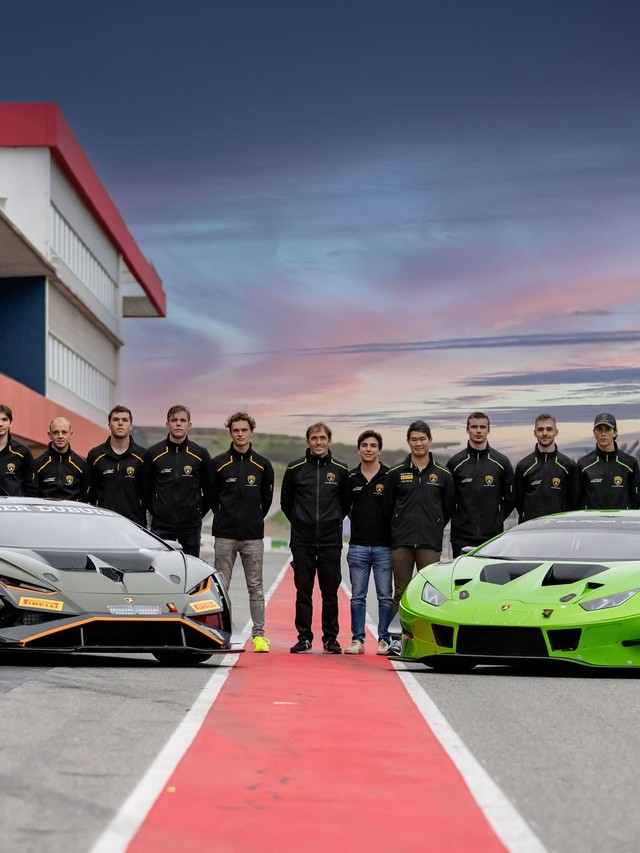
Lamborghini Elevates Pulcini to Factory Driver, Establishes a New Young Professional Tier
Leonardo Pulcini will race as an official Lamborghini Factory Driver in 2023 after winning the GT3 Junior Program shootout held at Portugal’s Circuito Internacional do Algarve in Portimão on November 7 and 8. The 24-year-old Roman topped a field of 15 GT3 Junior candidates evaluated across the season by Lamborghini Squadra Corse‘s technical staff, led by Raffaele Giammaria.
But the bigger story is structural. Alongside Pulcini’s promotion, Lamborghini introduced the Young Professional Driver category, an intermediate step between the existing Young Driver Program and the GT3 Junior Program. Danny Formal, Yuki Nemoto, and Maximilian Paul are the first three drivers to graduate into it. Squadra Corse states that this new tier is dedicated to experienced GT3 drivers, offering financial and technical support to train them as future Factory Drivers.
Taken together, the announcements reveal a manufacturer that is no longer content to scout talent and hope for the best. Squadra Corse is formalizing a career ladder that, until now, lacked a clear middle rung between grassroots scouting and the rarefied air of full factory status. For anyone tracking Lamborghini’s motorsport ambitions, the organizational architecture matters as much as the names on the contracts.
Understanding the Squadra Corse Ladder and Why It Just Got a New Step
Lamborghini’s driver development system operates across three continental Super Trofeo series (Europe, North America, and Asia) and feeds into GT3 competition worldwide. The broadest entry point is the Young Driver Program, open to competitors across those one-make championships. Above it sits the GT3 Junior Program, exclusively for drivers under 26 competing in GT3 championships. The apex is Factory Driver status: a contract with Automobili Lamborghini that places a driver in the most prestigious international GT championships and involves them in the development of both racing and road cars.
The new Young Professional Driver category addresses the gap between promising Super Trofeo talent and the small handful of seats available at the factory level. Drivers who demonstrate GT3 capability but need further seasoning now have a defined holding pattern rather than simply waiting and hoping. Squadra Corse confirms that the Young Driver Program for 2023 will include drivers from all three continental Super Trofeo series, keeping the scouting net global.
The numbers illustrate how steep the selection funnel is. Squadra Corse’s technical staff assessed 38 drivers throughout the 2022 season: 15 in the GT3 Junior Program and 23 in the Young Driver Program. One driver earned a factory contract. Three earned the intermediate classification. A program that promotes too many drivers dilutes the value of the badge; one that promotes too few risks losing talent to rival manufacturers. The new tier is Lamborghini’s answer to that tension.

Participants of the Lamborghini young driver program engage in a focused discussion during an indoor meeting.
What the GT3 Junior Shootout Actually Tests
The Portimão shootout is the culmination of a season-long assessment, not a single weekend audition. According to one report, the program evaluates drivers on single-lap pace, average speed, weekend consistency, experience, professionalism, technical feedback quality, and attitude both on and off the track. That last criterion matters more than casual observers might assume. A factory driver represents Lamborghini at sponsor dinners, in development debriefs with engineers, and in media sessions where the wrong answer can cost a brand real money. Squadra Corse is not simply looking for the fastest pair of hands; it is selecting ambassadors who can also develop a race car.
Pulcini’s progression through the Lamborghini ecosystem illustrates the model. He secured the Lamborghini Super Trofeo Europe Pro title in 2021, then won the 2022 International GT Open title alongside Benjamin Hites for Oregon Team. His path from single-seater racing into GT machinery ran through the Super Trofeo series, a deliberate step backward in outright speed that, by his own account, paid dividends in racecraft and car understanding.
“I feel like, by taking one step back, I was able to take another 10 steps forward in terms of track performance.”
That quote captures a philosophy Squadra Corse appears to value: patience and adaptability over raw qualifying pace. As a Factory Driver, Pulcini is set to compete in a full season of international GT3 racing in 2023, piloting the Huracán GT3 EVO2 in what will be the car’s final competitive years before the platform transition to the Temerario GT3.

A green Lamborghini Huracan GT3 EVO2 undergoes meticulous preparation in the pit lane, surrounded by its dedicated team.
The New Young Professionals: Formal, Nemoto, and Paul
The three drivers entering the Young Professional category arrived through distinctly different routes, which is precisely the point of a global scouting operation and precisely why the new tier exists: to retain diverse talent that might otherwise slip through the cracks.
Danny Formal, a Puerto Rican driver, earned his promotion after winning the Super Trofeo North America overall drivers’ title in 2022 with Wayne Taylor Racing co-driver Kyle Marcelli. His trajectory is notable for its speed: by his own account, his Lamborghini relationship began just three years earlier with a race he entered with zero preparation. Wayne Taylor Racing’s involvement adds credibility; the team’s pedigree in North American endurance racing is well established, and their willingness to pair a developing driver with Marcelli suggests they saw genuine potential.
Yuki Nemoto brings geographic and competitive diversity. His 2022 season included campaigns in Italian GT and Fanatec GT World Challenge Europe Endurance Cup, two series that demand very different skills. Italian GT rewards outright pace on familiar circuits; the GTWC Endurance Cup requires stint management, driver handover efficiency, and the ability to maintain consistent lap times across multi-hour races. Running both simultaneously is a grueling schedule that tests mental resilience as much as driving talent.
Maximilian Paul competed in the ADAC GT Masters, Germany’s premier GT series and one of the most competitive national GT championships in Europe. The grid depth in ADAC GT Masters means that strong results carry real weight against that caliber of competition.
Lamborghini has not disclosed the specific financial or technical support packages these three drivers will receive. What the announcement does confirm is that the Young Professional designation carries both resources and expectations: these drivers are being groomed for factory contracts, not simply recognized for past results.

A Lamborghini Huracan GT3 EVO2 in matte grey is attended by team members in the pit lane, ready for action.
Why Talent Investment Shapes Lamborghini’s Competitive Future
Factory driver programs are, at their core, a supply chain problem. GT3 racing relies on customer teams purchasing cars, and those customers increasingly expect manufacturer support in the form of skilled professional drivers who can anchor their lineups. A manufacturer with a deep bench of proven, factory-trained drivers makes its customer racing ecosystem more attractive. Teams know that when they buy a Huracán GT3, or soon a Temerario GT3, they can access a driver pool that Squadra Corse has already vetted for pace, professionalism, and development trajectory.
The timing of this structural expansion is deliberate. Lamborghini’s GT3 program sits at an inflection point as the Huracán platform nears the end of its competitive life and the Temerario GT3 prepares to take its place. Building a deeper roster of factory-aligned drivers now means that when the new car arrives, Squadra Corse will have experienced hands ready to provide development feedback and competitive results from day one. Pulcini closed his announcement by saying he cannot wait to get on track with the EVO2, a car he will likely help bridge toward its successor.
Giorgio Sanna, Lamborghini Squadra Corse’s head of motorsport, framed the program’s scope in global terms: the driver pool now includes male and female talent from Europe, North America, and Asia. That geographic breadth is not cosmetic. Each continental Super Trofeo series feeds local talent into the development funnel, and the drivers who emerge tend to understand the racing cultures and circuits of their home regions, a practical advantage when Lamborghini deploys factory support across different championship ecosystems.
One detail worth noting for those who follow the long game: Maximilian Paul, one of the three inaugural Young Professional Drivers named in this announcement, was later promoted to full Lamborghini Factory Driver status for the 2026 season, where he is set to pilot the Temerario GT3. The pipeline, in other words, works. The Young Professional category produced a factory driver within a few seasons of its creation.
How Squadra Corse’s Approach Compares to Ferrari and Porsche
Lamborghini is not the only manufacturer investing heavily in driver development for GT racing, and honest comparison helps clarify where Squadra Corse’s program sits in the broader landscape.
Ferrari operates its own driver academy structure, feeding talent into its Competizioni GT division and, at the highest level, into its Hypercar and Le Mans programs. The Ferrari pipeline benefits from the sheer gravitational pull of the Prancing Horse brand: young drivers aspire to Ferrari seats, giving Maranello a wider initial applicant pool. Porsche’s Junior Programme follows a similar logic, leveraging the Carrera Cup one-make series as a proving ground before promoting drivers into factory-supported GT and prototype roles. Both programs are well funded and have produced drivers who compete at the highest levels of endurance racing.
Where Lamborghini’s system distinguishes itself is in the granularity of its intermediate steps. The addition of the Young Professional Driver category creates a more graduated progression than most rival programs offer. Rather than a binary outcome of factory contract or nothing, Squadra Corse now provides a documented middle tier with dedicated financial and technical support. For a manufacturer whose GT3 customer base is smaller than Porsche’s enormous Carrera Cup network, this kind of structured retention matters. Losing a promising 23-year-old to a rival brand because no intermediate support existed is exactly the failure the new category is designed to prevent.
The competitive question going forward is whether Lamborghini can match the volume of its rivals’ talent pipelines. Porsche’s one-make series alone fields hundreds of drivers globally each year; Lamborghini’s three continental Super Trofeo series are smaller in scale. Squadra Corse’s response appears to be quality over quantity: assess fewer drivers more carefully, invest in the best ones earlier, and retain them through a structured ladder that makes the path to a factory seat visible and achievable.
For LamboCars readers who care about race results on Sunday, the practical takeaway is straightforward. The drivers wearing Lamborghini colors in GT3 competition over the next several years will increasingly be products of this system, trained specifically in the brand’s cars, attuned to its engineering philosophy, and integrated into the team culture from an early stage. Whether that produces more podiums than Ferrari or Porsche’s approaches will play out on track, but the organizational commitment is clear and, based on early evidence like Paul’s subsequent promotion, already producing results.
Gallery


