Ayrton Senna at the Lamborghini Museum: A Lost Chapter on Display
Formula 1 produces legends with mechanical regularity, but only a handful of its stories carry genuine dramatic weight decades after the fact. On April 12, 2017, the Lamborghini Museum in Sant’Agata Bolognese opened one of those stories to the public with “Ayrton Senna. The last night,” an exhibition running through October 9. Curated by motorsport photographer Ercole Colombo and journalist Giorgio Terruzzi, the show assembles every single-seat race car Senna drove during his career, from his early kart to the Williams of his final race, and pairs them with a photographic narrative tracing the Brazilian’s life from junior formulas to his death at Imola in May 1994.
The centerpiece, though, is not any of Senna’s championship-winning McLarens or the black Lotus JPS in which he claimed his first Grand Prix victory. It is a white, sponsor-free McLaren MP4/8, identical to the car Senna tested at Portugal’s Estoril circuit in September 1993, displayed alongside the Lamborghini V12 engine that powered it. That test is the thread connecting everything in the exhibition: a moment when Lamborghini’s engineering met the greatest driver of the era, only for corporate circumstance to sever the partnership before it could begin. Stefano Domenicali, then Chairman and CEO of Automobili Lamborghini, hosted the official presentation. Joining him were Mauro Forghieri and Daniele Audetto, both present at the original 1993 test, lending the exhibition firsthand witness authority rather than secondhand mythology.
Lamborghini says the exhibition also marks the start of a permanent partnership between its museum and Pirelli, a collaboration rooted in the two companies’ longstanding technical relationship. The Aventador S and the then-new Huracán Performante sit alongside the historical cars, a quiet reminder that Sant’Agata’s V12 lineage connects the museum’s past and present in a single building.
September 1993: The Test That Changed Nothing and Everything
The backstory is well documented in F1 circles, though rarely told from Lamborghini’s perspective. In the autumn of 1993, McLaren was searching for an engine supplier for the following season. The team’s Ford-Cosworth HB V8 was reliable but significantly underpowered compared to the Renault V10s propelling the dominant Williams cars. Chrysler, which owned Lamborghini at the time, saw an opportunity: its LE3512 V12, designed under the direction of Mauro Forghieri, could give McLaren the power advantage it needed.
Senna’s first laps in the white MP4/8B came on September 20, 1993, at Estoril. The car carried no livery, no sponsors, nothing but raw engineering intent. Lamborghini says the V12 filled Senna with enthusiasm, and the driver reportedly wanted to finish the remaining races of the 1993 season with the Lamborghini unit rather than wait for 1994. According to one account, the Lamborghini V12 produced approximately 730 to 750 horsepower, roughly 70 more than the Ford V8 McLaren was running. For a driver of Senna’s sensitivity, that kind of deficit in the existing engine would have been maddening, and the Lamborghini’s advantage immediately obvious.
The deal collapsed anyway. McLaren boss Ron Dennis reportedly chose a Peugeot V10 for 1994 instead, and Chrysler, losing appetite for motorsport expenditure, eventually sold Lamborghini. Senna moved to Williams. Seven months after the Estoril test, he was dead. That sequence of events is what gives the exhibition its emotional gravity and its title: the last night refers not just to Senna’s final hours, but to the closing of a door that might have kept him alive.
The ‘What If’ That Still Resonates
Few episodes in Formula 1 history carry the specific gravity of this one. The Senna-Lamborghini test sits at the intersection of two tragedies: a partnership that never materialized and a driver who never grew old.
The logic is seductive. If McLaren had adopted the Lamborghini V12, Senna would have had a more powerful car, possibly enough to stay with the team he knew intimately. He would not have been at Imola in a Williams he was still learning. The steering column that failed on lap seven of the 1994 San Marino Grand Prix would have been someone else’s problem. Enthusiast forums and F1 communities continue to debate the scenario with unusual intensity. Multiple discussions on Reddit’s r/formula1 describe the McLaren-Lamborghini pairing as one of the sport’s most tantalizing missed opportunities, with recurring speculation about whether a competitive McLaren could have kept Senna from switching to Williams altogether.
This kind of counterfactual reasoning is, of course, unprovable. Ron Dennis’s concerns about Chrysler’s long-term commitment to engine development were not irrational; Chrysler did exit motorsport and divest Lamborghini shortly after. The Peugeot deal, disastrous as it turned out for McLaren’s 1994 competitiveness, was made with corporate logic, not sporting intuition. Still, the emotional weight of the what-if endures precisely because the outcome was so catastrophic. For Lamborghini, the Estoril test represents a moment when its engineering was validated by the greatest driver of the era, even if the boardroom could not capitalize on it.
Lamborghini’s F1 Engine Program: Brief, Ambitious, Underestimated
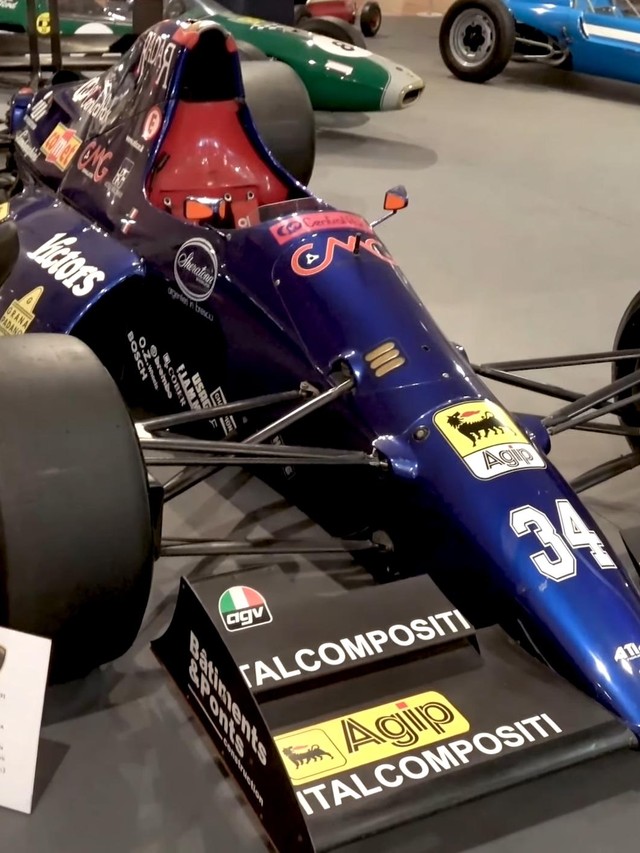
The exhibition places the white McLaren next to the Lambo F1 car designed by Forghieri, and that pairing is worth pausing on. Lamborghini’s involvement in Formula 1 as an engine supplier ran from the late 1980s into the early 1990s, a period when the company was under Chrysler’s ownership and eager to prove its engineering at the sport’s highest level. The LE3512 V12 powered several teams, including Lotus and Larighi’s Modena Team, with mixed competitive results but undeniable mechanical ambition.
As Road & Track noted in a feature on a Lamborghini-powered Lotus Type 102 coming to auction, the F1 V12 qualifies as a legitimate, if overlooked, chapter of both Lamborghini and Formula 1 history. The engine’s reputation within the paddock was complicated: powerful but sometimes unreliable, promising but backed by a parent company whose commitment wavered. Forum discussions from that era’s enthusiasts tend to be blunt, characterizing Lamborghini’s F1 reliability record as poor even while acknowledging the engine’s raw output.
What the Senna test proved, and what the exhibition underscores, is that the engineering itself was sound. The deficit was institutional, not mechanical. Chrysler’s retreat from racing, not a flaw in Forghieri’s design, killed the McLaren partnership. For Lamborghini enthusiasts who know the brand primarily through road cars, this distinction matters: the same V12 philosophy that defined the Countach, Diablo, and Murciélago was, for a brief window, competitive at the absolute peak of motorsport. The exhibition makes that case not through argument but through physical evidence, the engine and the car sitting side by side under museum lights.
Curating Heritage as Brand Strategy
Hosting an Ayrton Senna exhibition at Sant’Agata Bolognese is, on one level, a straightforward crowd-pleaser. Senna memorabilia draws pilgrims. His race cars command auction estimates in the tens of millions; Road & Track reported a $12 million to $15 million estimate for his 1991 McLaren MP4/6 at a dedicated RM Sotheby’s sale. Placing those cars inside the Lamborghini Museum guarantees foot traffic from an audience far broader than the typical supercar tourist.
The strategic calculation runs deeper, though. Ferrari, Lamborghini’s perpetual rival, operates an entire museum complex in Maranello built around its unbroken F1 legacy. Porsche fills its Stuttgart museum with Le Mans-winning prototypes. Lamborghini’s motorsport history, by contrast, is episodic: the Miura’s spiritual connection to racing, the brief F1 engine program, and the modern Squadra Corse era with the Super Trofeo series and the SC63 LMDh prototype. By anchoring the Senna exhibition around the Estoril test, Lamborghini claims a legitimate, emotionally resonant piece of F1 mythology without overstating its involvement. The company is not pretending it won championships. It is saying, accurately, that the greatest driver who ever lived tested its engine and wanted more.
That is a more honest and, arguably, more compelling brand narrative than a generic heritage display. Lamborghini’s motorsport story is one of ambition interrupted by corporate circumstance, then revived decades later under Volkswagen Group ownership. The Senna exhibition treats that interruption not as an embarrassment but as a dramatic chapter worth preserving. The company increasingly positions its museum as a cultural destination rather than a static showroom, and partnerships like the Pirelli collaboration reinforce that direction.
The Cars on Display: From Kart to Williams
Beyond the McLaren-Lamborghini centerpiece, the exhibition’s car roster reads like a timeline of competitive genius. Lamborghini says visitors can see Senna’s kart, the two Formula Fords from his British and European championship victories, and the Ralt F3 in which he dominated the 1983 British Formula 3 Championship. The single-seater collection continues with the Toleman from his first F1 season in 1984, the black Lotus JPS of his maiden Grand Prix victory, the McLaren MP4 series that carried him to three World Championships, and the Williams FW16 from his final, fatal weekend.
Assembling every single-seat car a driver of Senna’s stature raced is no small logistical feat. These machines are scattered across private collections, team archives, and museums worldwide. That Lamborghini managed to gather them in one location speaks both to the Senna family’s cooperation and to the curatorial ambition of the project.
The photographic exhibition by Colombo and Terruzzi provides the narrative thread connecting the cars. Colombo, one of F1’s most respected photographers, shot Senna throughout his career, and the images are displayed, according to Lamborghini, “like paintings.” The exhibition culminates in a recreation of Suite 200 at the Hotel Castello in Castel San Pietro Terme, the room where Senna spent his final night before the 1994 San Marino Grand Prix. It is a deliberately intimate, even unsettling, conclusion to a show built around speed and competition, shifting the visitor’s experience from admiration to something closer to grief. That final room circles back to the exhibition’s core question: what if the Estoril test had led somewhere, and Senna had never needed to spend that night at all?
Planning a Visit to Sant’Agata Bolognese
The exhibition ran from April 12 to October 9, 2017, with the museum open daily, including Sundays, from 9:30 a.m. to 7:00 p.m. For those who missed it, the Lamborghini Museum continues to operate as a year-round destination in Sant’Agata Bolognese, rotating special exhibitions alongside its permanent collection. The Pirelli partnership inaugurated with this show remains active, adding another layer of motorsport context to future visits.
For Lamborghini owners and enthusiasts planning a trip to Emilia-Romagna, the museum sits roughly 25 kilometers northwest of Bologna, in the heart of Italy’s Motor Valley. Ferrari’s museums in Maranello and Modena, Pagani’s factory, and the Dallara Academy are all within an hour’s drive, making a multi-day automotive pilgrimage entirely practical. The Senna exhibition, even in retrospect, represents the kind of curatorial ambition that elevates a factory museum beyond product display into genuine cultural programming, and the precedent is set: Sant’Agata can tell stories that extend well beyond its own production line, anchored by the authority of firsthand participants like Forghieri and Audetto.
Gallery


