The Moment of Ignition: February 2020 in Sant’Agata Bolognese
In February 2020, inside Lamborghini’s factory complex in Sant’Agata Bolognese, a 6.5-liter naturally aspirated V12 turned over for the first time in a chassis that would never touch a public road. Lamborghini Squadra Corse, the company’s motorsport division, offered almost nothing concrete: no name, no full specifications, no images of the complete car. Just the fact of ignition and a handful of technical breadcrumbs describing a track-only hypercar with a carbon fiber monocoque, an aluminum front frame, and a stated target of 830 horsepower from a naturally aspirated twelve-cylinder.
The hypercar teased that winter was later fully revealed as the Essenza SCV12, formally introduced on July 29, 2020, with deliveries beginning that December. But the deliberate theatrics of the initial announcement told a story on their own. Squadra Corse was not simply building another track toy. The division was staking a claim for the naturally aspirated V12 at a moment when the rest of the industry, Lamborghini included, was accelerating toward electrification. That tension between purity and progress runs through every detail of the car, and it is what makes the Essenza SCV12 more than a footnote in the brand’s history.
A Naturally Aspirated Statement at the Edge of the Hybrid Era
By early 2020, Lamborghini’s roadmap toward the hybrid Revuelto and the twin-turbo V8 Temerario was already taking shape internally. The Aventador SVJ, whose engine architecture formed the basis of the Essenza’s V12, was approaching the end of its production life. Choosing to extract the most extreme version of that engine for a limited-run, track-only machine was a deliberate act of preservation.
Lamborghini says the Essenza SCV12‘s 6.5-liter V12 produces 830 horsepower, making it the most powerful naturally aspirated V12 the company built. The road-legal Aventador SVJ produced 770 horsepower from the same displacement. That additional 60 horsepower came from the freedom of designing without road-car emissions regulations, noise limits, or the compromises of daily usability. A ram air induction system, reported by multiple sources, contributed to the gains.
The philosophically significant part is what Squadra Corse chose not to do. The division could have turbocharged the engine, added hybrid assistance, or gone in any number of directions. Instead it refined the naturally aspirated formula to its logical extreme. No electric motors. No forced induction. Just displacement, airflow, and an 8,500-rpm power peak that rewards a driver willing to chase every revolution. In a world already pivoting toward electrification, that restraint amounted to a declaration of intent.
Squadra Corse’s Extreme Engineering: Built Without Compromise
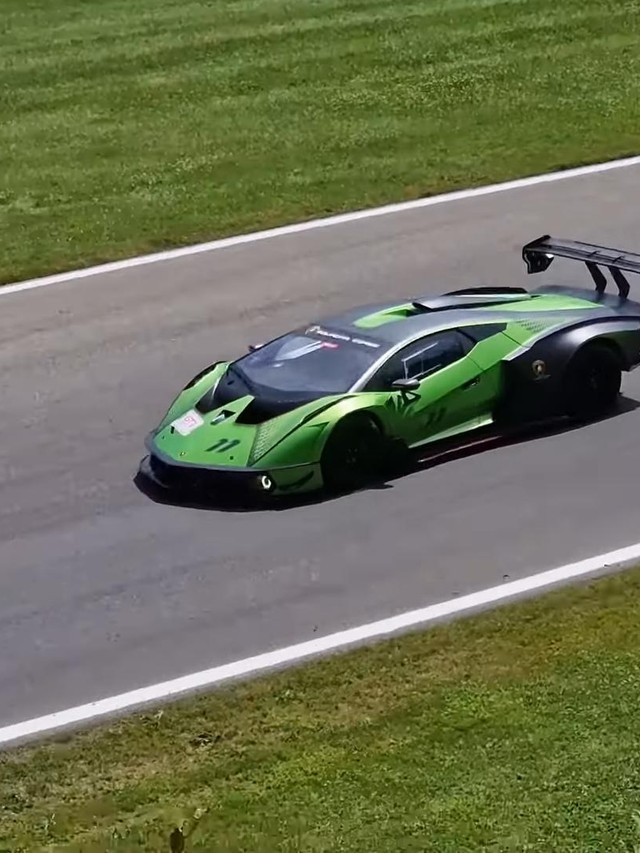
Because the Essenza SCV12 never needed to pass crash tests, meet pedestrian-impact regulations, or accommodate a luggage compartment, Squadra Corse and Centro Stile could design purely around aerodynamic and structural performance. The result looks more like a prototype endurance racer than anything from Lamborghini’s road-car catalog.
Distinctive features include a large rear wing, a roof-mounted airscoop, and a racing hood with dual air intakes. Construction pairs an aluminum front frame with a carbon fiber monocoque, a combination that prioritizes both crash protection and weight reduction. An innovative self-locking differential replaced the electronically controlled units found in Lamborghini’s road cars, offering more predictable mechanical behavior under the sustained high-speed cornering loads that track driving demands.
One report from web research indicates the car uses a six-speed Xtrac sequential manual gearbox, a non-synchromesh racing unit entirely different from the automated transmissions in Lamborghini’s road-going lineup. A sequential box requires deliberate, forceful shifts and rewards precision. It belongs on a circuit, full stop. Every component choice reinforces the same thesis: freed from regulation, Squadra Corse built the purest possible expression of what a V12 Lamborghini can be.
The workshop image released alongside the original announcement reveals heavy-duty orange shackles and steel cables securing the car during what appears to be testing or transport preparation. Rear suspension geometry and exhaust routing are partially visible, confirming the kind of robust, race-derived hardware that separates a machine like this from even the most aggressive road-legal Lamborghini.

Heavy-duty shackles secure the track-only Lamborghini Essenza SCV12 during its initial testing phase.
The Ultimate Club: Owning a Car You Cannot Drive Home
Buying an Essenza SCV12 means buying into a program, not just a car. Lamborghini confirmed the vehicle as a limited edition, and the ownership model revolves around the company storing the cars and providing dedicated track days at circuits worldwide. Owners arrive, drive, and leave. The car stays with Lamborghini’s support infrastructure.
This concierge approach mirrors programs from Ferrari’s FXX lineage and Aston Martin’s Valkyrie AMR Pro, but Lamborghini’s version leans heavily on Squadra Corse’s existing track-day expertise built through years of running the Super Trofeo one-make series. The infrastructure for managing customer race cars at circuits across multiple continents already existed. The Essenza SCV12 simply occupied the top tier of that pyramid.
Lamborghini has not publicly disclosed the Essenza SCV12’s production total or original transaction price. What the confirmed details establish is a machine that sits above the Super Trofeo and GT3 programs in exclusivity, offering unrestricted performance that homologated race cars cannot match because they must conform to balance-of-performance regulations. For its owners, the Essenza represents something rarer than a collectible: access to the uncompromised V12 experience that road regulations and racing rulebooks alike now prevent.
Where the Essenza SCV12 Fits in Lamborghini’s Motorsport Arc
Squadra Corse now operates across a wider competitive spectrum than at any point in Lamborghini’s history. The Temerario GT3, set to replace the decade-old Huracán GT3 platform, represents the brand’s next chapter in production-based racing. According to Road & Track, the Temerario GT3 brings an entirely new architecture after Lamborghini ran updated versions of the same basic Huracán racer for ten years. The SC63 LMDh prototype, meanwhile, marks the company’s first serious entry into top-level endurance racing, though early results at events like Daytona have exposed the growing pains of that program.
The Essenza SCV12 occupies a different category entirely. Free from the Balance of Performance restrictions governing GT3 racing and the technical regulations constraining LMDh prototypes, it represents what Squadra Corse can build when no rulebook applies. That freedom produced the most powerful naturally aspirated V12 in the company’s history, a distinction that carries particular weight now that Lamborghini’s road-car V12, in the Revuelto, operates alongside three electric motors and a hybrid system.
Looking back at the February 2020 engine fire-up, the Essenza SCV12 reads as a deliberate capstone. Lamborghini built the purest possible expression of its signature engine configuration at the exact moment the brand was preparing to move beyond it for road cars. Whether that makes the Essenza a farewell or a time capsule depends on where Squadra Corse takes its track-only programs next. Either way, the 830-horsepower answer to the question of how far a naturally aspirated V12 can go now belongs permanently to this car.


