Monza’s Record Grid and a Victory Decided by Inches
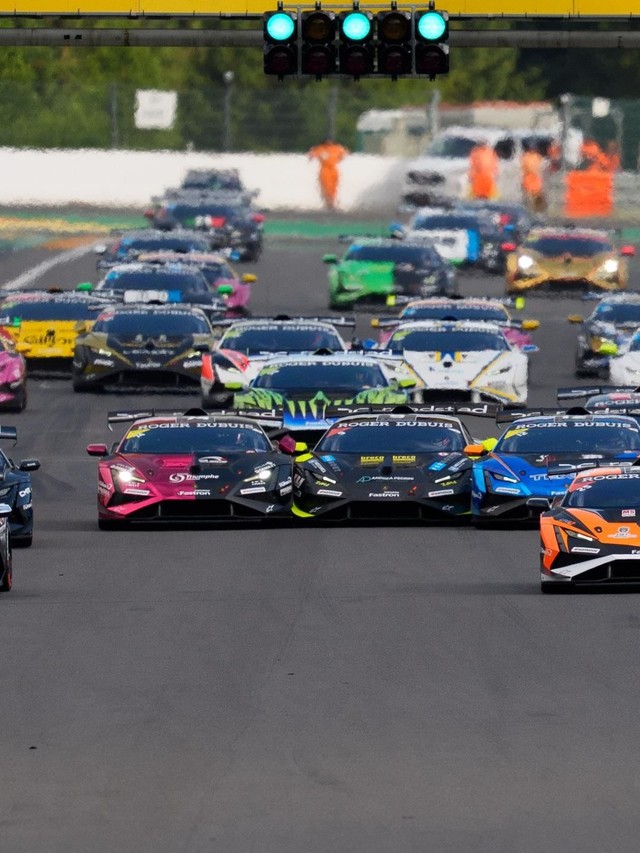
Forty-eight Lamborghini Huracán Super Trofeo cars lined up at Monza for the opening round of the series’ tenth European season, the largest field the Brianza circuit had ever hosted for the one-make championship. The occasion also marked the continental debut of the new Huracán Super Trofeo Evo. Together, the record entry and the new car told the same story: Lamborghini’s customer racing program is not just surviving its first decade, it is accelerating.
The racing itself delivered a script no one could have written in advance. Rookies Giacomo Altoè and Job Van Uitert, running with Antonelli Motorsport, took the win in the most improbable fashion. Pole-sitter Vito Postiglione and co-driver Karol Basz, representing Imperiale Racing, controlled the race from the front until Basz was forced to slow dramatically in the closing ninety seconds. James Pull and Kelvin Snoeks of Bonaldi Motorsport inherited the lead, only for Van Uitert to draft past Pull on the finish straight and steal the victory before the timing beam. Altoè, speaking afterward, was characteristically honest: “We had a bit of luck to win at the last meter. But so are the races. We were very careful to preserve the car until the last minute and were rewarded in the end.”
Antonelli Motorsport doubled its podium haul when Kikko Galbiati and Joffrey De Narda brought their sister car home in third. VS Racing’s Takashi Kasai and Philipp Wlazik finished fourth overall and won the PRO-AM category, while Raffaele Giannoni of Automobile Tricolore claimed the AM class after a penalty was applied to Cedric Leimer of Autovitesse. In the Lamborghini Cup, Thai driver Supachai Weeraborwornpong took his debut European victory with Team Lazarus.
Why the Grid Size Matters More Than the Finish Order
A 48-car grid at a one-make series opener is a commercial signal, not just a nice statistic for the program notes. The Super Trofeo launched in 2009 and runs across three continental championships in Europe, North America, and Asia, each culminating in a combined World Final. Growing the European grid to a record entry in the tenth season suggests that the economics and the competitive product are working for customer teams, and that Lamborghini’s proposition is holding its own against Ferrari Challenge and Porsche’s various Cup programs in the fight for funded drivers and team budgets.
The series splits drivers into Pro, Pro-Am, Am, and Lamborghini Cup categories, a structure designed to keep racing competitive across experience levels. That layered approach makes the series viable for both aspiring professionals and gentleman drivers who want serious wheel-to-wheel competition in identical machinery. For Lamborghini, each filled grid slot represents a car sold, a team funded, and a customer embedded in the brand’s racing ecosystem. Few marketing programs generate revenue while simultaneously building brand loyalty and feeding the driver pipeline.
The Huracán Super Trofeo Evo: What Changed and Why It Matters
The Evo designation signals a comprehensive aerodynamic redesign rather than a simple facelift. The most visible changes include a large roof-mounted air intake, a vertical fin on the engine cover borrowed from LM-style endurance cars for high-speed stability, a reworked front splitter, and an adjustable rear wing. The side air intakes were eliminated entirely, allowing engineers to redesign the rear section for improved airflow management.
Underneath the bodywork, the fundamentals remain potent. The naturally aspirated 5.2-liter V10 produces 620 horsepower, sent exclusively to the rear wheels through a six-speed sequential gearbox with Marelli electric actuation. The hybrid carbon and aluminum frame keeps dry weight at 1,270 kg, yielding a weight-to-power ratio of 2.05 kg per horsepower. A Motec M182 engine management system governs the drivetrain and provides 12-position racing ABS and 9-position traction control, giving drivers meaningful adjustability to suit conditions and driving style.
For teams already running the previous-generation car, the Evo’s aerodynamic gains translate to higher cornering speeds and better stability under braking into Monza’s heavy stop zones. That kind of incremental evolution keeps the platform relevant and gives existing customers a reason to upgrade rather than look elsewhere, reinforcing the commercial momentum that a record grid already demonstrates.
The Proving Ground That Feeds Lamborghini’s GT3 Future
What separates the Super Trofeo from a track-day experience with timing transponders is its explicit role as a development pathway. Young drivers like Altoè and Van Uitert, both rookies at this level, use the series to build race craft in professional conditions before stepping up to GT3 competition. Identical machinery strips away equipment advantages and forces drivers to find time through technique, racecraft, and tire management, precisely the skills a manufacturer wants when it scouts for its GT3 roster.
Lamborghini’s broader motorsport architecture reinforces this pipeline. Reports indicate that Lamborghini unveiled the Temerario GT3 at the 2025 Goodwood Festival of Speed, described as the company’s first competition car fully designed, developed, and built in-house. The Super Trofeo series functions as the proving ground where Lamborghini identifies drivers and refines the operational knowledge that will eventually feed into that GT3 program.
For anyone considering the Super Trofeo as a racing investment, this is one of the few manufacturer-backed series where the pathway from customer racing to factory-supported GT3 competition is both visible and actively maintained. The series positions itself as accessible relative to GT3 budgets, offering professional-grade competition infrastructure, Squadra Corse technical support, and global media exposure across six double-header weekends per continental series.
With the Temerario Super Trofeo confirmed to replace the Huracán race car from the 2027 season onward, the current V10-powered cars represent the final era of naturally aspirated customer racing for Lamborghini. That transition adds a layer of significance to every remaining Huracán Super Trofeo grid, and it makes the record turnout at Monza feel less like a statistical footnote and more like a milestone in a program that has earned its place at the center of Lamborghini’s competitive identity.
Gallery


