Redemption at Monza: Basz and Postiglione Take Race 2
Karol Basz and Vito Postiglione spent Saturday watching a dominant Race 1 performance slip away in the final minute. On Sunday, the Imperiale Racing pair left nothing to chance. Basz qualified second, handed the car to Postiglione during the pit window, and the Italian veteran methodically built a gap that nobody could close. The result: an outright and PRO class victory in Race 2 of the Lamborghini Super Trofeo Europe at Monza, the opening round of the series’ tenth season.
Dennis Lind of Target Racing grabbed the lead at the start and held it through a brief safety car period. When the pit window opened, young rookie Simon Larsson took over Lind’s car, but Postiglione’s experience told. He emerged from the stops in front and stretched his advantage lap by lap over the Bonaldi Motorsport entry of James Pull and Kelvin Snoeks, who matched their Race 1 second place. Giacomo Altoè and Job Van Uitert, the Antonelli Motorsport duo who won Saturday’s opening race, rounded out the overall podium and left Monza leading the PRO standings.
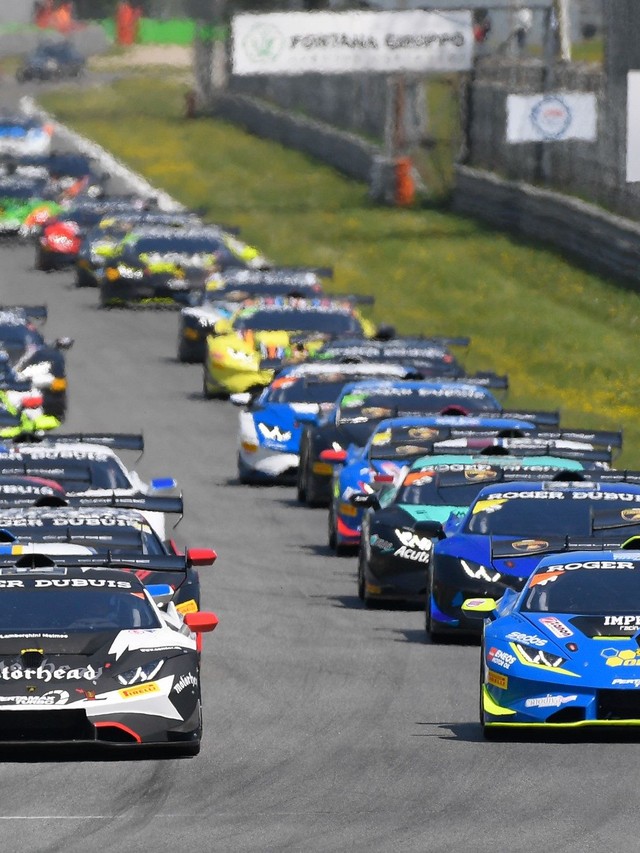
Forty-seven Lamborghini Huracán Super Trofeo Evos lined up on Sunday’s grid, all running the same naturally aspirated 5.2-liter V10, all separated by driver skill, team preparation, and racecraft rather than mechanical advantage. That kind of parity is exactly the point of a one-make series, and at Monza it produced the sort of close, unpredictable racing that spec sheets alone can never promise. It also revealed something deeper about the role this championship plays in Lamborghini’s motorsport strategy: the Super Trofeo is not merely a customer racing series. It is a proving ground, and the drivers who shine here tend to surface in far more prominent cockpits.
The Super Trofeo Ladder: Where Lamborghini Builds Its Next Factory Drivers
A 47-car grid at the season opener speaks to the health of Lamborghini’s motorsport ecosystem. Established in 2009, the Super Trofeo Europe now operates alongside continental series in Asia and North America, all feeding into an annual World Final that crowns a global champion. The structure carries a specific strategic purpose that becomes clearer when you look at who fills these cockpits.
Altoè and Van Uitert, both teenagers making their continental series debuts, exemplify the pipeline. At 17 and 19 respectively, they arrived at Monza, won Race 1, and left atop the PRO standings. Larsson, another first-timer, ran at the front before the pit stop shuffle. The Super Trofeo functions as a controlled environment where young drivers learn racecraft in identical machinery, proving themselves to Squadra Corse scouts without the variable of unequal cars muddying the evaluation.
That evaluation carries real consequences. Drivers who perform here graduate to GT3 and endurance programs carrying institutional knowledge of how Lamborghini builds and races its cars. For anyone watching the series casually, names like Altoè are worth remembering. The path from a Super Trofeo podium to a factory contract is shorter than most fans realize.
Huracán Super Trofeo Evo: A Decade of Naturally Aspirated Racing
The car at the center of all this remains the Huracán Super Trofeo Evo, which succeeded the earlier LP 620-2 Super Trofeo and refined its formula rather than reinventing it. The core proposition is a 5.2-liter V10, rear-wheel drive, and a stripped, caged chassis optimized for 50-minute sprint races on circuits like Monza, Silverstone, and Spa.
Monza rewards top speed and braking stability in roughly equal measure, and the Evo’s aerodynamic package, visible in the prominent rear wings and aggressive front splitters across the grid, balances low-drag efficiency on the straights with enough downforce to keep drivers confident through Lesmo and Parabolica. Postiglione’s ability to pull away after the pit stops suggests Imperiale Racing found the right compromise for Sunday’s conditions.
For enthusiasts who follow the road car side of Lamborghini, the Super Trofeo Evo occupies a fascinating middle ground. It shares its V10 DNA with the STO and Performante but strips away the road-legal compromises: no air conditioning, no infotainment, no sound deadening. What remains is the closest thing to a pure expression of what Lamborghini’s naturally aspirated architecture can do when unburdened by homologation requirements.

A pack of Lamborghini Huracán Super Trofeo Evo race cars speed down the track during a competitive race event.
Category Winners and the Moments That Decided Monza
Beyond the overall result, each category produced its own storyline, and each one reinforced the depth of talent and commitment running through the grid.
In PRO-AM, Loris Spinelli and Juan Perez of Antonelli Motorsport pulled off the weekend’s most improbable result, starting from 31st on the grid and climbing to a class victory. Spinelli credited a combination of Perez’s composure in traffic and the safety car period for compressing the field at the right moment. Raffaele Giannoni of Automobile Tricolore swept the AM class with back-to-back wins, declaring Monza his favorite circuit and backing up the claim with consistent pace across both races. In the Lamborghini Cup, William Van Deyzen of Van der Horst Motorsport prevailed over Saturday’s winner Supachai Weeraborwornpong in what Van Deyzen described as a physically punishing race under high temperatures.
The AM and Lamborghini Cup classes deserve attention from a different angle, too. These categories exist for gentleman drivers, owners, and semi-professional racers who buy into the series as participants rather than spectators. Filling a grid with 47 cars requires more than a handful of factory-backed professionals. It requires a broad base of paying competitors who see value in the experience, the competition, and the brand association. The size of this grid suggests the value proposition remains compelling for the clientele Squadra Corse targets, and that broad base is precisely what sustains the ladder for younger drivers climbing toward professional seats.
Silverstone Is Next, and the Championship Picture Is Already Forming
The series moves to Silverstone on May 19-20 for round two of six. Altoè and Van Uitert carry the PRO points lead, Giannoni looks formidable in AM, and Imperiale Racing proved at Monza that Basz and Postiglione can win from any position on the grid when the strategy comes together.
Monza’s opening weekend offered more than race results. It confirmed that the Super Trofeo, now entering its second decade, remains the place where Lamborghini’s competitive future takes shape, one 47-car grid at a time. Pay attention to the names coming through this championship. Some of them will be racing factory Lamborghinis at far bigger events before the decade is out.


