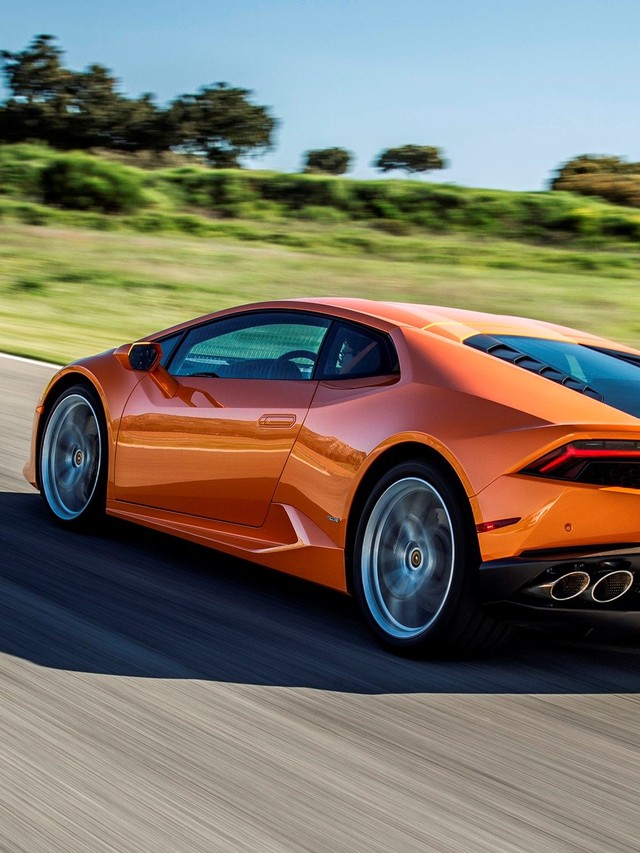
More Standard Equipment, Same Sticker Price
Lamborghini’s 2016 model year update for the Huracán LP 610-4 is a study in quiet reinforcement: cylinder deactivation now standard on both the coupé and the newly launched Spyder, a recalibrated all-wheel-drive system tuned for more neutral behavior in STRADA mode, expanded leather trim inside, and a substantially wider palette of colors and materials through the Ad Personam customization program. The price stays at 169,500 Euros plus tax. Autoweek estimates the U.S. sticker will land close to the previous year’s $241,945.
Nothing here rewrites the fundamental character of a car that already proved itself as one of the most approachable and capable V10 supercars on the market when it replaced the Gallardo in 2014. Instead, every change serves a single purpose: making the Huracán harder to resist without touching the qualities that made it desirable in the first place. From the engineering hiding inside the intake manifold to the leather now wrapping the door handles, the 2016 car is a meaningfully better-equipped vehicle for the same money, and that combination of invisible technical progress and visible personalization tells you exactly how Lamborghini intends to defend the Huracán’s position against turbocharged rivals.
A V10 Running on Five Cylinders (and You Might Not Notice)
The headline technical addition is cylinder deactivation, and Lamborghini says this marks the first time the technology appears in a naturally aspirated V10. The mechanics are straightforward in concept: when full power is unnecessary, one entire bank of five cylinders shuts down, letting the engine coast along on the remaining five. Step on the throttle and all ten cylinders reactivate instantaneously.
The real engineering challenge is making that transition invisible in a car whose entire emotional appeal is built around the way its 5.2-liter V10 sounds and responds. Lamborghini claims the switchover is imperceptible. The efficiency gain, a CO2 figure of 283 g/km, is modest rather than transformative. Nobody buys a 610-horsepower supercar to save fuel. The point is regulatory survival: tightening European emissions standards demand incremental improvements, and cylinder deactivation lets Lamborghini meet those targets without resorting to turbocharging or hybridization, both of which would fundamentally alter the character of the engine. This is the invisible hand keeping the naturally aspirated V10 alive.
Owner discussion on enthusiast forums paints a slightly more nuanced picture than the official claim of seamless operation. Some drivers report noticing a subtle change in sound and pedal feel during light-load cruising, and occasional perceptible transitions when the engine returns to full ten-cylinder mode. Whether that matters depends on your sensitivity and your priorities. For most owners, the system operates in the background during exactly the kind of low-demand driving where the V10’s full voice is irrelevant anyway. The moment you want all 610 PS, they are all present.
Ad Personam Grows Up
If cylinder deactivation is the invisible upgrade, the expanded Ad Personam program is its visible counterpart. Lamborghini now offers heritage colors and matt exterior paints alongside deeper interior personalization, giving buyers a substantially broader canvas for creating a car that reflects individual taste rather than a dealer-lot configuration.
Standard interior refinements for 2016 include leather on the door handles and upper center console sections, plus matt black air vents. These are small touches, but they address areas where the original 2014 interior felt slightly utilitarian compared to the exterior drama. The cumulative effect is a cabin that reads as more considered and more luxurious without any structural redesign.
For buyers willing to invest further, the full Ad Personam catalog opens up a level of customization that rivals what Ferrari offers through its Tailor Made program and McLaren through MSO. Lamborghini does not publicly detail typical Ad Personam pricing, and the cost of individual options can vary considerably. The practical advice for anyone configuring a new Huracán: heritage colors and unique interior treatments tend to protect resale value better than generic metallic paints, because they signal a car that was ordered with intention rather than pulled from allocation stock. Experienced Lamborghini owners on forums frequently cycle through multiple Huracán variants, and the ones that command premiums on the secondary market almost always carry distinctive spec sheets.
New Options: Sound, Light, and Unexpected Practicality
The options list expands in directions that range from predictable to genuinely surprising. The Sensonum audio system, now available as an option, delivers 390 watts RMS through a ten-channel amplifier and ten loudspeakers housed in hexagonal grilles, complete with a dedicated badge. For owners who spend real highway miles in their Huracán (they exist, and in greater numbers than the supercar stereotype suggests), it makes a tangible difference over the base audio.
Lamborghini’s optional sports exhaust system is now available in every market worldwide, eliminating the regional restrictions that previously frustrated some buyers. It can be specified with a style package adding high-gloss black tailpipes. For those who want the visual drama of the V10 on display, new LED engine bay lighting pairs with the optional transparent engine bonnet and carbon fiber engine compartment to create a genuinely theatrical presentation at night.
The most telling additions, though, may be the least glamorous. Cruise control is now an available option. A travel pack adds front and rear storage nets, an extra 12V outlet, and cupholders. These are the kinds of features that acknowledge a real-world truth about the Huracán: it is, for many owners, a car that gets driven regularly rather than trailered to track days. The Gallardo proved that a junior Lamborghini could function as a daily driver for the committed, and the Huracán continues that tradition with greater refinement. Taken together with the cabin upgrades and the imperceptible cylinder deactivation, these options reinforce the same thesis: Lamborghini is making the Huracán easier to live with every day while preserving everything that makes it extraordinary on the days that matter.
Refined 4WD and the Competitive Picture
The recalibrated electronically controlled all-wheel-drive system targets more neutral handling, particularly in STRADA mode. Lamborghini’s official description is characteristically brief, but the implication is clear: the 2014-2015 car’s tendency toward understeer at moderate speeds in its most relaxed driving mode has been dialed back. For owners who spend most of their time in STRADA (which, realistically, is most owners most of the time), this is a meaningful quality-of-life improvement, and another example of refinement that works hardest precisely when the car is being used most casually.
Considered against the competitive landscape of 2016, these updates position the Huracán LP 610-4 as a car that refuses to cede ground to newer arrivals. Ferrari’s 488 GTB had already shifted to turbocharging, gaining low-end torque but sacrificing the linear, high-revving throttle response that naturally aspirated engines provide. McLaren’s 570S offered a compelling driver-focused alternative with its twin-turbo V8 and lighter curb weight. Lamborghini’s response was not to chase those cars on their terms but to double down on what made the Huracán distinctive: the naturally aspirated V10, the all-wheel-drive confidence, and the visual and emotional intensity that only Sant’Agata delivers. Cylinder deactivation, better cabin materials, a wider personalization program, and a more neutral chassis are the tools of a mid-cycle refresh, not a revolution. They keep the Huracán current without compromising the qualities that earned it more than 3,000 sales in its first full year of production, a pace the Gallardo never matched. That is the real story of the 2016 update: Lamborghini found ways to make the Huracán more efficient, more livable, and more personal while leaving its soul completely untouched.
Gallery


