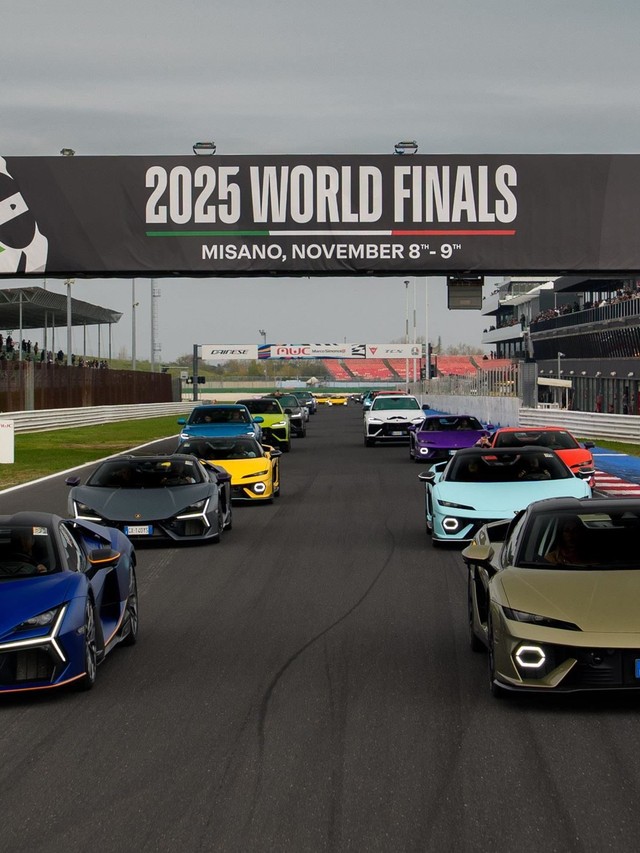
A Season Decided in the Spray at Ricardo Tormo
The fourth Lamborghini World Final came down to eight minutes, a safety car, and a pass in the rain. Dennis Lind, a 23-year-old Dane driving for Raton Racing, overtook race leader Loris Spinelli late in Race 2 at Valencia’s Ricardo Tormo circuit to claim the PRO World Championship for the 2016 Lamborghini Blancpain Super Trofeo season. Spinelli, representing Antonelli Motorsport, had taken pole and led from the start, but Lind’s composure in deteriorating conditions proved decisive. The safety car froze the order with Lind in front, sealing a title won by just two points over Vito Postiglione of Imperiale Racing.
Lind also secured the 2016 European championship, making his debut season in the one-make Huracán Super Trofeo series a clean sweep of the two most important titles Lamborghini Squadra Corse offers at this level. Race 1 went to Postiglione, with Lind finishing second, so the championship hinged entirely on the final race in conditions that punished hesitation and rewarded calculated aggression. For a driver competing in his first full season of the series, the margin of victory told the story: close enough to be dramatic, decisive enough to be earned.
Race 2’s downpour reshaped the entire field across every class. Visibility dropped to near-zero at points, and the wet surface at Ricardo Tormo, a circuit originally designed for motorcycle racing, offered limited drainage. The conditions turned what could have been a processional finale into a genuine survival exercise, and the results across every category reflected it.
What Lind’s Title Signals for Lamborghini’s Young Drivers Program
Lind’s championship carried weight beyond the trophy because of what it validated. Lamborghini says he competed as a member of the Young Drivers Program run by Squadra Corse, the company’s motorsport division. The program exists to identify and develop professional racing talent within Lamborghini’s own ecosystem, feeding drivers upward through the brand’s expanding competition ladder.
The one-make format is central to why the result matters. Every driver in the Blancpain Super Trofeo races the same Huracán Super Trofeo. The car is equalized. Budget advantages in chassis development or aerodynamic trickery are effectively neutralized. When a driver wins this series, the result reflects racecraft, tire management, and the ability to extract pace from identical machinery. For a talent identification program, that purity of signal is the entire point.
The Super Trofeo series functions as Lamborghini’s answer to programs like Ferrari Challenge and Porsche’s various one-make cups. Each manufacturer uses these championships to build brand loyalty among wealthy amateur racers while simultaneously scouting professional talent. Lamborghini’s version, backed by the Blancpain title sponsorship, ran three continental series in 2016 (Europe, Asia, and North America) plus a Middle East series, all feeding into the World Final. The 2016 season set a record of 50 cars on the grid at the Spa-Francorchamps round, suggesting the series was gaining commercial traction at exactly the right moment for Squadra Corse’s ambitions.
Lind’s trajectory from Young Drivers Program member to double champion in a single season represented the kind of outcome Lamborghini could point to as proof that the investment in customer racing infrastructure was producing real competitive returns, not just hospitality weekends with track time attached.
Class Champions and the Depth of the Grid
The PRO title grabbed the headlines, but the supporting classes told their own stories about the breadth of the Super Trofeo’s appeal. Andrea Fontana and Lorenzo Veglia, driving together for Antonelli Motorsport, claimed the PRO-AM world championship. Their path was anything but smooth. A difficult start to the weekend gave way to a second-place finish in Race 1, and then a Race 2 victory in the rain secured the title.
“Today’s race, under the rain, was really tough, but in the end, both Andrea Fontana and I handled it in the best way,” Veglia noted after the final.
Adrian Amstutz of Bonaldi Motorsport delivered a dominant performance in the AM class, winning both World Final races to add the world championship to the European PRO-AM title he had already clinched alongside co-driver Patrick Kujala. His Race 2 was a miniature epic: Amstutz dropped three positions in the rain, slipped to fifth, then fought back through the field to retake the lead in the closing stages. Behind him, Nouri Shahin of Leipert Motorsport barely edged past Shota Abkhazava of Artline Team Georgia on the final lap for second, after Abkhazava had led convincingly during the opening stint.
Ross Chouest of DXDT Racing completed a perfect weekend in the Lamborghini Cup, winning both races to claim the world championship. The American finished ahead of Tim Richards and Supachai Weeraborwornpong in the final classification.
| Class | World Champion | Team |
|---|---|---|
| PRO | Dennis Lind | Raton Racing |
| PRO-AM | Andrea Fontana / Lorenzo Veglia | Antonelli Motorsport |
| AM | Adrian Amstutz | Bonaldi Motorsport |
| Lamborghini Cup | Ross Chouest | DXDT Racing |
Dovizioso in the Rain: A MotoGP Star Validates the Series
The most talked-about participant at Valencia was not a full-season competitor. Andrea Dovizioso, Ducati’s factory MotoGP rider, entered the Blancpain Super Trofeo as a guest driver and produced results that went well beyond a celebrity cameo. Dovizioso finished second in the PRO-AM class in Race 2 of the World Final, his second podium of the weekend after winning the PRO-AM class in the European series final round on Friday.
The conditions in Race 2 played directly to the kind of adaptability a MotoGP rider develops over years of managing traction on two wheels. Dovizioso acknowledged the difficulty openly.
“It was a crazy race because it took place under a pouring rain which was a further new experience for me. Handling the situation wasn’t easy, especially at the beginning, because the visibility was very poor. I tried not to take too many risks and this paid off in the end.”
Beyond the obvious publicity value, Dovizioso’s performance said something about the Huracán Super Trofeo itself. A driver with limited four-wheel racing experience could climb into the car, adapt to its behavior in the worst possible conditions, and finish on the podium against drivers who had raced the platform all season. That speaks to the car’s predictability and the accessibility of its limits, qualities that matter enormously in a customer racing series where the driver roster ranges from professional aspirants to wealthy amateurs learning racecraft for the first time.
For Lamborghini, the Dovizioso storyline generated mainstream sports coverage that a PRO-class result alone would not have attracted, reinforcing the narrative that the Huracán Super Trofeo is a serious racing tool rather than a track-day toy dressed in competition livery.
The Super Trofeo’s Place in Lamborghini’s Motorsport Architecture
Viewed from the vantage point of where Squadra Corse stands today, the 2016 World Final reads as an early chapter in a much larger strategic arc. The Super Trofeo series served, and continues to serve, as the entry point of Lamborghini’s competition ladder. Drivers prove themselves in the one-make championship, develop relationships with the brand’s racing infrastructure, and potentially move into GT3 competition.
The Huracán Super Trofeo that Lind, Dovizioso, and the rest of the 2016 field raced was the backbone of this system for nearly a decade. According to Autoblog, the Temerario GT3 debuted at the 2025 Goodwood Festival of Speed as Lamborghini’s first competition car fully designed, developed, and built in-house, a significant escalation of Squadra Corse’s capabilities compared to the outsourced development models of earlier GT programs. CarBuzz reports that a Temerario Super Trofeo is expected to replace the Huracán in the one-make series from 2027, completing the generational handover.
That transition will ask teams and drivers who built their programs around the Huracán’s naturally aspirated V10 characteristics to adapt to an entirely new powertrain philosophy. The Temerario’s twin-turbo V8 hybrid architecture represents a fundamental shift in how the car delivers power and how drivers manage it in wheel-to-wheel combat. For the Super Trofeo series, which depends on equalized machinery and driver skill as the primary variable, the calibration of the new car will be critical.
The pipeline that the 2016 season helped establish, from regional series through the World Final and upward into GT3 and potentially beyond, remains the structural logic of Lamborghini’s customer racing operation. Fifty cars at Spa in 2016 was a record worth celebrating. The ambition now is to make Lamborghini a permanent, credible force in international GT racing, not just a provider of entertaining one-make support races.
What the 2016 Finale Meant for the Brand
The 2017 World Final was announced for Imola, signaling Lamborghini’s intent to keep the series on prestigious European circuits that carry genuine motorsport heritage. The choice of venue matters in customer racing: the clients writing the checks to compete care about where they race almost as much as what they race.
For those evaluating Lamborghini’s motorsport credibility against Ferrari’s and Porsche’s well-established programs, the 2016 season provides a useful reference point. The grid depth was growing, the racing was competitive enough to attract a MotoGP star and produce genuine drama, and the Young Drivers Program was delivering tangible results. Lind’s championship, won on pace in the rain rather than on strategy or attrition, was precisely the kind of outcome that gives a manufacturer’s racing program legitimacy.
The Huracán Super Trofeo proved at Valencia that it could produce close, unpredictable racing in mixed conditions across multiple skill levels. That quality, more than any single result, is what made the platform viable for nearly a decade and set the standard the incoming Temerario will need to match.


