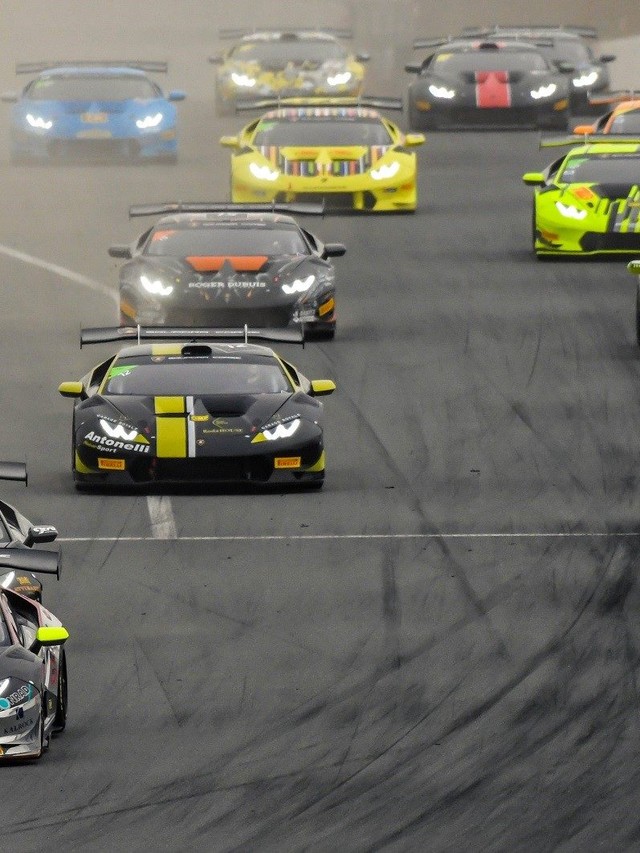
Sepang 2017: A Brand Event Disguised as a Race Weekend
When Lamborghini kicked off its sixth consecutive Super Trofeo Asia season at Malaysia’s Sepang International Circuit on April 8, 2017, the weekend was never really about the 50-minute sprint races alone. It was about who was watching, and what they were being shown. The Sepang round marked the ninth time the series visited the Hermann Tilke-designed, 5.54-kilometer circuit, a venue that also hosts Formula 1 and MotoGP. The track hosted the Super Trofeo’s Asian debut in 2012 and the 2014 World Final, making it the closest thing the series owns to a spiritual home in the region.
The concurrent running of the Blancpain GT Series Asia at the same venue sharpened the commercial logic. Lamborghini fielded Huracán GT3 cars alongside the Super Trofeo grid, stacking two racing programs on one weekend, at one track, in front of one VIP audience. Owners and prospective buyers could see the full spectrum of Lamborghini’s customer racing ecosystem in a single visit, from the entry-level Lamborghini Cup class to the GT3 tier. That density of brand exposure is not accidental. It is the thesis of the entire operation: motorsport as a loyalty engine, with the checkered flag as a supporting character.
Motorsport as Lifestyle: The Hospitality Play Behind the Grid
Lamborghini says it provided premier hospitality and fine Italian dining for VIP guests at every stop of the 2017 Super Trofeo Asia series. The specifics remain undisclosed in official material, but the strategic logic is transparent. For a manufacturer whose road cars start well north of $200,000, the Super Trofeo paddock functions as a controlled environment where owners engage with the brand on terms a showroom visit cannot replicate. Pit walks, grid access, and shared meals with team principals and factory representatives build the kind of personal loyalty that advertising budgets struggle to buy.
This is the part of Lamborghini’s motorsport investment that rarely gets analyzed. The racing validates the Huracán platform. The hospitality converts that validation into emotional attachment. An owner who watches a 620-horsepower Huracán Super Trofeo car scream past the Sepang grandstand, then sits down to dinner with the people who built it, is far less likely to cross-shop a McLaren or a Ferrari when the next purchase decision arrives. The series’ entry costs for competitors remain unpublished, but the investment in hospitality infrastructure around each round suggests the company views the VIP program as equal in strategic importance to the racing results themselves.
The Huracán Super Trofeo: Road Car DNA Under a Roll Cage
The 2017 Huracán Super Trofeo carried over unchanged from the previous season, a sign of how mature the platform had become. The car uses the same naturally aspirated 5.2-liter V10 found in the road-going Huracán, managed by a Motec M182 control unit that also handles data logging, gear changes, and traction control. Lamborghini says the engine produces 620 horsepower. The frame retains the hybrid carbon-fiber and aluminum construction from the road car, housing the radiator at the front and a six-speed sequential racing gearbox at the rear.
One source claims the Super Trofeo variant sheds roughly 550 pounds compared to the production Huracán, achieved through extensive carbon fiber bodywork developed with Dallara Engineering and a lightweight roll cage that adds just 43 kilograms while improving torsional stiffness by 45 percent over the previous Gallardo-based car. The rear wing offers ten different settings, and Öhlins TTX 36 dampers handle suspension duties. Brembo steel discs replace the road car’s optional carbon-ceramics, a concession to the economics of customer racing where brake replacements are a routine operating cost.
The engineering philosophy matters more than the spec sheet. Lamborghini deliberately kept the Super Trofeo mechanically close to the road car so that track performance could be credibly linked to the showroom product. The engine is the same block. The chassis is the same architecture. The difference is weight reduction, a Motec brain, and a roll cage. That proximity is the entire commercial point, and it is what makes the hospitality tent so effective: the car on track and the car in the owner’s garage share real DNA, not just a badge.
Drivers, Teams, and the Multi-Class Grid
The 2017 Sepang grid reflected the international diversity Lamborghini actively cultivates. Former Super Trofeo champion and Malaysian favorite Afiq Yazid returned with Clazzio Racing. Sri Lanka’s Dilantha Malagamuwa brought veteran experience. Indonesian AM driver Andrew Haryanto represented the gentleman-driver contingent that forms the commercial backbone of any customer racing series.
Cross-pollination from other Super Trofeo regions added depth. Gabriele Murroni, winner of the Middle East Lamborghini Cup class, and Rik Breukers, a Young Drivers Program graduate who won the Middle East Pro class, both entered the Asia series. European teams Leipert Motorsport, FFF Racing Team, and Team Lazarus also fielded entries. This kind of inter-regional movement is precisely what Lamborghini designed the Super Trofeo’s global structure to encourage: drivers build reputations in one region, then test themselves against unfamiliar competition in another, with the World Final at season’s end serving as the convergence point.
The championship’s class structure, with separate podiums for Overall, Pro-AM, AM, and Lamborghini Cup competitors, keeps the series commercially viable. The Lamborghini Cup class, specifically designed for rookies and new drivers, lowers the barrier to entry. A wealthy enthusiast with limited racing experience can compete meaningfully against peers of similar skill rather than being lapped by professionals. That accessibility fills the grid, which fills the hospitality suites, which sells the next generation of road cars. Every layer of the program feeds the one above it.
The 2017 Calendar: Six Weekends, Five Countries, One World Final
The 2017 Super Trofeo Asia season comprised 12 rounds across six race weekends, each planted in a key luxury-car market. Following Sepang, the calendar moved to Thailand’s Buriram International Circuit, then Japan’s Suzuka Circuit and Fuji International Speedway, followed by Shanghai International Circuit in China. The season’s final two rounds relocated to Italy’s Imola circuit, near Lamborghini’s Sant’Agata Bolognese headquarters, where the Asia, Europe, and North American series converged for the World Final.
| Round | Circuit | Country | Date |
|---|---|---|---|
| 1-2 | Sepang | Malaysia | April 8-9 |
| 3-4 | Buriram | Thailand | May 20-21 |
| 5-6 | Suzuka | Japan | June 24-25 |
| 7-8 | Fuji | Japan | August 19-20 |
| 9-10 | Shanghai | China | September 23-24 |
| 11-12 | Imola (World Final) | Italy | November 16-19 |
The geographic spread is deliberate. The Italian finale pulls competitors and their entourages to Lamborghini’s home territory, closing the loop between the Asian markets where cars are sold and the factory where they are born. For context, the 2026 Super Trofeo Asia calendar, according to multiple recent reports, maintains a similar six-round structure and still opens at Sepang, suggesting the template Lamborghini established by 2017 proved durable enough to survive nearly a decade of refinement.
The Playbook That Outlasted the Car
Single-make racing series exist across the supercar industry. Ferrari Challenge runs a well-established program. Porsche operates multiple one-make cups worldwide. Both are serious series with deep histories. Where Lamborghini differentiates is in the explicit commercial architecture surrounding the racing itself, treating the paddock as a customer-retention tool with the same attention it gives to lap times.
The Huracán Super Trofeo, first revealed in 2014, served as the backbone of this program for years before the EVO update arrived. By 2017, the car’s mechanical stability (unchanged from the prior season, per Lamborghini) meant teams could focus on driver development and race craft rather than chasing setup changes from a new-spec car. That consistency benefited gentleman drivers and rookies especially, reducing the cost and complexity of competition.
For anyone following Lamborghini’s motorsport trajectory today, the 2017 Super Trofeo Asia season represents a mature middle chapter. The series had found its operational rhythm, the Huracán platform was proven, and the commercial model of blending racing with lifestyle hospitality was fully operational. The Temerario GT3, now confirmed as Lamborghini’s first fully in-house competition car, will eventually inherit the customer-racing mission. But the playbook it will follow, from the class structures to the VIP dinners to the World Final convergence, was already running smoothly at Sepang in April 2017.
Gallery


