Two Cars, Two Stages of Rebirth, and a Brand-New Event
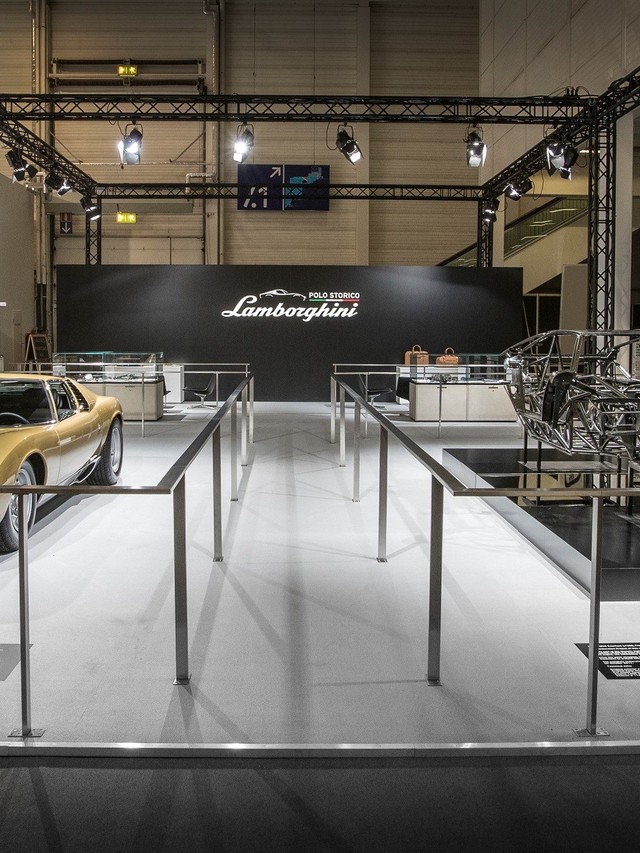
Lamborghini Polo Storico brought a compelling visual argument to Techno Classica in Essen this April: a Miura P400 SV gleaming in factory-correct Oro Metallizzato, parked beside the stripped tubular chassis of a Countach LP400 “Periscopio” still deep in a restoration that will consume 11 months. One car finished, one barely started. The pairing was deliberate, a before-and-after that lets onlookers grasp the scale of what factory restoration actually involves.
The stand, though, was only half the story. Alongside the two cars, Lamborghini confirmed its inaugural “Lamborghini and Design: Concorso d’Eleganza,” a brand-exclusive concours event scheduled for September 15 to 17, 2017, in La Chaux de Fonds, Switzerland. The location pays homage to Le Corbusier, the modernist architect born there, and the event will be reserved entirely for Lamborghini models. Together, the restorations and the concorso reveal something more calculated than a heritage department burnishing its reputation at a classic car fair. Lamborghini is assembling an ecosystem around classic ownership in which the factory controls the restoration pipeline, the certification paperwork, and now the stage on which these cars are judged.
Why a Lamborghini-Only Concorso Changes the Equation for Owners
Multi-marque concours events like Villa d’Este are prestigious, but a Lamborghini entered there competes against Bugattis, Alfa Romeos, and prewar Delahayes for the attention of judges and spectators. A dedicated Lamborghini concorso flips that dynamic. Every car on the lawn shares the same DNA, so judging can focus on the nuances that matter to actual Lamborghini collectors: the correctness of a Miura’s eyelash vents, the exact shade of a Countach’s Giallo, the provenance chain documented in Polo Storico’s archives.
Enrico Maffeo, Head of Lamborghini Polo Storico, positioned the event as a permanent fixture rather than a one-off experiment. The choice of La Chaux de Fonds, a UNESCO World Heritage site celebrated for its watchmaking and architectural pedigree, signals that Lamborghini wants to associate its design legacy with broader creative disciplines, not just motorsport or horsepower. For collectors who invest six figures in a factory restoration, a curated venue to display the result and have it judged by people who understand the marque adds tangible value to the ownership experience.
The practical implication is worth spelling out. A Polo Storico restoration yields certification. That certification strengthens an entry at the brand’s own concorso. Success at the concorso reinforces the car’s documented history and, by extension, its market standing. Lamborghini is constructing a closed circuit of authenticity and prestige that independent restorers simply cannot replicate.
Inside the Miura SV: What 2,000 Hours of Factory Work Actually Means
Chassis #5030, the Miura P400 SV on display, marks only the second complete restoration of an SV model by Polo Storico. Lamborghini says the project consumed over 2,000 hours across body, engine, and interior work, using original Lamborghini spare parts throughout.
Work began with a complete strip of the chassis and body, followed by cataphoresis treatment to arrest corrosion at a molecular level. Cataphoresis is an electrochemical immersion process that bonds an anti-corrosion coating to bare metal far more uniformly than traditional primer. It is standard practice in modern automotive manufacturing but rarely applied to vintage restorations because it requires full disassembly and access to industrial-scale equipment. That Polo Storico uses it routinely speaks to the advantage of operating within an active car factory rather than a standalone workshop.
The paint was mixed to the exact original Oro Metallizzato formula, sourced from Polo Storico’s archives. Black leather for the interior was processed and selected to match the factory’s original tanning and preparation methods. Every mechanical component, including the 3.9-liter V12, was fully reconditioned to SV specification. The result is not a restomod or a sympathetic refresh; it is a car returned to the condition in which it left Sant’Agata Bolognese, verified by the people who hold the original production records.
Multiple ownership reports across enthusiast forums describe Polo Storico restorations as philosophically distinct from independent work: the department prioritizes factory-correct authenticity over cosmetic perfection, meaning a car will be restored to how it was built, including any period-correct manufacturing tolerances, rather than polished to a standard the original production line never achieved.
The Countach LP400 Periscopio: Restoring Lamborghini’s Most Radical Silhouette
The second car on the stand, chassis #1120204, is a 1976 Countach LP400 “Periscopio” currently mid-restoration. The “Periscopio” designation refers to the earliest LP400 production cars, which featured a distinctive periscope-style rear-view mirror channel integrated into the roofline. Later Countach variants replaced this with conventional side mirrors, making the Periscopio the purest expression of Marcello Gandini’s original design intent.
Lamborghini says the expected timeline for this restoration is 11 months. The engine, mechanical components, and electrical systems are all undergoing a full overhaul, while the interior will be refurbished in tobacco-colored leather replicating the original specification. Displaying the bare chassis at Techno Classica was a smart curatorial choice: visitors could see the intricate tubular steel frame that underpins Gandini’s wedge, along with the complex geometry of the scissor-door hinges engineered by Paolo Stanzani. Those doors required their own careful disassembly before cataphoresis treatment and repainting in the original Giallo.
For collectors, the Periscopio LP400 occupies a particular position in the market. It is the first and most desirable variant of a car that defined supercar aesthetics for two decades, and correct, documented examples command significant premiums. A factory restoration with full Polo Storico certification reinforces that provenance in a way no independent shop’s paperwork can match, which circles back to the ecosystem Lamborghini is quietly building around its classics.
Factory Certification and the Classic Lamborghini Market
Polo Storico’s certification program operates under a “Comitato dei Saggi” (Experts Committee) that verifies the originality of individual vehicles against the department’s archive of production files, technical drawings, and original sketches. The certification document confirms a car’s specification as it left the factory, and any subsequent changes are noted. For buyers at auction or in private sales, this document functions as the closest thing to an official factory guarantee of authenticity.
Lamborghini has not publicly disclosed the cost of a full Polo Storico restoration. Available reporting suggests figures in the range of €300,000, which can approach the price of a new production Lamborghini. That is a substantial investment, but it needs to be weighed against what it protects. A Miura SV or early Countach LP400 with factory certification and a documented Polo Storico restoration history carries a provenance story that follows the car through every future transaction. In a market where the difference between a correctly restored example and a questionable one can represent hundreds of thousands of dollars at auction, the certification becomes a form of insurance.
The competitive context matters here as well. Ferrari established its Classiche program years earlier and now offers a well-known “Red Book” certification. Porsche Classic operates its own parts manufacturing and restoration services from dedicated facilities. Lamborghini’s Polo Storico, established in 2015, is the youngest of these programs, but the addition of a dedicated concorso gives it something neither Ferrari nor Porsche currently offers in quite the same format: a factory-organized competitive stage exclusively for the marque’s own classics. Whether that exclusivity translates into measurable market-value premiums for certified cars remains to be seen, but the intent is unmistakable.
What Polo Storico’s Expanding Ambitions Mean for Classic Lamborghini Collectors
Lamborghini’s heritage department covers models from the 350 GT through the Diablo, with future classics like the Murcielago expected to enter the program eventually. For current owners of cars in that window, the calculus is straightforward: factory engagement is expanding, not contracting. More events, more certification activity, and more visibility for correctly restored examples all work in favor of cars that carry Polo Storico documentation.
For prospective buyers considering a classic Lamborghini purchase, the question to ask any seller is becoming increasingly specific. A car restored by a respected independent specialist may be mechanically excellent, but it will lack the factory paper trail that Polo Storico provides. As the concorso program matures and Polo Storico’s archive becomes the definitive reference for judging authenticity, the gap between factory-certified and uncertified examples could widen.
Lamborghini has not disclosed entry criteria for the “Lamborghini and Design” concorso beyond confirming it is reserved for Lamborghini models. The September 2017 event in Switzerland will be the first test of whether the format resonates with the collector community. If it does, Polo Storico will control not just the restoration and certification of classic Lamborghinis, but the most prestigious venue for displaying them. For a department that only began operations two years ago, that is a remarkably complete ecosystem.
Gallery


