Twenty-Three Drivers, One Proving Ground: The 2017 GT3 Junior Program
In April 2017, Lamborghini Squadra Corse selected 23 young drivers for the third edition of its GT3 Junior Program, expanding the roster by three over the previous year. The intake spanned 11 nationalities and fed into 13 GT championships worldwide, from Blancpain GT to IMSA WeatherTech. Every one of those drivers would race behind the wheel of the Huracán GT3, fielded by customer teams rather than a factory operation.
The expansion tracked a concrete reality: the Huracán GT3’s rapid proliferation on global grids. Lamborghini says the car went from just two units competing in 2015 to over 50 in 2017. That kind of growth in customer racing creates a practical problem. You need drivers who can represent the brand credibly, deliver technical feedback to engineers, and win races that validate the platform. The GT3 Junior Program was Squadra Corse’s answer to all three.
New members for 2017 climbed directly from the Super Trofeo one-make series, which served as the entry ramp. Dennis Lind, the 2016 European and World Super Trofeo PRO champion from Denmark, stepped up. So did Andrea Fontana, the 20-year-old Italian who took the Pro-Am world title. Martin Kodric, a 19-year-old Croatian who impressed during the Super Trofeo season, joined them. The pathway was deliberate: prove yourself in Lamborghini’s own championship, then graduate to the broader GT3 arena with Squadra Corse’s backing and oversight.

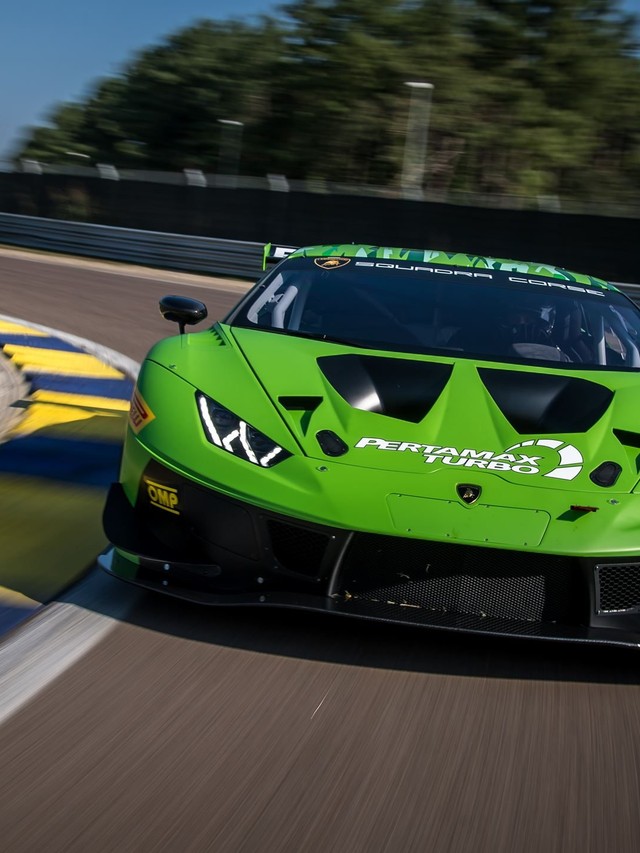
The green Lamborghini Huracan GT3 race car navigates a turn on the track with speed and precision.
Beyond the Cockpit: Building Brand Ambassadors, Not Just Racers
Racing fast was the minimum requirement. What separated this program from a simple talent search was everything Lamborghini expected these drivers to become once they climbed out of the car.
The training covered product range knowledge, teaching techniques, behavioral conduct, physical and dietary preparation, and communication skills. Squadra Corse wanted drivers who could lead a Lamborghini Accademia driving school event the week after a GT3 race, coaching wealthy owners through the finer points of a Huracán’s limits at circuits around the world. The most suitable candidates were selected to work as Accademia instructors, giving them income, brand visibility, and a professional role that extended their value well beyond race weekends.
This dual-purpose model deserves attention. Most manufacturer junior programs focus exclusively on lap times and race craft. Lamborghini was training its juniors to be the human interface between the brand and its most engaged customers. An Accademia instructor who also races GT3 carries a credibility that a hired driving coach simply cannot replicate. For the drivers, it meant a more stable professional footing; for Lamborghini, it meant ambassadors who understood the entire product ecosystem, from road car dynamics to race car development.
Raffaele Giammaria, an experienced Italian driver and ACI Sport Federal School Director, was appointed in 2017 as the new on-field supervisor for both the Young Drivers Program and the GT3 Junior Program. His role was to monitor performance continuously and provide structured tools for professional improvement, adding a layer of formal coaching infrastructure that the program’s earlier editions lacked.
Competitive Proof: Championship Titles Validated the System
Programs like this live or die on results, and the 2017 roster included drivers who had already delivered. In 2016, GT3 Junior Program members Andrea Amici and Edoardo Liberati won the GT Asia Series championship. Fabrizio Crestani captured the International GT Open title. Michele Beretta triumphed in the Blancpain GT Silver Cup. Riccardo Agostini and Alberto Di Folco finished third in the Italian GT Championship, while Madison Snow took a podium in the IMSA WeatherTech SportsCar Championship.
Giorgio Sanna, then Head of Motorsport for Automobili Lamborghini, framed it plainly at the time:
“Winning two international championship titles with Amici, Liberati and Crestani, Super Trofeo drivers and members of the GT3 Junior Program, demonstrates that the young driver program works and provides mutual opportunities both for drivers and our company.”
Those results served a secondary purpose, too. Junior drivers contributed to the technical development of the Huracán Super Trofeo and GT3 platforms, participating in track tests alongside Squadra Corse engineers and Pirelli technicians. A driver who wins a championship and then helps refine the car for the next season creates a feedback loop that benefits the entire customer racing operation. The Huracán GT3 replaced the aging Gallardo FL2, and the pace of its competitive improvement during this period owed something to the structured testing input these junior drivers provided.
From Junior to Factory: How the Program Evolved by 2026
The 2017 program planted seeds that took years to bear their most significant fruit. By 2026, Lamborghini Squadra Corse marked the 13th consecutive year of its Young Driver Programs, and the structure looked considerably more sophisticated than the original format.
The current system operates across three distinct tiers. For 2026, 30 drivers were selected: 17 Super Trofeo Junior Drivers competing in regional championships across Europe, North America, and Asia, and 13 GT3 Junior Drivers piloting the Huracán GT3 EVO2 in series like the Italian GT Championship. Above both sits the Young Professional Driver designation, where top performers receive direct Squadra Corse support in GT3 machinery.
The critical addition is what sits at the very top of the ladder. Maximilian Paul and Mattia Michelotto were promoted from Young Professional ranks to full factory driver status for 2026. That progression, from junior category entrant to contracted factory representative, did not exist as a formal pathway when the 2017 program launched. The infrastructure was aspirational then. Now it produces tangible outcomes.
A new partnership with Formula Medicine, introduced for 2026, added structured physical and mental conditioning to the curriculum. The youngest participant in the current program, 17-year-old Patrik Fraboni, enters a system far more comprehensive than what Dennis Lind or Martin Kodric encountered in 2017. The informal mentoring and ad hoc training sessions of the early editions gave way to a formalized academy with measurable benchmarks and a clear career trajectory. The timing of this maturation is not coincidental: the program now functions as a structured pipeline designed to produce ready-made factory talent for the upcoming Temerario GT3 era.
The Temerario GT3 Connection: Why the Talent Pipeline Matters Now
The Lamborghini Temerario GT3 is slated to succeed the Huracán GT3 Evo 2 as Lamborghini’s factory-backed GT3 entry. According to Car and Driver, the Temerario GT3 represents the first race car fully designed and developed in-house at Lamborghini’s Sant’Agata Bolognese facility. Previous GT3 efforts relied more heavily on external partners for race car development, making this a significant shift in how Squadra Corse operates.
Bringing the engineering in-house makes the driver development pipeline even more strategically important. Factory drivers who grew up within the Squadra Corse system understand Lamborghini’s engineering culture, know the staff, and can provide the kind of nuanced feedback that an outside hire needs months to develop. When the Temerario GT3 begins its competitive life, the drivers at the wheel will ideally be products of the same system that shaped them from their Super Trofeo days onward.
The Huracán Super Trofeo Evo2, which Car and Driver tested at a base price of $360,000, remains the entry point for the one-make ladder. Aspiring drivers buy or lease a seat in the Super Trofeo series, prove themselves against peers in identical machinery, and the best graduate upward. The financial commitment for participants is substantial, and Lamborghini does not publicly disclose the specific support or scholarship details provided to junior drivers. What the company does offer is access: to engineers, to factory resources, to Accademia instruction roles, and now to a documented path toward a factory contract.
For customer teams running Lamborghini GT3 cars, the junior program also provides a practical benefit that rarely gets discussed. Teams gain access to young, motivated drivers who arrive with Squadra Corse endorsement and structured coaching, reducing the risk for team owners who might otherwise gamble on an unknown talent with a checkbook but no development infrastructure behind them.
Competitive Landscape: How Lamborghini’s Approach Compares
Ferrari, Porsche, and Lamborghini each operate driver development programs, but their objectives diverge in revealing ways. The Ferrari Driver Academy, established in 2009, focuses primarily on cultivating talent for a potential path to Formula One. One report describes the FDA’s model as combining theoretical and practical classes aimed at maximizing talent for single-seater progression. Porsche’s Junior Programme similarly channels its best prospects toward factory prototype and GT efforts, though with a stronger emphasis on sportscar endurance racing.
Lamborghini’s program occupies a different niche entirely. Because Squadra Corse does not compete in Formula One, the entire development ladder feeds into GT racing and the broader brand ecosystem. The Accademia instructor pathway, the brand ambassador training, the product knowledge curriculum: these elements reflect a company that views its drivers as multi-functional assets rather than purely competitive ones. A Ferrari FDA graduate who does not reach F1 faces an uncertain future within the Scuderia’s structure. A Lamborghini junior who does not earn a factory GT3 seat can still build a career as an Accademia instructor, a customer team driver, or a brand representative.
Whether that broader approach produces better racing results is debatable. What it clearly produces is loyalty and retention within the Lamborghini ecosystem. Drivers who train as brand ambassadors, who coach owners at Accademia events, who test development cars alongside Squadra Corse engineers, develop a professional identity tied to the raging bull. That kind of institutional knowledge becomes especially valuable during a platform transition, when the Temerario GT3 replaces a car that defined Lamborghini’s customer racing identity for nearly a decade.
The 2017 edition, with its 23 drivers and ambitious dual-purpose training, established the template. Nine years later, the system produces factory drivers. For a company that entered serious customer racing relatively recently, that is a meaningful return on a long investment.


