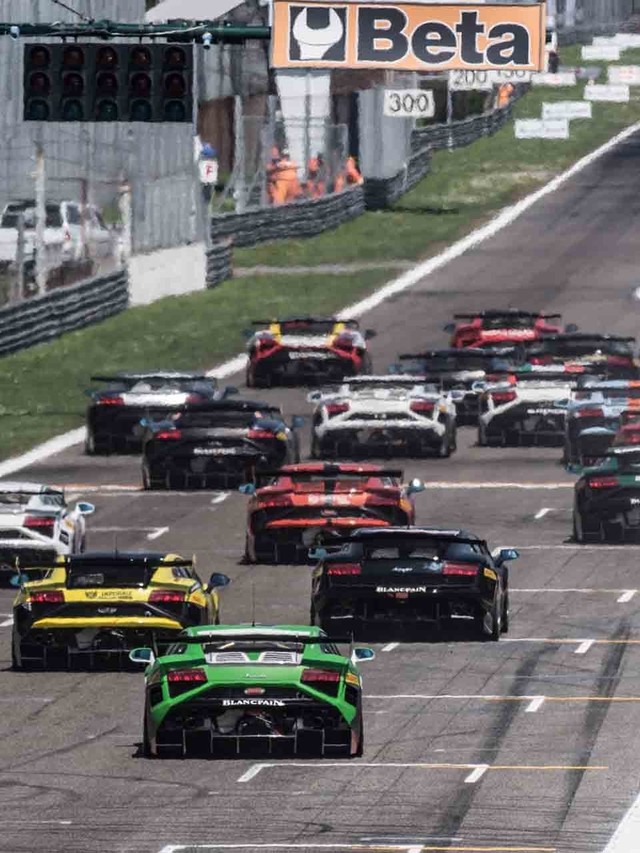
Rain, Rooster Tails, and a Safety Car Start at Suzuka
Suzuka Circuit on June 25, 2017 offered the kind of conditions that make customer racing genuinely dangerous and genuinely revealing. The third round of the Lamborghini Super Trofeo Asia series opened under persistent rain that intensified throughout the afternoon, forcing officials to declare a wet race, mandate rain tires, and start the field behind the safety car. When the green flag finally dropped after two sighting laps, tall rooster tails of spray immediately illustrated how little grip the circuit’s famously technical layout was offering.
This was the second day of a double-header weekend at the Japanese circuit, and conditions were considerably worse than the day before. Temperatures hovered just above 20 degrees Celsius under heavy overcast skies. For a single-make series where every car on the grid runs virtually identical Huracán Super Trofeo machinery, the rain stripped away any remaining equipment advantage and left nothing but driver judgment, car setup, and nerve.
The roster underscored the breadth of Lamborghini’s customer racing ambitions. Former Formula One driver Shinji Nakano lined up alongside accomplished Japanese GT racer Hiroyuki Iiri, while gentleman drivers from across Asia competed in their own classes. That mix of professional pedigree and amateur ambition, all piloting the same rear-wheel-drive platform through standing water, produced exactly the kind of drama that a dry race rarely delivers.
The Race: Cozzolino’s Control and Haryanto’s Charge
Kei Cozzolino in Clazzio Racing’s #11 car seized control from the safety car restart, building a two-second lead over Lazarus driver Toby Sowery by just the fourth lap. Emperor Racing’s Kaneishi Toshihiro slotted into third, trailing Sowery by just over a second. The front of the field was orderly. The back was chaos.
Andrew Haryanto, driving the #69 X-One Racing entry in the AM class, started fifteenth after a qualifying spin had buried him near the tail of the grid. As the rain intensified, Haryanto began dismantling the field. Gabriele Murroni fell first, then Thai AM driver Bobby Suttiluck, then Samson Chan and FFF Racing’s Carrie Schreiner in quick succession. By lap six, Haryanto sat tenth overall, with PRO driver Jack Bartholomew, who also started from the back after qualifying problems, following a similar trajectory just seconds behind him.
The rain punished mistakes ruthlessly. Hiroyuki Iiri, pressuring Rory Collingbourne at the hairpin on lap seven, spun and dropped nine places. Maxx Ebenal lost traction on lap twelve but recovered quickly enough to overtake Takeshi Kimura. Armaan Ebrahim in the #5 car received a stop-and-go penalty on lap eighteen for missing the mandatory minimum pit stop time by fractions of a second, tumbling from seventh to twelfth. Another competitor, Farmer, earned a DNF after a pit stop infringement left him unable to exit the pit lane before the checkered flag.
In conditions like these, the margin between a brilliant recovery drive and a race-ending error can be measured in millimeters of steering input. The Huracán Super Trofeo’s rear-wheel-drive layout, which in dry conditions rewards precision, becomes a genuinely demanding machine when grip disappears. Traction control settings can only compensate so much. The rest comes down to the person behind the wheel.
Podium Results Across All Four Classes
| Class | 1st | 2nd | 3rd |
|---|---|---|---|
| PRO | Afiq Yazid / Cozzolino Kei (Clazzio Racing) | Artur Janosz / Toby Sowery (Lazarus) | Masami Kageyama / Kaneishi Toshihiro (Emperor Racing) |
| PRO-AM | Takeshi Matsumoto / Toshiyuki Ochiai (HoJust Racing) | Carrie Schreiner / Richard Goddard (FFF Racing) | Mikko Eskelinen / Maxx Ebenal (Leipert) |
| AM | Andrew Haryanto (X-One Racing Team) | Takeshi Kimura / Yasuke Hayashi (Car Guy Racing) | George Chou / Samson Chan (Top Speed Racing) |
| Lamborghini Cup | Supachai Weeraborwornpong (Top Speed Racing) | Gabriele Murroni (Petri Corse) | , |
Lamborghini says the final results broke down as follows: Emperor Racing’s PRO class podium came in only their first weekend competing in the 2017 Super Trofeo Asia season, a notable achievement given the conditions. Haryanto’s AM class win, after climbing from fifteenth on the grid, was arguably the drive of the day.
Cozzolino and Afiq Yazid went on to claim the overall PRO championship title later that season, clinching it at Shanghai. Haryanto, whose wet-weather charge at Suzuka was a standout moment, reportedly took the AM championship as well. Suzuka, in other words, was not just a dramatic afternoon. It was a preview of who had the consistency and composure to win titles.
Why a Rear-Wheel-Drive Single-Make Series Still Matters
The Super Trofeo format eliminates the engineering arms race that defines open GT competition. Every team runs the same Huracán Super Trofeo, a car that debuted in 2014 as the successor to the Gallardo Super Trofeo. The differences come down to setup choices, driver talent, and, on days like Suzuka’s second race, the ability to manage a 620-horsepower, rear-wheel-drive platform in conditions where traction barely exists.
That rear-drive layout is the key detail. Lamborghini’s decision to send all power exclusively to the rear wheels in its one-make racer, while the road-going Huracán offered all-wheel drive, created a car that rewards skill disproportionately. In the wet, that philosophy becomes almost punitive. Traction control settings can be adjusted, but the fundamental challenge of managing throttle application through Suzuka’s off-camber corners on a soaked surface is a test that no electronic nanny can fully solve.
This is precisely the point. A customer racing series succeeds when it produces visible, dramatic differences between drivers in identical machinery. Wet races at circuits like Suzuka accomplish that better than almost any other scenario. The gentleman driver who keeps a clean nose and finishes on the lead lap earns genuine respect. The professional who finds time in standing water earns a reputation. Haryanto’s fifteen-to-first charge and Iiri’s hairpin spin happened within minutes of each other, in the same car, on the same tires, on the same track. The only variable was the driver.
The Calendar Ahead and the Road to Imola
Suzuka marked the midpoint of the 2017 Super Trofeo Asia calendar. Three rounds remained: Fuji International Speedway in August, Shanghai International Circuit in September, and the World Final at Italy’s Autodromo di Imola in November. Imola is where the Asia, Europe, and North American Super Trofeo series converge, with regional champions competing for a global podium on Lamborghini’s home turf in the Bologna region.
That convergence functions as the capstone of Lamborghini’s entire customer racing ecosystem, a global funnel that gives regional competitors a shot at international recognition. For gentleman drivers, it represents the highest-profile stage they can reach within the Lamborghini family. For professionals, it offers visibility in front of Squadra Corse decision-makers who control seats in higher-tier programs. A monsoon masterclass at Suzuka, then, is not just a weekend result. It is an audition tape that travels all the way to Sant’Agata.
The practical reality for anyone considering Super Trofeo competition is that the series operates as both a racing championship and a brand engagement platform. Lamborghini does not publicly disclose the full cost of a competitive season, but the buy-in extends well beyond the car itself: travel across multiple countries, engineering support, tire allocations, and the inevitable repair bills that accumulate when rear-wheel-drive race cars meet monsoon conditions at 200 km/h.
From Super Trofeo to Temerario GT3: The Longer Arc
The 2017 Super Trofeo Asia season sits at an interesting point in Lamborghini’s motorsport timeline. The Huracán Super Trofeo was the workhorse of Squadra Corse’s customer programs for nearly a decade, and the lessons learned from running identical rear-wheel-drive race cars across three continents fed directly into Lamborghini’s broader competition strategy.
Reports indicate that the recently unveiled Temerario GT3 represents Lamborghini’s first competition car to be fully designed, developed, and built in-house. According to Autoblog, the Temerario GT3 debuted at the 2025 Goodwood Festival of Speed, marking a significant shift from the outsourced development that characterized earlier GT3 efforts. The operational knowledge accumulated through years of running the Super Trofeo series globally, managing customer teams, understanding tire degradation patterns, and refining race-day logistics, all of that institutional expertise now informs a factory GT3 program built entirely within Sant’Agata.
The connection between a rain-soaked customer race at Suzuka in 2017 and a factory GT3 car unveiled eight years later might seem tenuous. It is not. Every data point from every Super Trofeo weekend, including the traction control calibrations that drivers adjusted before this very race, contributes to the engineering database that Squadra Corse draws upon. Customer racing is where Lamborghini stress-tests its ideas with other people’s money, and the feedback loop between those programs and factory development is shorter than most enthusiasts realize.
For the collectors in the audience, the Huracán Super Trofeo’s place in Lamborghini history is becoming clearer as the platform reaches the end of its competitive life. One report from Autoblog highlights a rare instance of a Huracán Super Trofeo being offered for sale with road-legal title in Michigan, a curiosity that underscores both the car’s desirability and the creative lengths some owners will go to in order to experience it outside a racing context. As the naturally aspirated V10 era fades from Lamborghini’s competition lineup, cars like the Super Trofeo will only become more significant to the brand’s heritage narrative.
Gallery


