Twelve Points, Four Crews, and a Championship on the Line
September 2017. The Lamborghini Super Trofeo Europe arrived at the Nürburgring for its penultimate round with a PRO class championship so compressed that a single bad pit stop could redraw the entire standings. Lamborghini described the situation as “absolutely uncertain,” and the numbers bore it out: the leading four crews were separated by only 12 points, with 64 still available across the remaining rounds.
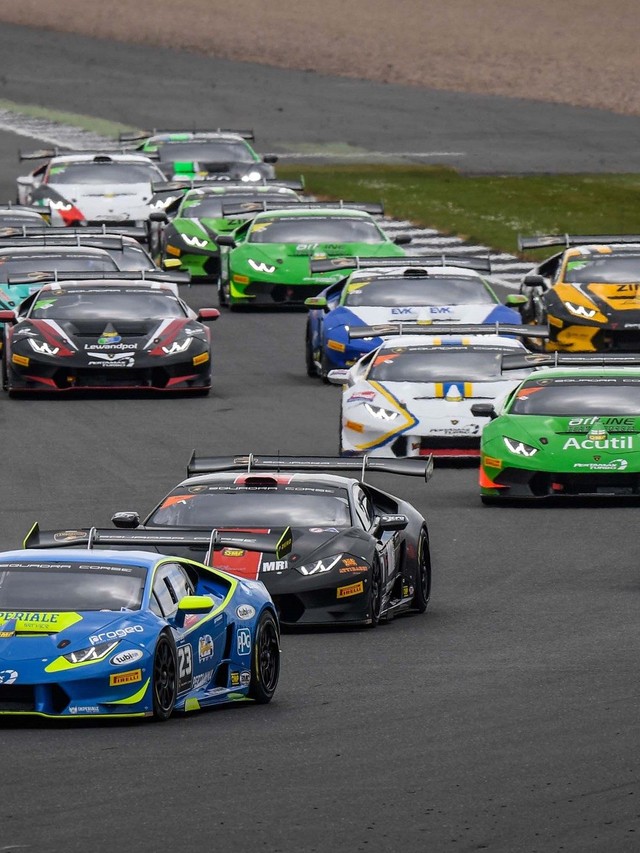
The Nürburgring Grand Prix circuit was the stage. Seventeen teams brought their Huracán Super Trofeo machines to the grid for two 50-minute sprint races across the September 16-17 weekend. For a one-make series built around identical rear-wheel-drive race cars, this was exactly the kind of pressure cooker that rewards driver skill over equipment advantage.
The tightness of the standings was not a fluke. It was the product of a format deliberately engineered to make the human element decisive, and the penultimate round at the Ring laid that philosophy bare.
The PRO Battle: Cecotto, Breukers, Spinelli, and the Art of the Two-Point Gap
Jonathan Cecotto and Vito Postiglione of Imperiale Racing held the PRO class lead heading into the Nürburgring. Cecotto was just eighteen years old at the time, while Postiglione brought years of professional experience. They had taken control of the standings at Silverstone and refused to relinquish it through four subsequent rounds.
Just two points adrift, Rik Breukers and Axcil Jefferies ran under GDL Racing colors, arriving with momentum after their second win of the season at Spa-Francorchamps. Ten points further back, Mikaël Grenier and Loris Spinelli of Antonelli Motorsport matched Cecotto and Postiglione’s victory count at three wins apiece, making them statistically the most dangerous crew despite sitting third in the table.
Raphael Abbate and Yuki Nemoto rounded out the title contenders for VS Racing. Five podium finishes without a win told a story of remarkable consistency, but consistency alone would not close the gap without a breakthrough result. With four races remaining, every crew could still win the championship. That is an unusually rare situation for the penultimate round of any series, and it spoke directly to the quality of competition the Huracán Super Trofeo format was generating.
PRO-AM, AM, and the Lamborghini Cup: Separate Wars, Equal Intensity
The PRO class drama overshadowed equally compelling fights further down the grid. In PRO-AM, Liang Jiatong and Christopher Dreyspring led with 86 points for VS Racing, but Shota Abkhazava and Kelvin Snoeks of Artline Team Georgia trailed by just three points after a dominant Spa weekend. Kikko Galbiati sat third on 79 points, sharing an Antonelli Motorsport entry with Davide Roda. Three points between first and second, seven between first and third: the same compressed pattern that defined the PRO class repeated itself here.
The AM class told a different story. Andrej Lewandowski and Teodor Myszkowski, the Polish pairing with VS Racing, had already wrapped up the title with five victories. Raffaele Giannoni of Automobile Tricolore, 50 points behind, was racing for pride rather than a championship he could no longer reach.
Gerard Van der Horst led the Lamborghini Cup standings for Van der Horst Motorsport, carrying a 16-point cushion over teammate William Van Deyzen. Colombian driver Juan Perez, competing simultaneously in the North American series, was chasing a fourth consecutive Lamborghini Cup victory with Antonelli Motorsport. The multi-class structure meant professional-caliber drivers were threading through traffic of ambitious amateurs and gentleman racers, all in identical machinery, reinforcing the series’ central promise: in a field of equal cars, the driver makes the difference.
New Faces and Homecoming: Debuts, Returns, and a Sole Female Competitor
Getspeed Performance made its Super Trofeo debut, fielding a car for Oliver Engelhardt and Manuel Lauck. For a German team entering at their home circuit, the pressure to perform was immediate and public.
Edoardo Liberati’s return added a different dimension. The 2016 Asian Super Trofeo champion and Asian GT title winner with a Huracán GT3 was stepping back into the European series for a one-off appearance, sharing a Dörr Motorsport entry with Jaap Bartels. His career trajectory illustrated exactly the driver development pathway the Super Trofeo series was designed to create: win in one regional championship, build experience in GT3 machinery, and use guest appearances to stay sharp and visible.
Carrie Schreiner competed as the sole female driver on the grid, racing on her home circuit with Konrad Motorsport. Philipp Wlazik shared a Dörr Motorsport cockpit with Florian Scholze in the AM class, adding to the local contingent. The grid composition reflected the Super Trofeo’s international reach: Venezuelan, Japanese, Georgian, Chinese, Polish, Italian, Dutch, German, and Canadian drivers all competing under the same regulations in identical cars, their differences resolved not by budget or machinery but by talent and preparation.
The Huracán Super Trofeo as a Proving Ground: Why the Format Works
The Lamborghini Super Trofeo series, established in 2009, was built on a deceptively simple premise: give every competitor the same car and let the drivers sort it out. The Huracán Super Trofeo LP 620-2, unveiled in 2014, stripped away the road car’s all-wheel-drive system in favor of rear-wheel drive. That single engineering decision changed everything. A mid-engine supercar with a naturally aspirated V10 producing 620 horsepower demands precise throttle management, especially in the wet or on cold tires. It rewards feel over brute force.
The race format reinforced driver skill as the differentiator. Two 50-minute sprint races per weekend, each with a rolling start and mandatory pit stop for driver changes, compressed the action into a window where every second of pit lane execution carried championship weight. The class structure, spanning PRO, PRO-AM, AM, and Lamborghini Cup, ensured that drivers at every experience level faced meaningful competition within their own category while sharing track with faster or slower traffic.
A 12-point spread across four PRO crews at the penultimate round is not an accident. It reflects a series where machinery is equalized and the human element dominates. In 2017, the Super Trofeo Europe delivered on that promise with unusual precision.
From Huracán to Temerario: How the Super Trofeo Ladder Feeds Lamborghini’s GT Future
The 2017 Nürburgring round matters beyond its own season because it represents a chapter in a longer story about how Lamborghini develops its racing ecosystem. The Super Trofeo series functions as the first rung on a competitive ladder that leads to GT3 and, for the most talented drivers, to factory-supported endurance racing programs.
Liberati’s career arc illustrates this clearly. His progression from Super Trofeo champion to GT3 competitor followed a template that Lamborghini’s Squadra Corse division actively cultivates. The series identifies talent, gives it structured competition in identical machinery, and funnels the best performers into more demanding categories. The tight championship battles of seasons like 2017 are not just entertainment; they are the selection mechanism.
That pipeline remains active and is arguably more important now than it was in 2017. The Temerario GT3, Lamborghini’s first competition car to be entirely designed, developed, and built in-house, represents a fundamental shift in how the company approaches motorsport. The drivers who will race it competitively will need the same skills the Super Trofeo series teaches: car management, racecraft in traffic, and the ability to extract performance from a standardized platform. According to Autoblog, the Temerario GT3 debuted at the 2025 Goodwood Festival of Speed, marking the beginning of a new era for Lamborghini customer racing. When that car eventually replaces the Huracán in the Super Trofeo series, the competitive DNA forged through seasons like 2017 will carry forward.
What the Nürburgring Weekend Meant for the 2017 Title Race
The penultimate round is the last opportunity to build a cushion before the finale, and the last chance for trailing crews to close the gap without relying on a single decisive weekend. At the Nürburgring in 2017, the stakes were amplified because the season finale was not just another round but the World Final at Imola, where European competitors would share the stage with their North American and Asian counterparts.
Lamborghini’s event summary did not include race results, as it was published before the weekend took place. One report indicates that Loris Spinelli and Mikaël Grenier won both races at the Nürburgring, with Race 2 starting behind the safety car due to rain. If accurate, that double victory would have dramatically reshaped the PRO standings heading into Imola, potentially vaulting the Antonelli Motorsport crew from third to the championship lead.
That possibility captures the essence of the 2017 season and the Super Trofeo format at its best. In a one-make championship with this level of parity, a single weekend can rewrite the entire narrative. The investment in seat time, team preparation, and driver development pays dividends not in tenths of a second of car advantage, but in the human capacity to execute under pressure. That remains the series’ most valuable currency, whether the car wears a Huracán badge or, in the years ahead, a Temerario one.
Gallery


