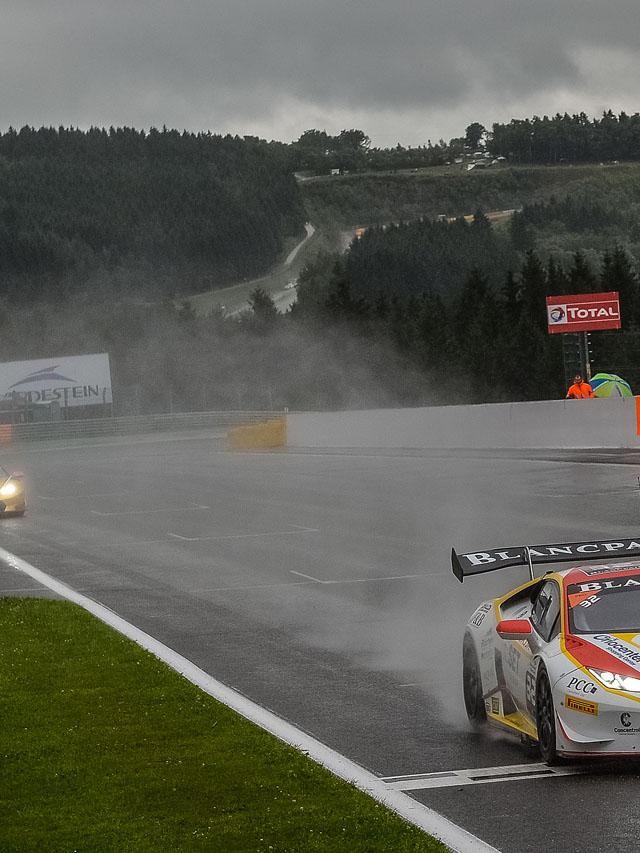
Watkins Glen’s Weather Turned Practice Into a Strategy Exercise
On June 28, 2018, the Lamborghini Super Trofeo North America field arrived at Watkins Glen International for two 40-minute practice sessions ahead of the championship’s third and fourth rounds. What they got was a condensed lesson in risk management. Steady rain soaked the 3.4-mile upstate New York road course for the entirety of the first session, and with a dry, hot forecast for race day, most teams made a calculated choice: stay in the garage.
Only six of the eighteen entered Huracán Super Trofeo Evo machines bothered to set a time in Practice 1. Running in conditions that bore no resemblance to the expected race-day weather meant burning through wet-weather tires, risking bodywork, and gathering data that would be largely irrelevant by Friday afternoon. Corey Lewis, who would go on to top the dry session, put it bluntly: “Practice 1 we elected not to go out, it just wasn’t beneficial for us.”
That kind of pragmatism is easy to overlook in a single-make series where every car rolls off the same Squadra Corse assembly specification. When the hardware is identical, the margins live in setup choices, tire management, and knowing when not to drive. The teams that sat out Practice 1 were not being cautious. They were being strategic.
Who Ran in the Rain, and What They Gained
Damon Ockey, piloting the No. 09 US RaceTronics, Lamborghini Calgary entry, was the fastest of the brave few who ventured out. His best lap of 2:20.883 over ten laps translated to an average speed of roughly 86.9 mph, a number that says more about standing water and limited visibility than about the Huracán Super Trofeo Evo‘s pace.
For Ockey and the handful of drivers who ran, the session offered something the garage-bound teams forfeited: a feel for the circuit’s drainage patterns, curb behavior in the wet, and braking reference points under reduced grip. In a series built on driver skill and team preparation rather than engineering arms races, that sensory data can pay dividends if race day delivers a surprise shower. Whether it was worth the tire wear and the small but real risk of contact with a barrier is the sort of cost-benefit calculation every Super Trofeo team makes differently, and it speaks to the variety of approaches that coexist in Lamborghini’s customer racing paddock.
Dry Running Reveals the Real Pecking Order
The afternoon session delivered conditions far closer to what teams expected for qualifying and racing. As the track dried, lap times tumbled and the competitive picture sharpened considerably.
Corey Lewis, driving the No. 29 Change Racing, Lamborghini Charlotte car, posted the quickest lap of 1:59.146 at an average of 102.7 mph. That 21-second gap between the wet and dry best laps underscores just how dramatically conditions shifted between sessions. Lewis was candid about the improvement: “As the session went it got drier and drier so the times just continued to drop.”
Pro class drivers Trent Hindman and Jonathan Cecotto, sharing the No. 1 Wayne Taylor Racing, Lamborghini Paramus entry, slotted in just behind at 1:59.278. The margin between first and second was a scant 0.132 seconds, a gap that in a single-make series often comes down to a single corner’s worth of confidence or a slightly better line through the Bus Stop chicane. Rounding out the top three, Taylor Proto and Edoardo Piscopo recorded a 2:00.095 in the US RaceTronics, Lamborghini Beverly Hills car.
Lewis’s confidence was palpable afterward. “Our Change Racing, Lamborghini Charlotte car is on point,” he said. “I think we learned a couple things that we can push for qualifying tomorrow.” In a field where tenths separate the front runners, that conviction heading into qualifying carries real weight.

A red and white Lamborghini Huracan Super Trofeo race car navigates the track with an 'I love NY' sign in the background.
What Practice Tells You (and Doesn’t) About Race Day
Practice pace in a one-make series is a peculiar thing. Because every Huracán Super Trofeo Evo runs the same naturally aspirated 5.2-liter V10, the same sequential gearbox, and the same aerodynamic package, the timing sheets reflect driver talent and team preparation more directly than in multi-manufacturer GT racing. A fast practice lap confirms that a driver is comfortable and the setup is in the window. It does not guarantee qualifying position, let alone race results.
Qualifying for both rounds was scheduled for Friday at 9:30 a.m. ET, with Race 1 set for 4 p.m. ET that same day and Race 2 following on Saturday at 10:20 a.m. ET. The compressed schedule meant teams had limited time to iterate on what they learned in Practice 2, so any setup changes needed to be decisive.
The top three in the dry session represented two of the series’ most established operations, US RaceTronics and Change Racing, alongside Wayne Taylor Racing. These were not newcomers stumbling into quick laps. They were professional outfits with deep experience in the Huracán platform, and their presence at the top of the timing sheet reflected accumulated knowledge as much as raw speed. For prospective Super Trofeo participants evaluating which team to align with, practice results like these offer a useful, if imperfect, proxy for operational quality.
Lamborghini’s Customer Racing Machine in 2018
By the summer of 2018, the Super Trofeo North America series was well into its stride as one of the most accessible and professionally managed single-make championships in the supercar world. The Huracán Super Trofeo Evo, with its rear-wheel-drive layout and naturally aspirated V10, rewarded precise driving in a way that made the series genuinely educational for gentlemen drivers while remaining fiercely competitive at the Pro level.
The strict homologation rules that govern the series deserve emphasis. Every car is technically identical, which eliminates the spending wars that can plague open-development GT categories. The playing field is as level as professional motorsport gets, a deliberate choice by Squadra Corse to keep the series attractive to customers who want to race rather than outspend their competitors. Ferrari and Porsche both operate their own single-make series, the Challenge and Carrera Cup programs respectively, but the Super Trofeo’s integration with Lamborghini’s dealer network creates a direct pipeline between the showroom and the paddock. Note the team names: Lamborghini Calgary, Lamborghini Charlotte, Lamborghini Beverly Hills, Lamborghini Paramus. That visibility reinforces brand loyalty in a way few other manufacturers replicate as clearly.
Viewed from the vantage point of Lamborghini’s current motorsport trajectory, the 2018 season sits at an interesting inflection point. The Huracán platform was the backbone of Lamborghini’s customer racing efforts, and the lessons learned through years of running the Super Trofeo series fed directly into the development culture at Squadra Corse. According to Autoblog, the Temerario GT3, revealed at the 2025 Goodwood Festival of Speed, represents Lamborghini’s first competition car fully designed, developed, and built in-house. That capability did not materialize overnight. It grew out of a decade-plus commitment to organized customer racing, the kind of commitment that put eighteen Huracán Super Trofeo Evos on the Watkins Glen entry list on a rainy Thursday in June.
What Happened Next at Watkins Glen
For readers curious about how the weekend unfolded after practice, reporting from the event indicates that Race 2, held on Saturday, June 30, saw Damon Ockey and Jacob Eidson take the overall and Pro class victory in the No. 09 US RaceTronics, Lamborghini Vancouver entry. Ockey’s willingness to run in the wet Practice 1 session may or may not have contributed to that result, but it is a satisfying narrative arc for anyone who watched him circulate alone in the rain while the majority of the field stayed dry.
The 2018 races from Watkins Glen were streamed on IMSA.TV and the official Squadra Corse website, a distribution model Lamborghini maintained throughout the season to keep the series accessible to fans who could not attend in person. For a customer racing program, visibility matters almost as much as competitiveness. Participants want to know their on-track efforts are being seen, and prospective entrants want to evaluate the series before committing.
What the Watkins Glen practice sessions ultimately demonstrated was not a headline-grabbing technological breakthrough or a dramatic on-track incident. It was something more revealing: the depth of strategic thinking that exists within a series often dismissed as a gentleman-driver playground. Twelve teams chose to sit out a wet session because the data would not serve them. Six chose to run because different data might. Both decisions were defensible, and both reflected the informed, professional approach that made the Super Trofeo series worth following and worth entering.


