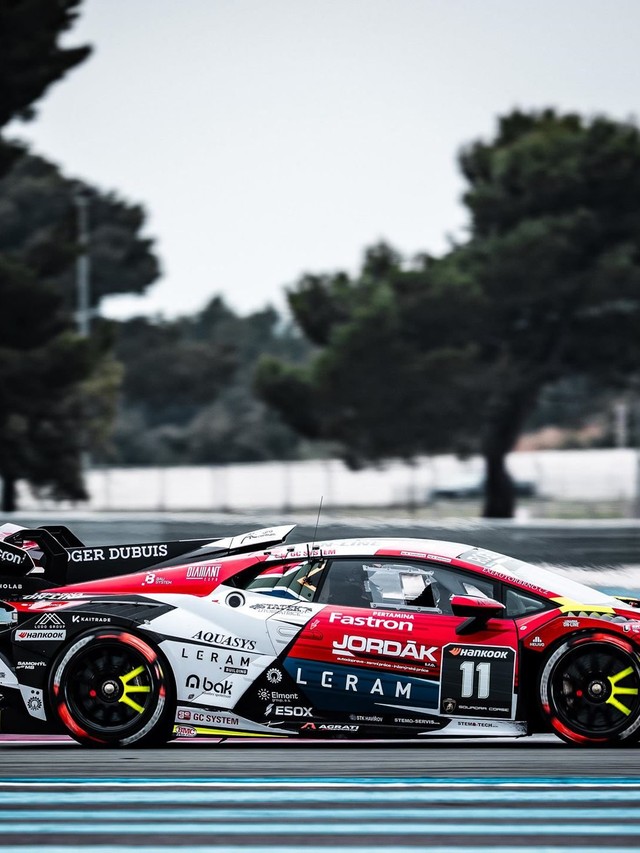
Sixteen V10s, Zero Cautions, and a Finish Line That Lied
Watkins Glen International‘s 3.4-mile, 11-turn circuit hosted the third round of the Lamborghini Super Trofeo North America series on June 30, 2018, and the race ran green from start to finish. Sixteen Huracán Super Trofeo Evos took the flag, with Loris Spinelli leading the field away in the No. 71 P1 Motorsports entry. Spinelli, fresh off a victory at Italy’s Misano World Circuit the previous week, built a gap of more than three seconds over Trent Hindman’s No. 1 Wayne Taylor Racing car through the first seven laps. Edoardo Piscopo held third in the No. 50 US RaceTronics machine.
When the mandatory pit window opened on lap 11, the race’s real story began. Piscopo pitted on lap 15, handing the No. 50 to co-driver Taylor Proto. Spinelli stretched his stint to the limit, pitting a lap later to hand over to JC Perez. The sequence worked in Proto’s favor: the No. 50 emerged ahead and held the lead through the checkered flag. Proto crossed the line first. The trophy, however, went to someone else.
Post-race scrutiny revealed that the No. 50 US RaceTronics team’s pit stop fell short of the mandated minimum time. A 7.5-second penalty was applied, dropping Proto and Piscopo to second overall and handing the win to Perez and Spinelli’s No. 71 P1 Motorsports entry. Hindman and co-driver Jonathan Cecotto completed the overall podium in the No. 1 Wayne Taylor Racing car. And the overall result was not the only one reshaped. Penalties for short pit stops altered the AM class podium as well, making this one of the most penalty-affected races in recent Super Trofeo North America memory.
The Unseen Hand: How Minimum Pit Stop Rules Rewrote the Podium
The Super Trofeo series enforces a mandatory minimum pit stop time during its 50-minute races. In a one-make series where every car runs the same V10-powered Huracán Super Trofeo Evo, the organizers want driver skill and strategy to decide outcomes, not which team can execute the fastest tire-unchanged driver swap. A minimum stop time levels that particular playing field. When a team’s stop falls below the minimum, the shortfall is added back as a post-race time penalty, and the math is unforgiving.
For the No. 50 US RaceTronics entry, the deficit was 7.5 seconds. Proto himself acknowledged the root cause in his post-race comments, pointing to a miscalibrated pit stop timer that released the car too early. In a race decided by margins measured in single-digit seconds, 7.5 seconds is catastrophic.
The AM class suffered the same fate. Brian Thienes in the No. 17 US RaceTronics car crossed the line first but was assessed a 2.1-second penalty for a short stop, handing the class win to Ryan Hardwick in the No. 2 Dream Racing Motorsport entry. Damon Ockey’s No. 09 US RaceTronics car also received a 1.8-second penalty, though he retained third in class. Three separate US RaceTronics entries penalized in a single race amounts to a painful concentration of pit lane errors from one organization.
The range of penalties tells its own story: 7.5 seconds, 2.1 seconds, 1.8 seconds. The system does not apply a flat punishment. It measures the exact shortfall and adds it back. A team that misses the minimum by a fraction pays a fraction; a team that blows past it by several seconds pays accordingly. The precision of the enforcement mirrors the precision the series demands from its participants.
Precision or Peril: Why Super Trofeo’s Rules Cut Deeper Than Most One-Make Series
One-make racing series operated by manufacturers tend to enforce tight regulations, but the Super Trofeo’s approach to pit stop timing represents a particularly sharp edge. In many customer racing formats, a pit stop infraction might result in a drive-through penalty served during the race itself, giving the affected driver a chance to recover on track. The Super Trofeo’s post-race time addition offers no such opportunity. The driver who takes the checkered flag first may not learn of the outcome change until after the celebrations.
That creates a peculiar psychological dynamic. Proto described pushing hard in the second stint to build a buffer, unaware that the buffer he needed was not against the car behind him but against a clock that had already stopped ticking. Hardwick, meanwhile, raced knowing the two cars ahead of him had pitted aggressively. His post-race comments revealed a calculated patience: he closed on Ockey, battled past him, then sat on Thienes’s bumper for the final laps, confident that the penalties would deliver the result the stopwatch owed him.
The Lamborghini Super Trofeo series, established in 2009, now spans three continental championships (Europe, Asia, and North America) culminating in a World Final. The North American leg, running since 2013, visits circuits including Watkins Glen, Sebring, Laguna Seca, and Road America. Across all three continental series, the regulatory framework is standardized. A pit stop infraction at Watkins Glen carries the same consequence as one at Monza or Sepang. For gentleman drivers who compete across multiple rounds, or who aspire to the World Final, understanding these rules is not optional knowledge. It is the difference between a trophy and a time sheet that tells a different story than the one they experienced from the cockpit.
Squadra Corse runs the Super Trofeo as a proving ground, not a parade. The series is meant to be the entry point for drivers who may eventually move into GT3 or GT4 competition, and the regulatory discipline reflects that ambition.
Driver Reactions: Triumph Built on Someone Else’s Mistake
The post-race quotes from the principals tell a story where the emotional arc refuses to match the timing sheet. JC Perez, who inherited the overall and ProAm victory, was candid about the chaos:
“We made a mistake at the pit stop and lost our lap and five seconds and I didn’t think I would be able to recover from that. I was able to push and fortunately the car in front of me had a penalty and it gave us the lead.”
That Perez described the race as one of the best drives of his career is revealing. The P1 Motorsports team made their own pit stop error, losing time during the driver change, yet still won because a competitor’s error was worse. In Super Trofeo, relative precision matters more than absolute speed.
Proto’s frustration was measured but pointed. He attributed the penalty directly to equipment failure, not human judgment, calling out the miscalibrated timer that released the car prematurely. For a driver who did everything right on track, building pace and managing tires in the second stint, losing the overall win to a mechanical stopwatch error carries a particular sting. He noted that retaining the Pro class lead offered some consolation for the championship points battle.
Hardwick’s reaction was the most tactically interesting. He admitted to a poor start and falling behind during the pit cycle, but he read the race situation correctly. Knowing that the two AM class cars ahead of him had pitted aggressively, he focused on closing the gap rather than forcing overtakes. The strategy paid off when the penalties landed. Racing intelligence, in this case, meant understanding that the real competition was happening in the timing tower, not just on the circuit.
In the LB Cup class, Parris Mullins and co-driver Mark Proto (no relation to Taylor Proto in the No. 50) took the win for US RaceTronics, with Brett Meredith finishing second for GMG Racing and Sheena Monk rounding out the podium for Wayne Taylor Racing. The LB Cup escaped the penalty drama that consumed the upper classes, with the result standing as run.
What Super Trofeo’s Unforgiving Standards Mean for Lamborghini’s Racing Ladder
The Watkins Glen penalties illustrate something broader about Lamborghini’s motorsport philosophy. Every car on the grid runs the same naturally aspirated 5.2-liter V10 in the Huracán Super Trofeo Evo, a race-ready platform built on a hybrid carbon and aluminum frame. With identical machinery, the series compresses the performance window to the point where operational details, pit stop execution, tire management, driver changeover choreography, become the decisive variables.
Squadra Corse positions the Super Trofeo as the first rung on Lamborghini’s customer racing ladder. Drivers who prove themselves here graduate to GT3 and GT4 competition, where the regulatory environment is even more complex and the financial stakes considerably higher. Learning to respect a pit stop timer at Watkins Glen is preparation for the kind of procedural discipline required when racing against Ferraris, Porsches, and Mercedes-AMGs in international GT competition.
What Lamborghini achieves with the Super Trofeo’s strict enforcement is a series where results feel consequential. When a 2.1-second pit stop error can reverse a class victory, every participant understands that the margins are real. For the gentleman drivers who form the backbone of the AM and LB Cup classes, that consequence is part of the appeal. They are not playing at racing. They are racing, with all the procedural rigor that implies.
Looking ahead, Lamborghini’s motorsport trajectory points toward the Temerario GT3, which according to Autoblog represents Lamborghini’s first competition car fully designed, developed, and built in-house. The Super Trofeo series will eventually transition to the Temerario platform as well, meaning the operational lessons being learned and painfully reinforced at circuits like Watkins Glen will carry forward into a new generation of Lamborghini customer racing.
For teams like US RaceTronics, which saw three of its entries penalized in a single race, the takeaway is immediate and practical: invest in pit stop procedure and equipment calibration with the same intensity applied to driver coaching and car setup. In a series where the cars are equal, the stopwatch in pit lane is as important as the one on the timing tower. The teams that internalize that lesson will be the ones standing on the correct side of the podium when the final results are posted.
Gallery


