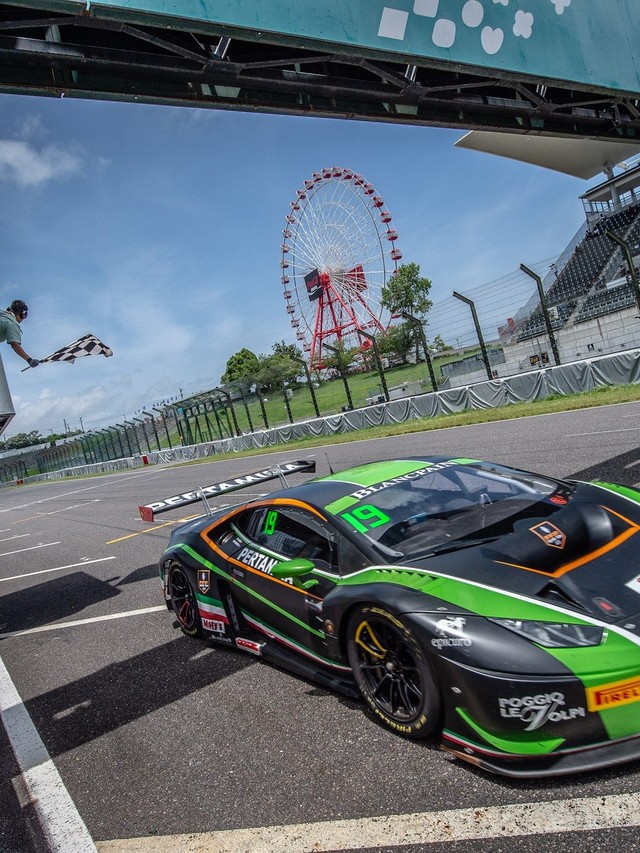
Suzuka, Watkins Glen, Interlagos: The Huracán GT3’s Multi-Continental Sweep
Within a single race weekend in mid-2018, Lamborghini customer teams collected victories or podiums on three different continents, all with the same car. At Suzuka, FFF Racing Team’s Martin Kodric and Dennis Lind took their first win of the Blancpain GT Series Asia season, extending what Lamborghini described as a championship lead already built on three podiums heading into round six. In the United States, Bryan Sellers and Madison Snow brought their Paul Miller Racing Huracán GT3 home third in the GTD class at the Sahlen’s Six Hours of the Glen, collecting their fifth podium of the campaign. And in São Paulo, Marcos Gomez and Chico Longo won the legendary 500 Km de Interlagos for Via Italia Racing, setting the fastest lap in the process.
Any single result would be a decent weekend. All three happening simultaneously told a different story: by mid-2018, the Huracán GT3 was no longer proving itself. It had become the baseline against which rival customer programs were measured.
Squadra Corse’s Real Product: Not the Car, but the Program
The victories matter less than the pattern they reveal. Lamborghini Squadra Corse designed the Huracán GT3 program around a specific bet: that privateer teams scattered across different time zones, running different series under different regulations, could win consistently with factory support delivered at arm’s length. FFF Racing in Asia, Paul Miller in IMSA, Via Italia in Brazil. None of these are factory efforts with unlimited budgets. They are customer operations buying a car, receiving technical support, and competing against well-funded rivals running Ferrari 488 GT3s and Porsche 911 GT3 Rs.
The strategic weight of this approach is easy to underestimate. Ferrari and Porsche both operate robust customer racing programs, and both had deeper motorsport histories when the Huracán GT3 first raced in April 2015. Lamborghini was the newcomer to serious GT3 competition. Winning at Monza on debut, with Grasser Racing Team’s Andrew Palmer, Fabio Babini, and Jeroen Mul, announced the car’s pace. Sustaining that pace across years and continents announced the program’s maturity.
For prospective customer teams evaluating which GT3 car to buy, the 2018 results offered a compelling argument. The Huracán GT3 worked in the humidity of Suzuka, the endurance grind of Watkins Glen, and the high-speed sweeps of Interlagos. Versatility at that level is expensive to engineer and difficult to fake.
The Competitive Ledger: Lamborghini vs. Ferrari and Porsche in Customer GT3
By 2018, the GT3 customer racing segment had become the most commercially significant battleground in sportscar racing. Ferrari’s 488 GT3 and Porsche’s 911 GT3 R dominated grid counts worldwide, and both manufacturers invested heavily in support infrastructure for their privateer teams. Lamborghini entered this fight later and with fewer resources, which made results like these disproportionately valuable for brand positioning.
The Huracán GT3’s naturally aspirated 5.2-liter V10 gave it a character distinct from its turbocharged rivals. Multiple discussions on enthusiast forums describe the car as well-balanced and stable under acceleration, though some note it can be track-dependent and occasionally prone to sharp oversteer off-throttle. The real-world results in 2018 suggest the car’s strengths outweighed its quirks in the hands of capable customer teams.
Paul Miller Racing’s season illustrates the point neatly. The team had already won the 2018 12 Hours of Sebring earlier that year, and the Watkins Glen podium was, according to Lamborghini, their fifth of the campaign. Paul Miller Racing went on to hold the GTD drivers’, teams’, and manufacturers’ championship leads through the end of the 2018 season. That kind of sustained competitiveness from a customer team running against factory-backed Ferrari and Porsche entries validated Squadra Corse’s entire approach.
A Platform That Kept Winning After 2018
What makes the 2018 results worth revisiting is what happened next. The Huracán GT3 EVO arrived in 2019 and won on its global debut, with Grasser Racing defending its 24 Hours of Daytona title. Lamborghini retained its GTD manufacturers’ championship that year. Andrea Caldarelli, Marco Mapelli, and Orange 1 FFF Racing nearly swept all six overall Blancpain GT Series titles. The Huracán then won GTD at Daytona for a third consecutive year in 2020 with Paul Miller Racing.
The platform kept evolving. The Huracán GT3 EVO2 launched in 2023, and the Temerario GT3 is slated as the successor, with an anticipated arrival in the first quarter of 2026. The through-line from those 2018 customer victories to a next-generation GT3 car is direct: Squadra Corse built its credibility one privateer podium at a time, and the Huracán was the tool that made it possible.
For Lamborghini enthusiasts watching the Temerario GT3’s development, the 2018 season is worth remembering as the inflection point. Before it, Lamborghini’s GT3 program was promising. After it, the program was proven. The Temerario GT3 will inherit that expectation, and the customer teams lining up to run it will expect the same global competitiveness that Kodric, Lind, Sellers, Snow, Gomez, and Longo demonstrated across three continents in a single weekend.
Gallery


