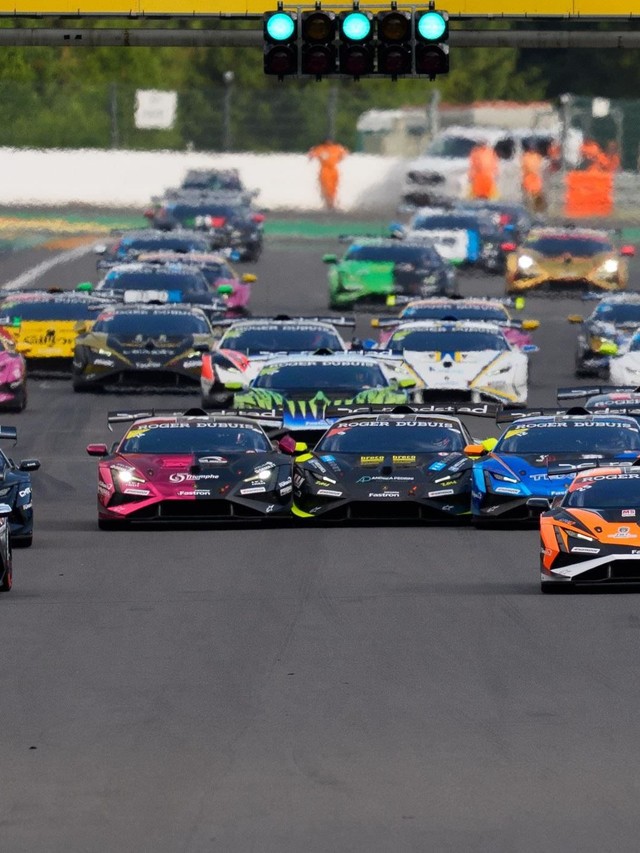
Wayne Taylor Racing Breaks Through at Watkins Glen
Jonathan Cecotto made one of those decisions that separates a good weekend from a forgettable one. Starting from the outside of Row 1 in Round 4 of the 2018 Lamborghini Super Trofeo North America series at Watkins Glen International, the Venezuelan driver threaded his No. 1 Wayne Taylor Racing, Lamborghini Paramus Huracán Super Trofeo around the outside through the circuit’s famous Esses to seize a lead the team would never relinquish across the 50-minute race. Co-driver Trent Hindman brought the car home 4.234 seconds clear of the field, giving the pair their first overall and Pro class victory of the season.
The win followed a second-place overall finish in Friday’s Round 3, and it came at a circuit that rewards commitment above all else. Watkins Glen’s 3.4-mile layout, with its fast, flowing corners and elevation changes, punishes hesitation. Cecotto’s own explanation was characteristically spare: he knew he needed to pass or be passed, so he went for it. Hindman, who took over during the mandatory pit stop with 28 minutes remaining, was rather more expressive, calling the move through the Esses one of the great passes he had seen. That single moment of courage set the tone for a round defined by bold moves and hard-earned recoveries across every class.
The Pass That Decided the Race
Polesitter Shinya Sean Michimi, running the No. 46 PPM, Lamborghini Palm Beach entry, suffered suspension damage after contact in Turn 1, dropping to the back of the field and effectively removing one of the strongest Pro class contenders from the equation. That incident opened a narrow window for Cecotto, who exploited it within seconds.
The Esses at Watkins Glen are not a conventional overtaking zone. The sequence demands precise weight transfer and total confidence in the car’s front-end grip. Attempting to go around the outside of another car there requires a level of trust in the chassis that most drivers never test in race conditions. Cecotto committed, completed the pass, and the gap only grew from that point.
When Hindman climbed aboard for the final stint, the lead was comfortable but not safe. Loris Spinelli, driving the No. 71 P1 Motorsports, Lamborghini Broward car, trimmed the margin to barely over a second. Hindman later admitted to overdriving the tires in the closing laps, a sign of the pressure Spinelli was applying. The gap stabilized only in the final minutes as Hindman managed his rubber and Spinelli’s charge faded. Even a dominant victory, it turned out, required grit to close out.
Ryan Hardwick’s Am Class Comeback at His Favorite Circuit
If Cecotto’s pass was the weekend’s most spectacular moment, Ryan Hardwick’s recovery in the Am class was its grittiest. Hardwick, driving the No. 2 Dream Racing Motorsport, Lamborghini Atlanta car, entered the pits in second place after the class leader came in. What followed was a self-inflicted disaster: he stalled the car in the pit lane and dropped to third.
For a driver competing in the Am class, where the margins between competitors tend to be tighter and mistakes more costly, a pit lane stall can end a race. Hardwick clawed his way back. He caught Brian Thienes of US RaceTronics, Lamborghini Beverly Hills, and pounced when Thienes made an error in the uphill section of the Esses, squeezing past with inches to spare. The same stretch of tarmac that defined Cecotto’s race proved decisive in the Am battle too, rewarding the driver willing to seize the moment.
Lamborghini says the win was Hardwick’s second of the weekend and his fourth career victory at Watkins Glen, a perfect record at the circuit. His own words captured the satisfaction: “That one we had to work for and that one we had to do the old fashion way.” The result stretched his Am class championship lead to seven points over Damon Ockey and nine over Thienes. For a gentleman driver building his record in Lamborghini’s customer racing ladder, Watkins Glen clearly suited his style, a circuit that rewards rhythm and flow over raw aggression.
Pro Am and LB Cup: Consistency Pays and a Newcomer Arrives
The Pro Am class continued to belong to P1 Motorsports. JC Perez and Loris Spinelli claimed their third consecutive class win, outlasting the No. 47 PPM, Lamborghini Palm Beach entry of Pippa Mann and Patrick Liddy. Perez acknowledged the car was difficult, describing tire problems that compromised braking and turn-in, but the team managed the issues well enough to secure a second-place overall finish alongside their class victory. That result pushed their Pro Am points lead to seven over Liddy. Their ability to extract results from a compromised car echoed the broader theme of the weekend: at Watkins Glen, persistence mattered as much as outright speed.
The LB Cup produced a genuinely satisfying storyline. Brett Meredith, driving the No. 66 GMG Racing, Lamborghini Newport Beach car, won his first race in the class. In his debut weekend, he started on pole Friday, finished second, then converted Saturday’s pole into a maiden victory. Meredith was candid about making mistakes, but the result demonstrated that the Super Trofeo’s entry-level class functions exactly as intended: a place where new competitors can learn, improve within a single weekend, and earn results.
Mark Proto and Parris Mullins of US RaceTronics, Lamborghini La Jolla held onto the LB Cup points lead with 57 despite finishing third, while Sheena Monk of Wayne Taylor Racing took second in the race and retained second in the standings.
Championship Picture After Round 4
Across every class, the championship picture tightened in ways that reflected the weekend’s competitive character. In the Pro class, Corey Lewis and Madison Snow, who finished third overall in the No. 29 Change Racing, Lamborghini Charlotte entry, held the points lead with 48. Taylor Proto and Edorado Piscopo of US RaceTronics trailed by just two points after their second-place finish. Brandon Gdovic and Michimi sat third with 43, though Michimi’s suspension damage in Round 4 represented a missed opportunity to close the gap further. Hindman and Cecotto, now on 35 points, remained mathematically alive but needed consistency in the second half of the season.
The team competition reflected the same intensity. P1 Motorsports led with 45 points, a single point clear of Change Racing. US RaceTronics held third with 40. In the dealer standings, Lamborghini Charlotte led Lamborghini Broward by two points, with Lamborghini Beverly Hills close behind.
No team or driver pairing controlled multiple classes, and the margins in every championship battle remained within a single race result. That kind of parity is precisely what a one-make series needs to sustain interest through the second half of a calendar.
The Huracán Super Trofeo Evo as a Competition Platform
Every bold pass and hard-fought comeback at Watkins Glen played out on identical machinery, and that uniformity is the point. The 2018 Lamborghini Super Trofeo ran exclusively with the Huracán Super Trofeo Evo, introduced the previous year. Its naturally aspirated 5.2-liter V10, rear-wheel-drive layout, and sequential gearbox created a machine that rewarded driver skill above all else. When every car on the grid runs the same powertrain and the same Pirelli slicks, the differences come down to setup, tire management, pit strategy, and the willingness to attempt a pass through the Esses.
The aerodynamic package, developed with Dallara Engineering and Lamborghini Centro Stile, gave the car a carbon fiber body kit and prominent rear wing visible in every on-track image from the weekend. Lamborghini Super Trofeo cars are typically purpose-built for the track and not street-legal, though the occasional titled example does surface on the secondary market. As Autoblog reported, a Michigan dealer later offered a road-titled Super Trofeo, underscoring the car’s collector appeal even outside competition.
The dealer-backed team structure deserves attention for anyone following Lamborghini’s customer racing philosophy. Every entry carried a dealership name: Lamborghini Paramus, Lamborghini Broward, Lamborghini Charlotte, Lamborghini Beverly Hills. This model ties the racing program directly to the retail network, giving dealers a motorsport identity and giving customers a path from the showroom to the grid. Lamborghini’s Squadra Corse division manages the series, and the progression from Super Trofeo to GT3 competition represents a defined motorsport ladder for aspiring customer racers.
Road America and the Second Half of 2018
The series was set to continue with Rounds 5 and 6 at Road America in Elkhart Lake, Wisconsin, during the first weekend of August. Road America’s four-mile layout, with its long straights and heavy braking zones, would present a fundamentally different challenge from Watkins Glen’s flowing character, potentially reshuffling the competitive order.
For the Pro class, the two-point gap between Lewis/Snow and Proto/Piscopo meant that a single podium swing could change the lead. Hindman and Cecotto, 13 points back but now carrying momentum from their first win, represented the kind of late-season threat that championship leaders dread. In the Am class, Hardwick’s perfect Watkins Glen record gave him a cushion, but Road America would test whether his advantage was circuit-specific or reflected genuine pace across the calendar.
Viewed through a longer lens, the 2018 Super Trofeo season represented one of the final chapters for the naturally aspirated V10 as the centerpiece of Lamborghini’s customer racing program. The Huracán Super Trofeo Evo would eventually give way to newer machinery, and Lamborghini’s Squadra Corse operation would evolve toward the factory-developed Temerario GT3 that Autoblog later reported as the brand’s first fully in-house competition car. The battles at Watkins Glen, fought by customer teams and gentleman racers pushing identical V10 machines to their limits, captured a specific era in Lamborghini’s motorsport story, one defined by accessible competition, dealer involvement, and the unmistakable sound of ten cylinders echoing off the hills of upstate New York.
Gallery


