Three Races Per Weekend, One Ticket to Jerez
For two years the Lamborghini Super Trofeo Middle East served as a pleasant warm-up act, a pair of Gulf weekends that opened the global calendar without carrying much weight beyond it. The 2019 edition changes that equation in a single stroke: class winners now earn automatic qualification to the World Final at Jerez de la Frontera in Spain on October 26 and 27. A regional curtain-raiser suddenly has real consequences for driver careers.
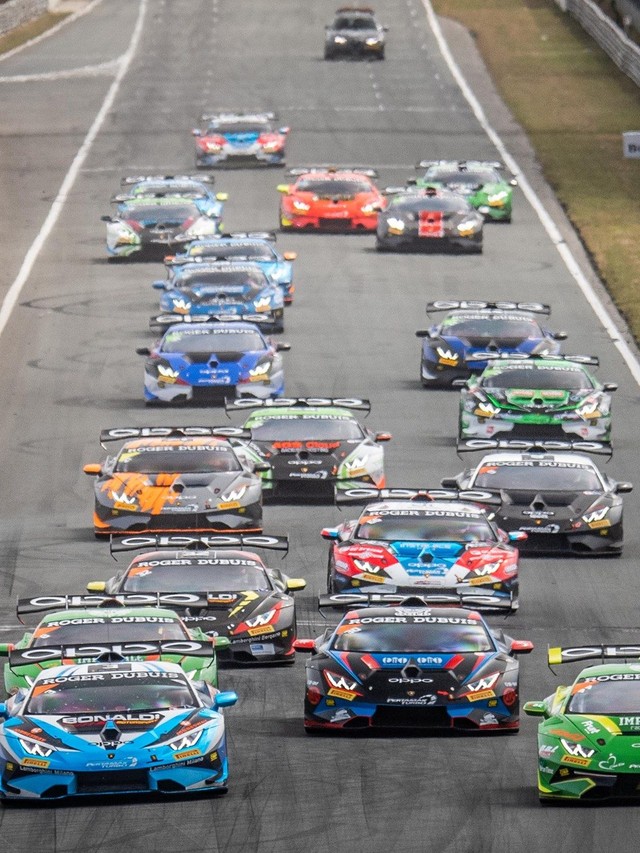
The format itself has been tightened to match those higher stakes. Each of the two rounds now packs three races into a single weekend rather than the previous two. Round 1 takes place at the Dubai Autodrome on February 15 and 16, with qualifying sessions on Friday morning followed by a 50-minute Race 1 in the afternoon and Races 2 and 3 filling Saturday. The identical structure repeats for Round 2 at the Yas Marina circuit in Abu Dhabi on February 22 and 23. Lamborghini says 20 Huracán Super Trofeo Evo cars will line up on the grid, split across four classes: Pro, Pro-Am, Am, and Lamborghini Cup.
Six races in eight days, compressed into two Gulf venues, all carrying genuine championship stakes. Linking class titles directly to a World Final berth transforms the Middle East leg from a footnote into a proving ground where results travel with the driver all the way to southern Spain in October.
A Global Calendar Built Around One Car
The Middle East opener sits at the front of a 2019 calendar that spans four continental championships, and the new qualification pathway only makes sense when you see the full picture. Europe runs six rounds from Silverstone in May through Jerez in October, with most weekends paired alongside the Blancpain GT World Challenge Europe. Asia covers six rounds as well, touching Sepang, Suzuka, Fuji Speedway, Yeongam, and Shanghai. North America begins at Barber Motorsport Park in April and works through Watkins Glen, Road America, Virginia International Raceway, and Laguna Seca. Every series funnels into the same World Final, where regional champions race for a global title.
Lamborghini’s one-make championship, now in its eleventh edition since launching in 2009, operates on a geographic scale that few rival manufacturer series match. The circuits host Formula 1, endurance classics, and major GT events, which keeps the racing relevant and the track data transferable for drivers moving up.
The convergence at Jerez is the payoff. Four separate regional grids, each developed over months of competition, collide in a single weekend. Middle East class winners now arrive with the same automatic right to compete as their European or North American counterparts, elevating the region’s role within Lamborghini’s motorsport structure from appetizer to full course.
Why the Super Trofeo Ladder Still Matters
One-make series exist for a reason that goes well beyond brand visibility, though that part certainly helps. They function as driver development pipelines, and the Super Trofeo’s four-class structure creates entry points for gentlemen drivers who want competitive wheel-to-wheel racing and for aspiring professionals who need seat time and results on their resume.
The career logic runs like this: perform well in Super Trofeo, earn attention from Squadra Corse, and potentially progress toward GT3 programs where Lamborghini competes against other manufacturers. That connection sits at the core of why Lamborghini invests in running a global one-make championship. The series generates paying customers, since teams and drivers buy the cars and fund their own entries. It builds brand loyalty among wealthy amateur racers. And it simultaneously identifies talent that could represent the brand at higher levels.
That pipeline becomes even more significant over time. According to Autoblog, Lamborghini debuted the Temerario GT3 at the 2025 Goodwood Festival of Speed as its first competition car fully designed, developed, and built in-house. The Super Trofeo series feeds the broader Squadra Corse operation that will manage programs like the Temerario GT3, making the one-make championship a foundational piece of Lamborghini’s long-term racing strategy rather than a standalone promotional exercise. The automatic World Final path from the Middle East strengthens every rung of that ladder by ensuring no regional champion is overlooked.
The Huracán Super Trofeo Evo: 620 Horsepower, No Compromises
Every car on the 2019 grid is a Huracán Super Trofeo Evo, and the spec sheet explains why the series produces close racing. The naturally aspirated 5.2-liter V10 delivers 620 horsepower through a rear-wheel-drive layout, managed by a Marelli-actuated six-speed sequential gearbox. Dry weight sits at 1,270 kg (2,800 lb), yielding a weight-to-power ratio of 2.05 kg/CV. One source indicates the Evo is 335 pounds lighter than its road-legal counterpart, achieved through a hybrid carbon and aluminum frame, extensive use of carbon fiber bodywork, and the removal of everything a race car does not need.
Braking comes from Brembo/PFC components, with a 12-position racing ABS and 9-position traction control giving drivers meaningful adjustability without opening up the kind of setup variables that separate rich teams from everyone else. The 42/58 front-to-rear weight distribution favors rear traction, which suits the rear-drive layout and rewards drivers who manage throttle application precisely.
Because every car runs identical hardware, results come down to driver skill, team preparation, and race-day decisions. For amateur drivers spending their own money to compete, that parity is the entire value proposition. Nobody is being outspent by a factory effort running secret aero updates. And when the reward for winning your class now includes a guaranteed seat at the World Final, the stakes behind that level playing field feel considerably sharper.
| Specification | Detail |
|---|---|
| Engine | 5.2L naturally aspirated V10 |
| Power | 620 hp |
| Dry Weight | 1,270 kg (2,800 lb) |
| Weight-to-Power | 2.05 kg/CV |
| Drivetrain | Rear-wheel drive |
| Gearbox | 6-speed sequential (Marelli-actuated) |
| Frame | Hybrid carbon/aluminum |
| Weight Distribution | 42% front / 58% rear |
| Brakes | Brembo/PFC |
| ABS | 12-position racing ABS |
| Traction Control | 9-position |
What This Means for Lamborghini’s Competitive Position
Ferrari runs its own one-make Challenge series. Porsche operates the Carrera Cup. Both serve similar dual purposes of customer engagement and talent scouting. Where Lamborghini’s Super Trofeo distinguishes itself is in the global convergence model: four regional championships feeding a single World Final, with the 2019 season adding automatic qualification from the Middle East for the first time. That structure creates a narrative arc across the entire calendar year, keeping the series relevant to fans and media well beyond individual race weekends.
Running costs remain a question Lamborghini does not publicly address in detail, and prospective entrants should expect the full spectrum of professional motorsport expenses: car purchase, spares, transport, crew, and entry fees. But the reward side now includes a legitimate shot at the World Final from every regional championship, including the Middle East. For anyone weighing a Super Trofeo entry, the value proposition has never been cleaner: a manufacturer-supported racing environment where the car is the constant and the driver is the variable.
Squadra Corse now operates a global racing infrastructure that connects weekend track days in Dubai to a world championship in Spain, all built around a naturally aspirated V10 that remains one of the most compelling engines in motorsport. That engine will eventually give way to whatever powers Lamborghini’s next generation of race cars, but for 2019, the formula remains pure, loud, and remarkably effective at doing what one-make series are supposed to do: put the driver first. The new Middle East pathway to Jerez is the clearest sign yet that Lamborghini intends every corner of its racing world to carry genuine weight.
Gallery


