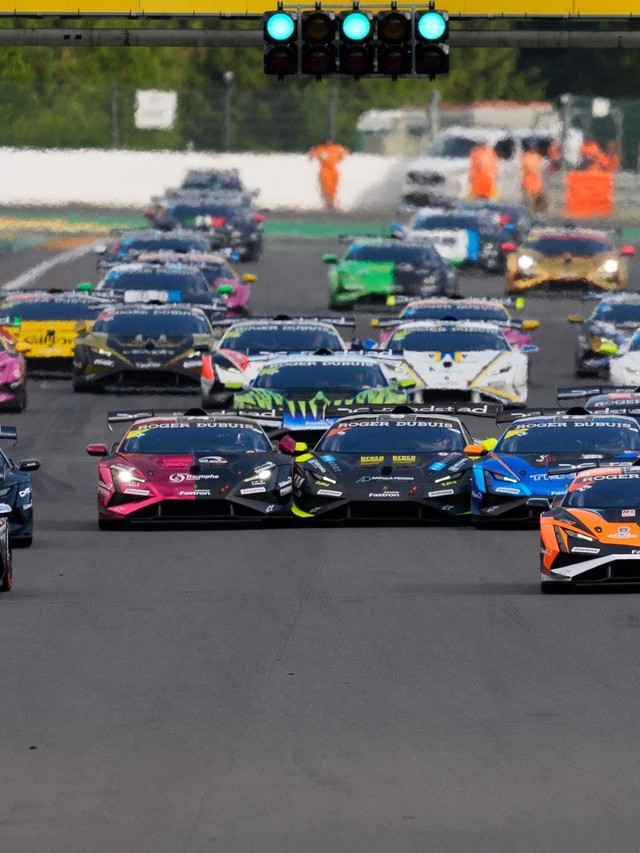
Target Racing Strikes First in Dubai
Timur Boguslavskiy and Frederik Schandorff secured victory in the opening round of the 2019 Lamborghini Super Trofeo Middle East, piloting the Target Racing team’s Huracán Super Trofeo Evo no. 9 to the top step at the Dubai Autodrome. Boguslavskiy started second, gained a position during his stint, and handed the car to Schandorff during a rapid pit stop. The Dane then moved into the lead and held it to the flag, finishing ahead of Jefferies and Azzam in the Konrad Motorsport no. 29, who also claimed the PRO-Am category win. Third place went to Puhakka and Kasai in FFF Racing’s no. 63.
“When I got into the car the cockpit was boiling hot,” Schandorff said afterward. “In spite of the tremendous heat we didn’t let up for a second. Right now, our main focus is holding on to our lead through the next two races.”
Vincent Schwart won the Am category for Konrad Motorsport in car no. 11, while Gerard Van der Horst took the Lamborghini Cup in no. 98. A clean set of results across every class, then, but the race itself only tells part of the story. What matters more for Lamborghini enthusiasts is why a factory-backed one-make series in the Middle East exists at all, and what it reveals about how Sant’Agata Bolognese thinks about competition, customers, and the long game.
Why Lamborghini Runs a Global One-Make Series
The Super Trofeo, organized by Lamborghini Squadra Corse, launched in 2009 with the Gallardo and expanded into a genuinely global operation spanning Europe, Asia, North America, and the Middle East. By 2019, the calendar included rounds at Silverstone, Spa-Francorchamps, Suzuka, Laguna Seca, and a combined World Final in Jerez de la Frontera. The European rounds ran alongside the Blancpain GT World Challenge Europe, giving the series real visibility beyond its own paddock.
Ferrari and Porsche both operate extensive customer racing programs, and the comparison is instructive. Porsche’s Carrera Cup and Ferrari’s Challenge series serve similar functions: they give wealthy enthusiasts a structured, competitive environment with factory support, equal machinery, and a clear ladder toward higher-level GT racing. Lamborghini’s version accomplishes the same goals, but with a twist that reflects the brand’s particular position. Where Ferrari can lean on decades of Formula 1 heritage and Porsche on an unbroken Le Mans lineage, Lamborghini built its modern motorsport credibility largely through programs like this one. The Super Trofeo became the proving ground where Squadra Corse earned its operational reputation before the brand committed to full GT3 and, eventually, LMDh competition with the SC63.
For buyers who already own a Huracán or Aventador, the series offers something no track day can replicate: genuine wheel-to-wheel racing with professional logistics, data support, and a championship structure. That experience builds a kind of brand loyalty that a showroom visit cannot.
The Huracán Super Trofeo Evo as Engineering Laboratory
The car at the center of the 2019 season deserves scrutiny beyond its race results. The Huracán Super Trofeo Evo is derived from the road-going Huracán LP610-4, but the two machines share less than a casual glance might suggest. The race car runs a naturally aspirated 5.2-liter V10 producing 620 horsepower, mounted in a hybrid carbon and aluminum frame stripped to a dry weight of 1,270 kg. It uses rear-wheel drive only, a deliberate departure from the road car’s standard all-wheel-drive layout.
That RWD configuration is worth pausing on. Lamborghini says the setup gives drivers valuable experience managing traction and car balance in a way that translates directly to GT3 competition, where rear-drive layouts are standard. For a customer who enters Super Trofeo with ambitions of moving up to the Huracán GT3 or, eventually, the incoming Temerario GT3, the one-make car functions as a training tool with real consequences. A 12-position racing ABS, 9-position traction control, and adjustable brake bias give drivers enough adjustability to learn setup philosophy without drowning in complexity.
Brembo and PFC supply the braking hardware (380×35 mm front, 355×32 mm rear steel discs), while a MOTEC M182 engine management system handles the electronics. None of this is exotic by GT racing standards, but the package is deliberately calibrated to sit below a full GT3 car in cost and complexity while still teaching the fundamentals. Think of it as Lamborghini’s version of a racing apprenticeship, wrapped in carbon fiber and 8,000-rpm V10 fury.
Developing Talent and Building the Squadra Corse Pipeline
One detail that rarely gets attention in race reports is how many professional GT drivers cut their teeth in Super Trofeo machinery. The series functions as a feeder system, and Lamborghini knows it. A driver who wins the World Final earns more than a trophy; they gain visibility within Squadra Corse’s network of factory-supported teams. Several drivers who competed in early Super Trofeo seasons went on to race Huracán GT3s in the Blancpain Endurance Series and other international championships.
For amateur participants, the value proposition is different but equally deliberate. The controlled environment, with identical cars and professional race management, means that a wealthy enthusiast can experience genuine competition without the intimidation factor of a mixed-class GT grid. Lamborghini has not publicly disclosed the full cost of a Super Trofeo season, but forum discussion among enthusiasts suggests the financial commitment is substantial, encompassing the car purchase, entry fees, tire allocation, and team support. The brand treats this opacity as a feature, not a bug: if you need to ask, the series may not be for you. For those who do participate, the experience cements a relationship with Squadra Corse that often leads to further purchases, whether that means a road-going STO or a step up to GT3 competition.
The Middle East Chapter and Super Trofeo’s Evolving Footprint
The 2019 Middle East calendar consisted of just two rounds: Dubai in mid-February followed by Abu Dhabi a week later. That compact format reflected the region’s role as a season opener and a showcase for Lamborghini’s Gulf-region clientele rather than a full championship in its own right. According to Wikipedia, the Middle East is now listed as “formerly” a region for the Super Trofeo series. Independent reporting indicates the series returned to the region in January 2022 after a pandemic-related hiatus, but its status beyond that season remains unclear.
Lamborghini has not publicly addressed whether the Middle East rounds will return on a permanent basis. What the 2019 event does illustrate is how Squadra Corse uses regional series to engage specific markets. The Gulf states represent a significant concentration of Lamborghini ownership, and a racing event at Dubai Autodrome puts the brand’s competition credentials in front of exactly the audience most likely to write a check for the next Revuelto or Temerario.
The broader 2019 calendar told a similar story of strategic placement. European rounds at circuits like Spa and the Nurburgring carried motorsport prestige. Asian rounds at Suzuka and Fuji tapped into Japan’s deep car culture. North American stops at Watkins Glen and Laguna Seca targeted the brand’s largest single market. Every venue choice doubled as a brand activation.
From Super Trofeo to Temerario GT3: What Comes Next
The Huracán Super Trofeo Evo represented the peak of a naturally aspirated, rear-drive, single-make formula that served Lamborghini well for a decade. The question now is what replaces it. The Temerario GT3, debuted at the 2025 Goodwood Festival of Speed, marks a significant shift as Lamborghini’s first competition car to be fully designed, developed, and built in-house. Previous GT3 efforts involved external partners like Dallara and Reiter Engineering; the Temerario GT3 keeps everything within Sant’Agata Bolognese.
As Autoblog reported, the Temerario GT3 represents a fundamental change in how Lamborghini approaches competition car development. Whether a Temerario-based Super Trofeo car follows remains unconfirmed, but the logic is difficult to ignore. A one-make series built around the Temerario’s twin-turbo V8 hybrid architecture would give Squadra Corse a platform to develop and refine that powertrain under the most demanding conditions possible, while simultaneously training the next generation of customer racers on the technology that will define Lamborghini’s road cars for years to come.
For current Super Trofeo participants and prospective buyers watching from the sidelines, the transition carries real implications. Teams built around the Huracán’s naturally aspirated character will need to adapt to forced induction, different heat management, and potentially heavier hybrid components. The V10’s signature sound, which remains one of the series’ most visceral selling points, will give way to something new. Whether that trade-off strengthens or diminishes the Super Trofeo’s appeal among the gentleman-driver community is a question Lamborghini will need to answer carefully. The Dubai victory in 2019 captured a moment when the formula worked beautifully. The challenge now is making the next chapter equally compelling.
Gallery


