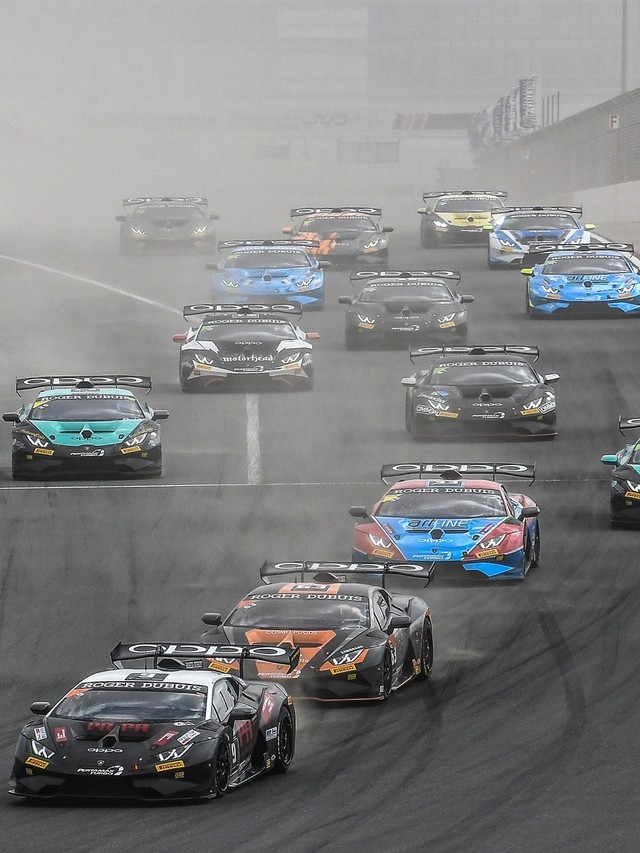
Three Races, Three Wins: Target Racing Sweeps the Dubai Autodrome
Timur Boguslavskiy and Frederik Schandorff, sharing Target Racing’s Huracán Super Trofeo Evo no. 9, won all three races at the opening round of the 2019 Lamborghini Super Trofeo Middle East at the Dubai Autodrome on February 15 and 16. The result left them leading the overall Pro class standings heading into the season’s concluding weekend in Abu Dhabi, scheduled for February 22 and 23.
A mild sand storm complicated Race 2, coating the circuit in fine grit and reducing visibility. Boguslavskiy and Schandorff pushed through it anyway. Takashi Kasai and Juuso Puhakka of FFF Racing finished second, with Axcil Jefferies, standing in for Ramez Azzam at Konrad Motorsport, taking third overall and first in the Pro-Am class. Vincent Schwartz, also under the Konrad banner, claimed Am class victories in both Race 2 and Race 3, while Gerard Van Der Horst won the Lamborghini Cup in Race 2.
Race 3 followed a similar script. Boguslavskiy controlled the field from pole, then handed the car to Schandorff at the mandatory pit stop. Target Racing executed a notably quick driver change, and Schandorff emerged still in the lead. Azzam and Jefferies finished second overall and first in Pro-Am, with Schwartz again the best Am runner. After Van Der Horst’s car stayed in the pits, Gabriele Murroni picked up the Lamborghini Cup win, keeping that title fight open for Abu Dhabi.
Why a Regional Sweep Matters to Squadra Corse
Lamborghini Squadra Corse operates the Super Trofeo as a one-make series across multiple continents, with championships in Europe, Asia, North America, and, at the time, the Middle East. The series began in 2009 with the Gallardo and expanded steadily, adding a World Final in 2013 where regional champions compete for an overall title. The Middle East championship, running its third edition in 2019, compressed its entire season into two weekends in the UAE.
That compressed format amplified the significance of Target Racing’s sweep. In a two-round championship, winning all three races in the first round left almost no mathematical path for rivals to recover. More importantly for Lamborghini, the result demonstrated that the Huracán Super Trofeo Evo could perform reliably and dominantly under conditions that differ sharply from the European circuits where most development takes place. Sand infiltration, high ambient temperatures, and abrasive track surfaces are real engineering tests, not marketing talking points.
The class structure reinforces Lamborghini’s customer racing philosophy. Races run for 50 minutes with a mandatory pit stop window, and the field splits into Pro, Pro-Am, Am, and Lamborghini Cup categories, keeping experienced professionals and gentleman drivers on the same grid without forcing them into the same fight. Schwartz winning the Am class twice in Dubai, or Murroni inheriting the Lamborghini Cup after Van Der Horst’s mechanical issue, illustrates how the series delivers competitive narratives at every level, not just at the front of the overall classification.
The Huracán Super Trofeo Evo as a Competitive Platform
By 2019, the Huracán Super Trofeo Evo represented the mature middle chapter of Lamborghini’s customer racing car. Built around the 5.2-liter naturally aspirated V10, it carried aggressive aerodynamic modifications and stripped significant weight compared to the road car. According to one report, the Super Trofeo variant shed roughly 550 lbs through extensive use of carbon fiber and aluminum. That same source attributes 611 hp to the race-spec engine, a modest but meaningful bump over the standard Huracán’s output.
What made the Evo compelling in competitive terms was consistency. Every car on the grid ran identical Lamborghini-supplied machinery with Hankook tires, managed by a MoTeC control unit. The differences came down to team preparation, driver talent, and pit stop execution. Target Racing’s dominance in Dubai reflected their operational quality as much as anything else, because the hardware was the same for everyone.
For anyone considering the collector market, the Huracán Super Trofeo Evo occupies an interesting niche. These cars occasionally surface at auction or through specialist dealers, sometimes with astonishingly low mileage. As Autoblog noted in a listing for a 2020 model with just 84 miles, the car’s rarity and motorsport pedigree appeal strongly to collectors who view it as an artifact of Lamborghini’s naturally aspirated racing era.
From the Huracán Grid to the Temerario GT3: What Comes Next
Lamborghini’s customer racing ladder did not stop evolving after the Evo. The Huracán Super Trofeo Evo2, an updated version with revised aerodynamics and a 620 CV engine, entered North American competition in 2022. The bigger shift is already visible on the horizon: the Temerario GT3, which Autoblog reported debuted at the 2025 Goodwood Festival of Speed as Lamborghini’s first competition car fully designed, developed, and built in-house. A Temerario-based Super Trofeo car is expected to follow in 2027.
The transition from a naturally aspirated V10 one-make car to a twin-turbo V8 hybrid platform represents the most fundamental shift in the series since the Gallardo gave way to the Huracán. For teams and drivers who built their programs around the Huracán’s characteristics, this means adapting to an entirely new powerband, different weight distribution, and the complexities of turbo management in wheel-to-wheel racing.
Results like Target Racing’s 2019 Dubai sweep matter in this context because they represent the high-water mark of a platform Lamborghini refined over nearly a decade. The Huracán Super Trofeo proved that Squadra Corse could run a credible, globally distributed customer racing program, one that attracted professional and amateur drivers alike and produced genuine competition at circuits from Monza to Dubai. Whether the Temerario generation can replicate that consistency while switching to forced induction and hybrid power remains the open question. The foundation, though, was laid by cars and results exactly like these.
Gallery


