Spa-Francorchamps: The 2020 Super Trofeo Europe’s Penultimate Showdown
A single championship point separated the top two Pro class contenders when the 2020 Lamborghini Super Trofeo Europe arrived at Spa-Francorchamps for its penultimate round. Dean Stoneman, running with Bonaldi Motorsport, carried that slender advantage over Oregon Team’s Dorian Boccolacci and Kevin Gilardoni, a pair of series newcomers who had stormed to a double victory at Barcelona just weeks earlier. Behind them, every class from Pro-Am to the Lamborghini Cup carried its own unresolved storyline.
The stakes alone would have made the October weekend compelling. Squadra Corse added a theatrical flourish: a 2001 Diablo VT 6.0 SE, pulled from the MuDeTec collection in Sant’Agata Bolognese, would pace the field before each of the two 50-minute races. The car marked the Diablo’s 30th anniversary, and its presence on a modern grid full of naturally aspirated V10 Huracán Super Trofeo EVOs drew a direct line between two eras of Lamborghini performance. That visual connection, a road car legend rolling ahead of purpose-built racers, quietly framed the deeper story of how Lamborghini’s motorsport identity has evolved from adapting road cars to engineering dedicated competition machinery.
A Diablo VT 6.0 SE Pacing the Modern Grid
Lead cars at one-make series races tend to be forgettable courtesy vehicles. Lamborghini says the choice of the Diablo VT 6.0 SE was deliberate, timed to the model’s 30th anniversary. The SE variant, produced in limited numbers during 2001, represented the final evolution of the Diablo line before the Murciélago took over, and the specific car used at Spa came from the Museo delle Tecnologie in Sant’Agata Bolognese.
For enthusiasts watching the livestream on the Squadra Corse YouTube channel, the visual contrast told a story no spec sheet could. The Diablo’s flowing, almost organic bodywork rolling ahead of a grid packed with angular, aero-loaded Huracáns illustrated how dramatically Lamborghini’s competition philosophy changed in two decades. The Diablo was a road car pressed into occasional motorsport duty. The Huracán Super Trofeo EVO exists purely to race. That shift, from adapting road cars to engineering dedicated racers, is the foundation Squadra Corse now builds on as it develops the Temerario GT3 entirely in-house for the first time. According to Autoblog, the Temerario GT3 debuted at the 2025 Goodwood Festival of Speed as Lamborghini’s first fully in-house competition car, a milestone that traces its roots directly through the Super Trofeo program.
Pro and Pro-Am: Championship Margins Measured in Tenths
Stoneman’s position at the top of the Pro standings looked precarious heading into Spa. Lamborghini says he returned to a solo entry for the weekend after team-mate Patrick Kujala moved to GT3 duties, meaning he would manage tire degradation, pit strategy, and race pace without the benefit of a shared stint. Boccolacci and Gilardoni, meanwhile, carried the momentum of Barcelona’s double win and the tactical advantage of running as a crew.
Target Racing’s Miloš Pavlović and Raul Guzman sat fourth after a Barcelona weekend that included an eighth-place finish and a non-start, a collapse from the points lead they held entering Spain. GSM Racing’s Jonathan Cecotto and Patrick Liddy, fresh off their first overall podium, and the Target Racing pairing of Alberto di Folco and Kevin Rossel added further pressure from behind.
The Pro-Am picture was equally fluid. VS Racing’s Karol Basz and Andrzej Lewandowski held the class lead after recovering from a difficult opening race at Barcelona with a Race 2 victory. Finnish pairing Mikko Eskelinen and Elias Niskanen from Leipert Motorsport remained winless on the season but were closing the gap. VS Racing also brought in Japanese GT regular Yuki Nemoto for his first Super Trofeo start of the year, replacing FIA Formula 3 driver Sebastian Fernandez, who had himself been a substitute at Barcelona. That kind of driver rotation reflects the series’ role as a proving ground where talent cycles through on the way to higher categories.

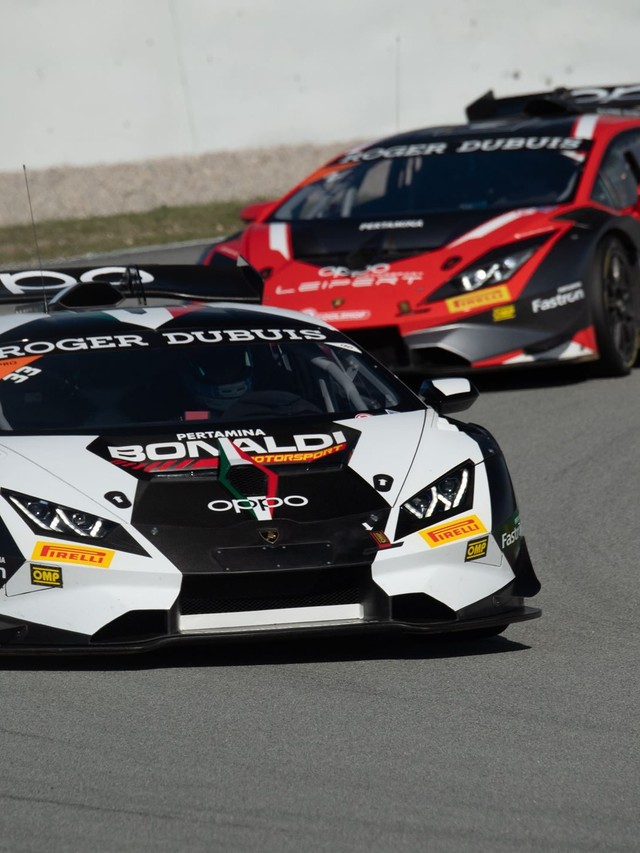
Two Lamborghini Huracán Super Trofeo EVO race cars battle for position on the track during a Super Trofeo Europe event.
Am and Lamborghini Cup: Veterans and Late-Season Surges
The Am class title race provided its own compelling subplot. Leipert Motorsport’s Yury Wagner and Fidel Leib arrived at Spa on a high after winning both races in Barcelona, vaulting Wagner to 61 points, level with Boutsen Ginion’s Giuseppe Fascicolo. Both trailed class leader Massimo Mantovani by 20 points, a gap that remained closeable with two rounds remaining.
Imperiale Racing’s Hans Fabri controlled the Lamborghini Cup with a 35-point cushion over Kurt Wagner and Libor Dvoracek of Micanek Motorsport ACCR. Konrad Motorsport’s Martin Lechman and Emir Keserovic returned to the grid after missing Barcelona entirely, adding a wildcard element to the class.
Both 50-minute races included mandatory pit stops, a format that rewards consistent pace over single-lap heroics. Race 1 ran on Friday, October 23rd, with Race 2 following on Saturday, October 24th. Fans could follow the action live through the Squadra Corse YouTube channel and Facebook page.
Super Trofeo’s Place in Lamborghini’s Motorsport Ladder
Seasons like 2020 illustrate why the Super Trofeo matters beyond its own championship. The series functions as a controlled environment where Squadra Corse identifies driver talent, refines its operational processes, and builds the institutional knowledge that feeds into GT3 and endurance racing programs. Stoneman’s championship fight, which one source indicates he ultimately won at the Paul Ricard finale with Bonaldi Motorsport, exemplified the kind of pressure-tested development the series provides.
For prospective customer racers evaluating one-make series options, the Super Trofeo occupies a specific niche. The Huracán Super Trofeo EVO’s naturally aspirated V10 delivers linear, predictable power, isolating driver skill at circuits like Spa where braking points and corner entry technique decide positions. That philosophy contrasts with multi-manufacturer GT3 grids, where Balance of Performance regulations and varied powertrain architectures introduce variables beyond the driver’s control.
The broader trajectory gives the 2020 season at Spa a transitional quality in hindsight. The Huracán platform that defined the Super Trofeo for a decade is giving way to the Temerario generation, and the in-house development of the Temerario GT3 signals that Lamborghini plans to control more of its racing destiny than it did during the Diablo era, or even the Huracán years. The Diablo pacing that Spa grid was a ceremonial gesture, but the strategic direction it symbolized was anything but.


