Two Museum Cars, One Demanding Rally, and a Surprising Choice of Driver
Lamborghini pulled a 1990 Countach 25th Anniversary and a 1973 Jarama GTS out of its MUDETEC museum in Sant’Agata Bolognese and entered them in the 2020 Modena Cento Ore, a six-day rally covering 1,000 kilometers of Italian road and racetrack between Rome and Modena. Then in its twentieth edition, the event ran from October 10 to 15 and combined timed hillclimb stages on closed public roads with circuit laps at Magione, Mugello, and Imola. This was not a concours lawn. It was a proper endurance exercise for old machinery.
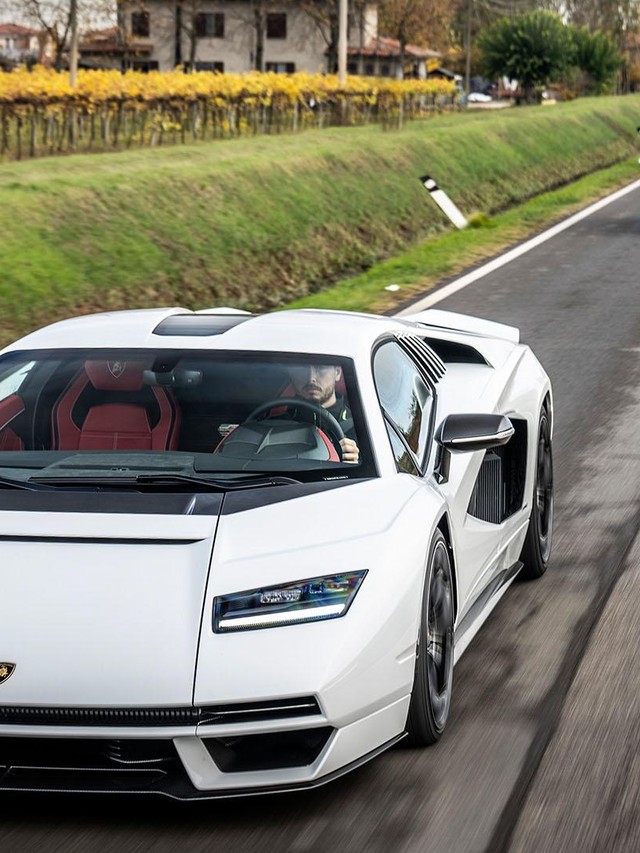
The more interesting decision was who Lamborghini seated behind the Countach’s wheel. Emanuele Pirro, a five-time winner of the 24 Hours of Le Mans and two-time winner of the 12 Hours of Sebring, had raced everything from Formula One cars to Audi prototypes. Yet by his own admission, he had never driven a Countach. Lamborghini handed one of the most experienced endurance racers alive the keys to the very last Countach 25th Anniversary to roll off the production line, still wearing its original Argento Luna metallic silver paint and grey interior, and pointed him toward central Italy. That combination of provenance, driver pedigree, and sheer audacity turned a heritage entry into something far more revealing.
Pirro’s Verdict: Pure, Unfiltered, and Unexpectedly Comfortable
What Pirro reported back is the most valuable part of this story, because his frame of reference includes decades of professional seat time in purpose-built race cars.
“I’d never driven a Countach before, and I fell in love with it. It is powerful with pure sensations, never filtered by electronic aids or even by common accessories such as power steering, and above all fast. Surprisingly, it is also comfortable, and although it has a fixed set-up, it certainly cannot be described as rigid.”
That last observation cuts against a deeply held assumption. The Countach occupies a peculiar space in automotive mythology: universally worshipped on bedroom walls, widely assumed to be miserable to actually drive. Its reputation for terrible visibility, heavy controls, and punishing ergonomics precedes it everywhere. For a driver of Pirro’s caliber to call it “comfortable” and “not rigid” after covering hundreds of kilometers of mixed terrain is a meaningful data point, not polite PR. His phrase “never filtered” reads as a genuine compliment from a man who spent his career wrestling prototypes at 200 mph.
Enthusiast forums echo a version of this duality. Multiple Countach owners on Reddit and dedicated Lamborghini communities describe the driving experience as a constant contradiction: uncomfortable seating paired with an intoxicating engine, limited visibility paired with extraordinary presence. Pirro’s assessment lands closer to the positive end of that spectrum, though his professional tolerance for physical discomfort probably exceeds the average owner’s.
The Countach 25th Anniversary: Last of a Lineage
The specific car Pirro drove carries weight beyond its mechanical specification. Produced between August 1988 and March 1990, the Countach 25th Anniversario was the final evolution of a design that first appeared in 1974. A total of 658 units were built. Lamborghini says this particular silver example was the last one to leave the production line, making it the full stop at the end of a 16-year sentence.
Horacio Pagani, years before founding his own supercar company, redesigned the Anniversario’s bodywork. The 5.2-liter V12 produced 420 horsepower and pushed the car to a top speed approaching 183 mph. No traction control. No ABS. No power steering. The Diablo replaced it, bringing Lamborghini into the 1990s with more power and more refinement but also more electronic intervention.
For collectors and enthusiasts, the Anniversario occupies a specific position: it represents the last moment Lamborghini’s flagship was entirely analog. Every V12 supercar the company built afterward added layers of electronic mediation between driver and machine. That context makes Pirro’s “never filtered” comment land with extra force. He was describing not just a car but the closing chapter of an engineering philosophy.
The Jarama GTS: Lamborghini’s Overlooked Grand Tourer Steps Up
The Countach grabbed the headlines, but the second entry deserves attention. Gerald Kahlke, Lamborghini’s Head of Communication, drove a 1973 Jarama GTS finished in Tahiti Blue with natural leather interiors. The Jarama sits in a part of Lamborghini’s catalog that most casual fans skip entirely: front-engine, V12-powered grand tourers built for covering long distances in comfort rather than setting lap records.
Lamborghini described the Jarama GTS as a fast and comfortable car, exemplary of a 1970s grand tourer. That positioning matters because it proves the brand’s heritage extends beyond mid-engine shock value. The Jarama shared its V12 DNA with the Countach but applied it to a fundamentally different purpose, and pairing the two at the Cento Ore was a quiet statement about the breadth of Lamborghini’s engineering history.
The Jarama rarely appears in these conversations. Ferrari’s front-engine GTs from the same era, the 365 GTC/4 and the Daytona, command enormous collector attention and auction prices. The Jarama remains comparatively obscure, which makes its inclusion here feel like Lamborghini gently reminding the world that its GT lineage runs deeper than most people realize.
1,000 Kilometers of Proof
Both Lamborghinis completed the rally in excellent condition, an outcome that sounds routine until you consider what the route actually demanded. The Modena Cento Ore alternates timed hillclimb tests on historic uphill race routes, closed to traffic, with hot laps at three serious circuits: Autodromo dell’Umbria in Magione, the Mugello Circuit, and Autodromo Enzo e Dino Ferrari in Imola. Mugello and Imola are not gentle on modern race cars, let alone on museum pieces built decades before the tracks were resurfaced to current standards.
Finishing 1,000 kilometers across six days without mechanical failure is the kind of evidence no static museum display can replicate. These cars were not trailered between stages for photographs. They drove the route. For a car like the Countach, which forum communities describe as requiring careful specialist maintenance and expensive parts sourcing, completing this distance without incident reflects genuine mechanical integrity.
Anyone considering a Countach 25th Anniversary purchase should note a caveat: the car Pirro drove was a museum-maintained example, almost certainly prepared to exacting standards by Lamborghini’s Polo Storico division. A privately owned example with uncertain service history might not deliver the same reliability over a similar distance. The event demonstrated what the car is capable of when properly maintained, a useful benchmark but not a guarantee for every example on the market.
Heritage as a Rolling Argument
Most luxury automakers run heritage programs. Ferrari Classiche certifies and restores classic Ferraris. Porsche Classic supplies parts and performs factory restorations. Mercedes-Benz maintains a museum fleet for static display and occasional demonstration runs. Lamborghini’s approach at the Cento Ore struck a different tone: rather than restoring cars for concours judging or offering curated track days with modern safety nets, the company entered museum cars into a competitive rally alongside other entrants and let them be driven hard by a professional racer and a company executive.
That distinction aligns with the brand’s broader identity. Lamborghini builds cars meant to be experienced at their limits, not admired from a distance. Entering the Countach and Jarama in a demanding multi-day event reinforced that philosophy more effectively than any marketing campaign could.
As Lamborghini moves deeper into the hybrid era with the Revuelto and Temerario, the contrast with cars like this Countach becomes sharper. The Revuelto’s V12 still screams, but it works through a sophisticated electronic architecture that manages torque vectoring, energy recovery, and multiple electric motors. Pirro’s description of the Countach as delivering sensations “never filtered by electronic aids” captures something the modern cars, brilliant as they are, simply cannot replicate. The Cento Ore entry was Lamborghini acknowledging that tension honestly: celebrating what the old cars do that the new ones cannot, while the new ones push performance into territory the classics never imagined.
Gallery


