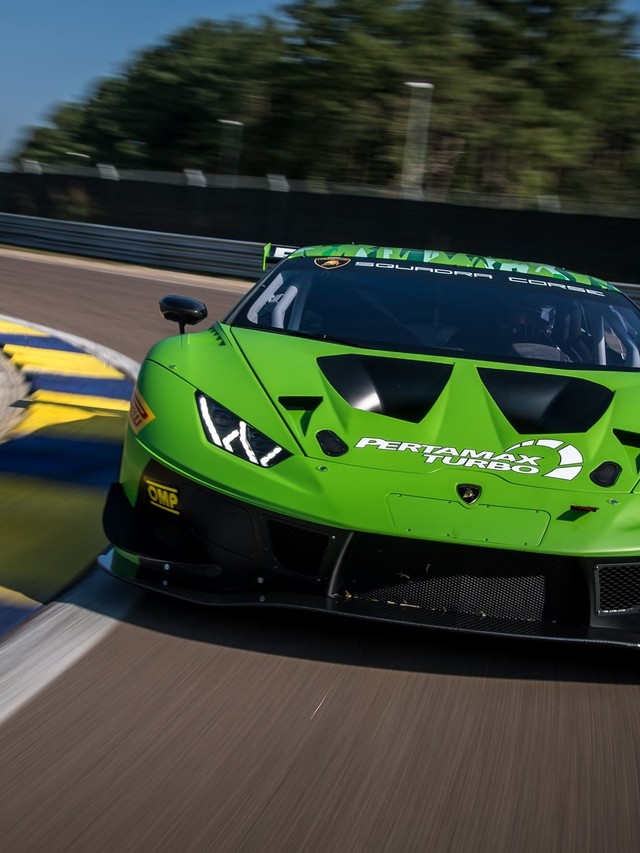
A Contract That Launched a Championship Arc
When Lamborghini Squadra Corse confirmed the extension of Mirko Bortolotti’s factory driver contract in early 2016, the immediate headline was a race entry: the then-25-year-old Italian would debut the Huracán GT3 at the 24 Hours of Daytona alongside American squad Paul Miller Racing. On paper, it looked like a straightforward driver announcement. In hindsight, it was the opening chapter of the most successful driver-car partnership in Lamborghini’s modern racing history.
Bortolotti arrived carrying serious single-seater credentials. Lamborghini says he won the Formula 3 Italian Championship in 2008, graduated as FIA Formula 2 champion in 2011, and took the drivers’ title in the World Series Renault Eurocup Megane Trophy in 2013. His pivot to GT racing came through the Lamborghini Blancpain Super Trofeo in Europe in 2014, and Squadra Corse quickly folded him into its young drivers’ program, where he contributed to development of both the Huracán Super Trofeo and GT3. By the time the 2016 contract landed, Bortolotti already knew the car’s engineering personality from the inside out.
Giorgio Sanna, then Head of Motorsport at Automobili Lamborghini, framed the deal as something bigger than a single season. The company positioned Bortolotti as a model for young drivers looking at Lamborghini’s motorsport ladder as a career path, signaling that Squadra Corse intended to build long-term continuity around its best talent rather than cycling through hired guns.
Building a Résumé in the Huracán GT3
Early results justified the investment quickly. In 2015, racing as an official Squadra Corse driver with Grasser Racing Team in the Blancpain Endurance Series, Bortolotti secured pole positions at Paul Ricard and the Nürburgring. A debut win in the ADAC GT Masters at the Red Bull Ring and two podiums at his first Blancpain Sprint Series appearance in Misano followed in rapid succession. He also accumulated five wins in the Italian GT Championship, finishing third overall that year.
The trajectory kept climbing. Bortolotti won the 2017 Blancpain Endurance Series title with Grasser Racing Team, a result that established both him and the Huracán GT3 as genuine forces in international GT competition. Consecutive GTD class victories at the Daytona 24 Hours in 2018 and 2019 added North American credibility to a program Lamborghini had initially built with a European focus. These were not inherited drives in dominant machinery. The Huracán GT3 was a relatively young platform competing against deeply established Porsche 911, Ferrari 488, and Mercedes-AMG GT3 entries, and Bortolotti’s consistency helped prove its competitiveness.
A brief departure to sister brand Audi in 2020 interrupted the story, but not for long. Bortolotti returned to Lamborghini in 2021, and the partnership resumed as if the gap never happened.

Two men pose with a striking red Lamborghini Huracán, showcasing its sleek design and vibrant color.
DTM Glory: The Huracán GT3 Evo2’s Crowning Moment
Lamborghini entered the DTM three years before the championship arrived. The buildup was patient, methodical, and occasionally frustrating. Bortolotti finished runner-up in the 2023 DTM season behind Porsche’s Thomas Preining, close enough to taste the title but unable to seal it.
The 2024 season delivered. Driving the Huracán GT3 Evo2 for SSR Performance, Bortolotti clinched the DTM Drivers’ Championship at the final round in Hockenheim. His campaign included one race win, six additional podiums, and three pole positions, defined by relentless consistency rather than a single dominant weekend. The result gave Lamborghini its first DTM title in four decades of the championship’s existence and marked the first time since 1993 that an Italian brand and driver combination won the crown.
The championship-winning car now sits in the Lamborghini Museum in Sant’Agata Bolognese. CEO Stephan Winkelmann, CMO Federico Foschini, CTO Rouven Mohr, SSR Performance owner Stefan Schlund, and team principal Mario Schuhbauer all attended the handover ceremony. That level of corporate presence at what could have been a quiet museum intake tells you how much the result meant internally. It also underscored the thesis Sanna had articulated back in 2016: sustained investment in one driver and one platform pays compounding dividends.
Why the V10 Mattered More Than the Trophies
The Huracán GT3 Evo2’s 5.2-litre naturally aspirated V10 occupies a unique position in the current GT3 landscape. As many contemporary competitors transition to turbocharged engines, the Huracán’s powerplant remains a holdout, delivering its power with a linear throttle response and an exhaust note identifiable from any grandstand seat without consulting a spotter’s guide.
For customer racing teams, this characteristic mattered in practical terms. Naturally aspirated engines respond differently under Balance of Performance regulations than turbocharged alternatives, and drivers who learned the Huracán’s power delivery developed a specific racecraft around its strengths. Bortolotti, who helped develop the car from its earliest iterations starting in 2014 alongside Audi’s engineering resources, understood those characteristics better than almost anyone on the grid.
The development arc itself deserves attention. From the initial Huracán GT3 that debuted in 2015 through the Evo and Evo2 updates, Lamborghini refined a single platform across a full decade of competition. That kind of sustained evolution on one architecture is unusual in GT3 racing, where manufacturers frequently introduce entirely new base cars. The Huracán GT3 program proved that deep, iterative improvement on a known platform could deliver championship-level results even against newer, purpose-designed competitors. Bortolotti’s unbroken involvement across those iterations was not incidental to the car’s success; it was structural.
The Temerario GT3 and What Comes Next
The Huracán GT3 faces retirement after the 2025 season. Bortolotti himself has expressed sadness about the car’s departure, a sentiment that carries weight given he was one of its original development drivers.
Its successor, the Temerario GT3, debuted at the 2025 Goodwood Festival of Speed. The new car represents a significant structural shift for Squadra Corse: it is Lamborghini’s first competition car fully designed, developed, and built in-house, without the collaborative engineering arrangement with Audi that underpinned the Huracán GT3’s creation. Development is underway for a 2026 racing debut. As Car and Driver reported, the Temerario GT3 will carry a modified version of the road car’s twin-turbocharged V8, bringing Lamborghini’s GT3 effort into alignment with the turbo trend it resisted for a decade.
For customer teams currently running the Huracán GT3 Evo2, the transition demands attention. Adapting to an entirely new powerband, different weight distribution, and the complexities of turbo management in wheel-to-wheel racing will require significant recalibration. The Huracán rewarded smooth, linear inputs; a turbocharged successor will ask for different habits. Whether Lamborghini can transfer the institutional knowledge built over ten years of V10 racing into a new architecture will define the Temerario GT3’s early competitive trajectory.
Ford’s updated Mustang GT3 Evo kit, also slated for 2026, means the Temerario will enter a competitive field that is itself resetting. Lamborghini’s advantage is that it enters this new cycle with a proven driver roster and a decade of GT3 operational experience, assets that do not depreciate with a platform change.
The Strategic Bet That Paid Off
Zoom out from the individual results and the 2016 contract extension looks less like a routine personnel decision and more like a deliberate strategic wager. Lamborghini bet that investing in a single driver across a single platform, year after year, would yield compounding returns. Bortolotti’s knowledge of the Huracán GT3 deepened with every season, every Balance of Performance adjustment, every track surface and tire compound combination. That accumulated expertise cannot be replicated by parachuting a fast driver into an unfamiliar car for a single campaign.
Competitors approach the GT3 market differently. Porsche fields large customer fleets and rotates factory support across numerous teams. Ferrari leverages its broader motorsport infrastructure. Lamborghini, with a smaller racing operation, concentrated its resources. The DTM title validated that concentration.
The Huracán GT3’s legacy is not just a list of wins and poles. It is proof that Squadra Corse’s model of long-term driver development and platform refinement can compete at the highest level of GT racing. Whether that model scales to the Temerario era remains the open question. Lamborghini confirmed the approach works. Now the company must prove it transfers.


