Two Races, Two Wins: Caldarelli and Beretta Own NOLA
Andrea Caldarelli and Michele Beretta swept both races at NOLA Motorsports Park in the Fanatec GT World Challenge America, piloting the #1 K-PAX Racing Lamborghini Huracán GT3 EVO to a pair of commanding victories. The weekend near New Orleans marked the first time the two shared the #1 car this season, following a strategic driver rotation within the K-PAX lineup that moved Caldarelli’s regular partner Jordan Pepper to the #3 entry alongside Misha Goikhberg.
The results left little room for debate. In Race 1, Beretta built a gap of nearly 20 seconds before the mandatory pit window even opened, handing the car to Caldarelli with a cushion so large that even a late safety car could not erase it. Caldarelli brought the car home with a 5.474-second margin, and the sister #3 machine completed a K-PAX one-two. Race 2 required more work: Caldarelli started sixth and climbed through the field before Beretta took over, chased down, then passed the Acura of Ashton Harrison to seize the lead. Beretta eventually crossed the line roughly 13 seconds clear.
Lamborghini says it won at least one race in nine of the 10 GT World Challenge America rounds it contested since joining the series in 2021. That kind of consistency goes beyond a single strong weekend and speaks to a platform and a support structure that deliver results round after round, regardless of circuit layout or conditions.

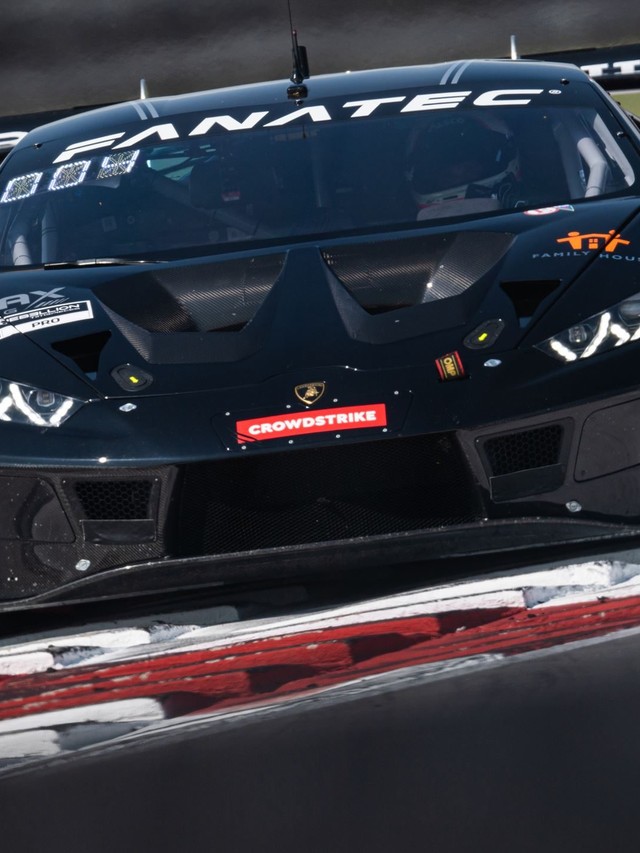
The black Lamborghini Huracan GT3 EVO race car navigates a turn with precision during the GT World Challenge America.
Why Customer Racing Wins Matter More Than Trophies
A weekend sweep at a 4.423 km circuit outside New Orleans might seem like a footnote in a long season, but customer racing results carry disproportionate weight in the supercar market. GT3 is the category where Ferrari, Porsche, Mercedes-AMG, BMW, and Lamborghini field cars that share their names, their silhouettes, and, in varying degrees, their engineering DNA with the road cars in their showrooms. Consistent victories validate a brand’s engineering credibility in a way no press event or lap record attempt can replicate.
For Lamborghini, the calculation is straightforward. Squadra Corse develops the Huracán GT3 EVO and supports teams like K-PAX Racing, but the cars compete against the full GT3 grid on equal terms, governed by Balance of Performance regulations designed to keep the field close. Winning within that framework, repeatedly, signals that the underlying platform is fundamentally sound: the chassis geometry, the cooling architecture, the reliability under sustained load. These are qualities that matter to the kind of buyer who cross-shops a Huracán against a 911 GT3 or a 296 GTB.
The broader season bore this out. The GT World Challenge America series reported that Andrea Caldarelli won the 2022 Drivers’ Championship, while K-PAX Racing claimed the Teams’ title and Lamborghini secured its second consecutive Manufacturers’ crown. Those are not isolated data points but a pattern of execution that competing manufacturers would prefer to disrupt.
The Huracán GT3 EVO’s Proven Pedigree
First revealed in 2018, the Huracán GT3 EVO is an evolution of the original Huracán GT3 that debuted three years earlier. The platform centers on a naturally aspirated 5.2-liter V10, the same basic architecture that powers the road car, adapted for endurance racing with dry sump lubrication and race-specific engine management. One report notes that the aerodynamic package was developed in collaboration with Dallara, the Italian chassis specialist whose fingerprints appear on everything from Formula 2 cars to IndyCar, and that the development brief prioritized drivability and reduced total cost of ownership for customer teams.
That last point deserves attention. GT3 racing is expensive, but the economics matter because the category exists specifically for privateer and customer teams. A car that costs less to maintain between races, that chews through fewer consumables, and that behaves predictably for drivers of varying skill levels will attract more entries, more teams, and more brand visibility. The Huracán GT3 EVO’s track record suggests Squadra Corse got that balance right.
The car’s competitive debut came at the 2019 24 Hours of Daytona, where, according to one report, it won on its first outing. That made Lamborghini the only manufacturer to win the Daytona endurance classic in consecutive years, following the original Huracán GT3’s victory in 2018. From Daytona to Sebring to GT World Challenge circuits across North America and Europe, the EVO variant compiled a résumé that few GT3 platforms of any era can match.

A competitive field of GT race cars, including two Lamborghini Huracan GT3 EVOs, lines up on the track.
From the Circuit to the Showroom: The Halo Effect
Lamborghini’s road car lineup benefits from racing success in ways that are real but difficult to quantify precisely. The company does not publish data linking GT3 victories to showroom traffic or order books, and any claim to that effect would be speculative. What can be observed is how Lamborghini positions its motorsport program as a direct extension of its product philosophy.
The Huracán STO, for instance, borrowed visual and aerodynamic cues from the Super Trofeo and GT3 race cars. Its marketing leaned heavily on motorsport lineage, and buyers responded. When a prospective owner sees a Huracán winning at Daytona or sweeping a GT World Challenge weekend, the road car sitting in the dealership inherits a measure of that credibility. Porsche pioneered this approach decades ago with the 911’s racing program, and Ferrari’s entire brand mythology rests on the same foundation. Lamborghini’s relative newcomer status in organized customer racing makes each win incrementally more valuable in building that narrative.
For current Huracán owners, the NOLA results reinforce something they already know: the platform underneath their car is genuinely competitive, not merely styled to look fast. For prospective buyers weighing a Huracán against a McLaren 720S or a Ferrari F8, the GT3 record offers a data point that transcends subjective styling preferences.
One insider detail worth noting: K-PAX Racing’s decision to rotate its driver lineup for NOLA, splitting Caldarelli and Pepper into separate cars, is the kind of move a team makes when it trusts the car’s baseline performance enough to experiment with personnel. That confidence in the machinery, rather than reliance on a single proven pairing, tells you something about how teams regard the Huracán GT3 EVO’s inherent competitiveness.

Two victorious race car drivers celebrate their success at the GT World Challenge America event.
Lamborghini vs. Rivals: The GT3 Battleground
GT3 racing is the most commercially important category in global motorsport for supercar manufacturers. Porsche fields the 911 GT3 R, Ferrari runs the 488 GT3 (and later the 296 GT3), Mercedes-AMG campaigns the GT3 version of its AMG GT, and BMW competes with the M4 GT3. Each manufacturer uses the category to prove its engineering credentials to customers who will spend six or seven figures on a road car.
What separates Lamborghini’s approach in GT World Challenge America is the concentration of success through a single elite team. K-PAX Racing, supported by Squadra Corse, functions as the de facto factory effort in the series, and the results reflect that level of commitment. The GT World Challenge America series reported that K-PAX remained unbeaten through 10 regular season rounds over a 10-month period in 2022. Porsche and Ferrari distribute their GT3 programs across a broader network of customer teams globally, generating more total entries but potentially diluting headline results at any single event.
The series itself evolved its competitive framework during this period. The GT World Challenge America reclassified its Pro category to require one FIA Silver-rated driver per entry, a regulation change designed to prevent teams from stacking two Platinum or Gold-rated professionals. For K-PAX, this meant adjusting driver combinations while maintaining winning pace, a challenge the NOLA results suggest the team handled comfortably.
NOLA Motorsports Park was also a late addition to the calendar, which meant every team arrived with limited track-specific data. In that context, the #1 car’s fastest time in the opening practice session (1m34.248) and subsequent pole position (1m34.097) indicate that the Huracán GT3 EVO’s setup window is broad enough to extract performance quickly on unfamiliar circuits. That adaptability is precisely the kind of competitive advantage rival manufacturers would prefer their own cars possessed.
What Comes Next for Lamborghini on Track
The Huracán GT3 EVO’s competitive chapter is approaching its conclusion. One report indicates the car was succeeded by the Huracán GT3 EVO2, designed to comply with updated FIA technical regulations and debuting in early 2023. Beyond that, Lamborghini’s next-generation customer racing car will be based on the Temerario, marking a fundamental shift from the naturally aspirated V10 to a twin-turbocharged V8 with hybrid assistance.
For teams and drivers who built their programs around the Huracán’s characteristics, that transition means adapting to an entirely new powerband, different weight distribution, and the complexities of turbo management in wheel-to-wheel racing. Whether the Temerario GT3 can replicate the Huracán’s dominance remains an open question. Lamborghini’s competitors will also be fielding new-generation cars, and Balance of Performance regulations will reset the competitive landscape.
What the NOLA weekend demonstrates, and what the broader 2022 season confirmed, is that Lamborghini’s customer racing infrastructure works. Squadra Corse’s engineering support, the team relationships, the driver development pipeline: these elements do not disappear when the platform changes. They transfer.
Lamborghini’s European efforts provided a secondary storyline from the same weekend. Kevin Gilardoni and Glenn van Berlo finished second in Race 2 of the International GT Open at Paul Ricard, moving into joint second in the championship standings on 38 points. The geographic spread of competitive results, from Louisiana to the south of France, illustrates the scale of Lamborghini’s customer racing commitment.
For anyone watching the GT3 landscape and wondering whether Lamborghini’s motorsport investment is serious or performative, the answer from NOLA is unambiguous. Nine wins in 10 rounds is not a marketing exercise. It is a program that works, built around a car that, even in the twilight of its competitive life, remains the benchmark its rivals measure themselves against.
Gallery


