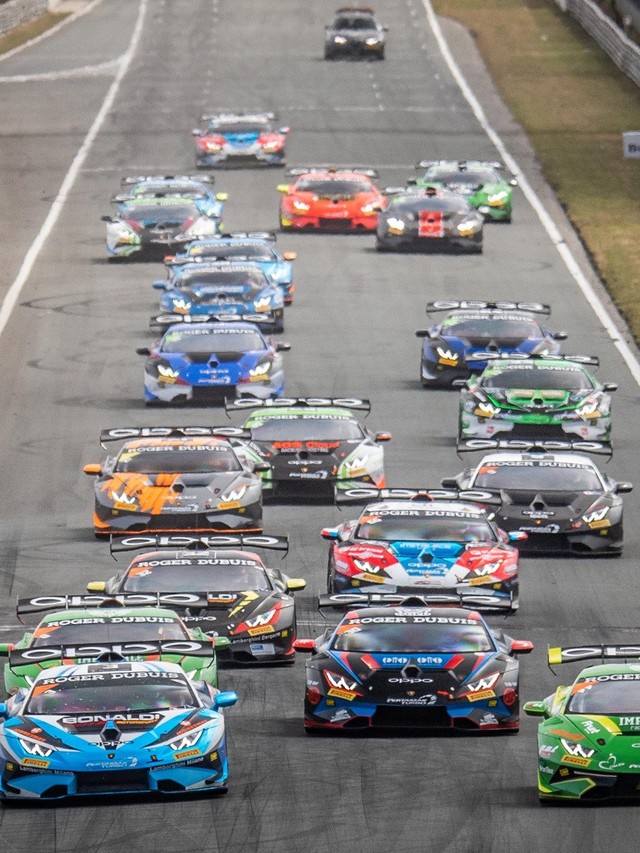
Two Huracan GT3s, 57 Cars, and a Belgian Monsoon
Grasser Racing Team brought two Lamborghini Huracan GT3s to the Spa 24 Hours, one of the most punishing endurance races on the calendar, and for the opening four hours the cars looked capable of winning it. Factory driver Mirko Bertolotti drove the #63 entry from the back of a 57-car grid to second position while torrential rain turned Spa-Francorchamps into something closer to a canal network than a racetrack. The sister car, #19, piloted by Squadra Corse driver Fabio Babini, carved its way to just outside the top ten in the same conditions.
Neither car saw the checkered flag. Both retired. Yet the story of how they fought, broke, were rebuilt, fought again, and ultimately succumbed tells you more about the Huracan GT3’s competitive standing than a comfortable mid-pack finish ever could. Spa did not give Lamborghini a trophy, but it gave the Huracan GT3 something harder to earn: proof that its speed was never the problem.
From the Back Row to Second: A Wet-Weather Masterclass
Qualifying at Spa is largely a setup exercise. The team committed practice and qualifying sessions to dialing in the best possible configuration, which left the #63 starting from the rear of the field. In dry conditions that would be a significant handicap. In the downpour that greeted the opening two hours, it became an opportunity.
Bertolotti exploited the Huracan GT3’s balance in standing water to overtake car after car, a sequence that took the #63 from last to second by the time the race entered its fourth hour. That kind of progress through a 57-car GT3 field, in rain heavy enough to reduce visibility to a few car lengths, is not something a merely adequate chassis produces. The car’s aerodynamic package, its pronounced rear wing and aggressive front splitter working in concert with fully grooved rain tires, clearly gave the drivers confidence that many rivals lacked.
Babini’s run in the #19 was less dramatic in raw positions gained but equally telling. He climbed to just outside the top ten after 180 minutes. Two Lamborghinis in the top dozen of a race that regularly destroys half the entry list by dawn is a strong opening statement, and it underlined the same point Bertolotti’s charge had already made: in the worst conditions Spa could throw at the field, the Huracan GT3 was among the fastest cars on track.
When the Night Came for Both Cars
Endurance racing at Spa is defined by what happens after dark, when the Ardennes fog rolls in and the Kemmel straight becomes a test of nerve as much as speed. The night session undid both Lamborghinis, turning a story of dominance into one of survival.
Car #19 retired first. While battling for tenth position, it hit the barriers and the damage proved terminal. Lamborghini’s account describes the incident as a mistake during the duel, though the exact cause remains unspecified. For a car that had spent three hours climbing through the field, the retirement was abrupt and final.
The #63 suffered a different kind of catastrophe. At 3:15 AM, Adrian Zaugg encountered fog at the end of the Kemmel straight, one of the fastest sections on any circuit in Europe. The resulting crash was severe. That Zaugg managed to nurse the damaged car back to the pit lane at all speaks to both driver composure and the structural integrity of the Huracan GT3’s carbon fiber tub and roll cage.
What happened next in the Grasser garage is the part of this story that matters most. The mechanics stripped and rebuilt the front end of the car, replacing the radiator entirely, a job that cost 24 laps. In a 24-hour race, losing 24 laps is roughly equivalent to losing an hour and a half of racing distance. The car dropped from the top five to the lower reaches of the field. A lesser team would have parked it.
The Repair, the Recovery, and the Final Failure
Grasser did not park it. Bertolotti, Zaugg, and Giovanni Venturini rotated stints and recovered eight positions, maintaining the same pace they had shown before the crash. The Huracan GT3 was, in effect, proving its speed a second time in the same race, now with a car that had been reassembled under pit lane lights in the middle of the night.
The recovery ended when the oil cooling system, damaged in the 3:15 AM crash but patched during the radiator repair, failed definitively. Overheating forced the #63 into retirement. The cruel irony is that the car’s speed was never in question. Its pace after the rebuild matched its pace before the crash. The failure was a downstream consequence of impact damage that no amount of pit lane heroism could fully address in the time available.
Lamborghini says the Huracan GT3 is among the best GT3 cars on the international race scene. Spa provided evidence for that claim, just not the kind that shows up in a results table. The car was fast enough to win. The race simply would not let it.
What Spa Reveals About the Huracan GT3’s Competitive Position
The Huracan GT3 was developed as the successor to the Gallardo FL2 race car, and it matured into one of the most widely campaigned GT3 platforms in the world. Sprint races had already established its credentials. Spa tested something different: whether the platform could sustain front-running pace across a full day of racing in conditions that ranged from monsoon to fog to dry.
The answer is that the car’s raw performance and the confidence it inspires in difficult conditions are clearly competitive with the best in the GT3 category. The vulnerabilities exposed were mechanical fragility after heavy impact and the driver errors that Lamborghini’s account attributes to the night session. Those are team and circumstance problems, not fundamental car problems.
Charging from last to second in the rain, rebuilding a wrecked car mid-race, and then matching pre-crash pace puts the Huracan GT3 in a very specific category: fast enough to lead, fragile enough after a major crash to break. That is a different competitive narrative than simply being slow or unreliable, and it is the narrative that matters for anyone evaluating where the car stands against the Porsches, Ferraris, and Audis that fill the rest of a Spa grid.
Nurburgring Next: One More Chance to Convert Speed Into a Result
Lamborghini confirmed that both Huracan GT3s will return to the grid on September 19 and 20 for the final round of the Blancpain Endurance Series at the Nurburgring. That race, shorter in duration than Spa but no less demanding in terms of circuit complexity, gives Grasser Racing Team a chance to convert the speed shown in Belgium into a result that the standings will actually record.
For now, the Huracan GT3 remains the car that Lamborghini sends into battle. Spa proved it belongs at the front. The Nurburgring finale offers one more chance to prove it can stay there.
Gallery


