A Fourth Consecutive Record Year, and the Money Behind It
In early 2015, CEO Stephan Winkelmann confirmed what the order books already suggested: Lamborghini had posted its best financial results in over half a century of existence. Turnover climbed 24 percent to 629 million euros, up from 508 million the previous year, and worldwide deliveries jumped 19 percent to 2,530 units. Production at the Sant’Agata Bolognese headquarters was already booked to capacity for the year ahead.
Strong numbers, certainly, but the detail that mattered most for the brand’s future sat buried in the fine print. Lamborghini achieved profitability in 2014 despite pouring more than 20 percent of its resources into research and development, a rate the company described as above the industry average. That combination of profit and reinvestment is rare in the low-volume supercar world, where a single model delay can erase a year’s margin. Winkelmann framed the position plainly: the company was operating from what he called a “very solid economic base,” with expectations of sustained medium-term growth driven by ongoing investment and stable global markets.
A two-car lineup firing on all cylinders made this possible. The Aventador continued to command its segment, while the newly launched Huracán was pulling in buyers at a pace that filled order slots almost immediately. Sales split evenly across EMEA, the Americas, and Asia, a geographic balance that insulated the brand from regional downturns. For a company building roughly 2,500 cars a year, that kind of demand discipline is the difference between healthy margins and overproduction headaches.
R&D Spending as a Strategic Weapon
Every supercar manufacturer invests heavily in engineering. What distinguished Lamborghini’s position in 2015 was the scale of that commitment relative to its size. Spending more than 20 percent of resources on R&D while remaining profitable requires either extraordinary demand or ruthless cost discipline, and Lamborghini appears to have exercised both.
Critically, the company confirmed it was channeling investment into factory premises alongside research and development, signaling that the spending went well beyond paper studies or concept sketches. Physical expansion of the Sant’Agata facility pointed toward something larger than incremental updates to the Aventador and Huracán. In retrospect, the factory investment was clearly laying groundwork for a third model line, one that would require an entirely different production process, body style, and supply chain.
Few outlets at the time connected these financial disclosures to specific product outcomes. The enthusiast press covered sales records and moved on. What the numbers actually revealed was a company building the financial and physical infrastructure for a transformation that would take several years to materialize, and that would ultimately redefine Lamborghini’s commercial scale.
From Balance Sheet to Showroom: The Urus and the Hybrid V12
The Urus arrived in 2018, and it changed everything. Annual deliveries, which hovered around 2,500 units in 2014, eventually surged past 10,000. Growth on that scale does not happen without years of advance planning, tooling investment, and factory expansion, precisely the kind of spending Lamborghini flagged in 2015.
On the supercar side, the R&D commitment bore different fruit. The Revuelto, which replaced the Aventador, retained the naturally aspirated V12 but wrapped it in a plug-in hybrid architecture producing over 1,000 combined horsepower. Developing a hybrid system that complements rather than compromises a high-revving twelve-cylinder engine is an expensive engineering problem, the kind of project that only gets funded when a company’s finances are genuinely secure. According to Car and Driver, the Revuelto carries a base price north of $625,000 and posted a 2:41.3 lap at their Lightning Lap test, placing it firmly among the fastest road cars they have ever timed.
The Huracán’s successor, the Temerario, took an even more radical path: a twin-turbo V8 paired with hybrid motors, a departure from the naturally aspirated V10 that defined its predecessor. Whether you consider that progress or heresy depends on your priorities, but funding two simultaneous hybrid supercar programs while also scaling up SUV production required exactly the kind of financial base Winkelmann described a decade earlier.
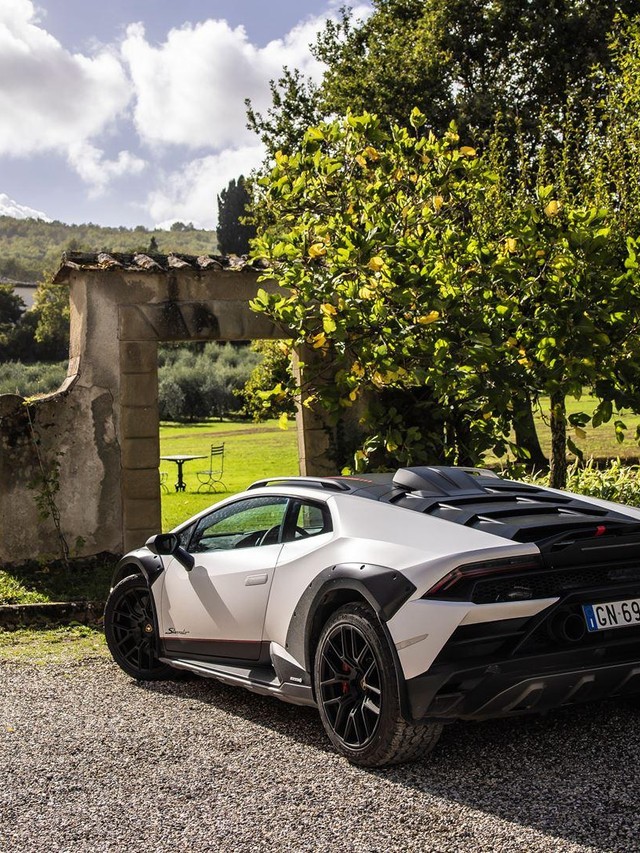
Lamborghini also found room for niche experiments. The Huracán Sterrato, an off-road supercar that seemed like a fever dream when first rumored, reached production. According to Jalopnik, Lamborghini’s sales and marketing chief Federico Foschini hinted that the Sterrato concept could inspire further unconventional models. Projects like these only get greenlit when the core business is healthy enough to absorb the risk.
Competitive Context: Spending Discipline vs. Spending Volume
Ferrari, Lamborghini’s most obvious rival, operates at a significantly larger scale and with higher margins. Comparing raw R&D budgets between the two misses the point. What matters is how each company allocates its investment relative to its output and strategic ambitions.
Lamborghini’s position under the Volkswagen Group umbrella allowed it to share certain platform technologies while directing its own R&D spending toward the elements that define the brand: powertrain character, aerodynamic philosophy, and design language. The company transitioned its entire lineup to hybrid power without abandoning its V12 flagship engine, a move Ferrari also made but with a very different architectural philosophy. Lamborghini’s hybrid transition preserved the naturally aspirated V12 in the Revuelto while electrifying around it, a choice reflecting a specific engineering conviction that required sustained funding and patience.
The Lanzador concept, originally announced as Lamborghini’s first fully electric vehicle, was recently confirmed to become a plug-in hybrid instead. According to Car and Driver, CEO Winkelmann cited shifting market realities as the reason. That kind of strategic flexibility, pivoting a major product program without financial panic, is a luxury only a well-capitalized company can afford. The seeds of that flexibility trace directly back to the financial discipline established a decade ago.
What This Means for Enthusiasts Now
For current and prospective Lamborghini buyers, the practical takeaway is straightforward. The brand’s financial health in the mid-2010s was not an abstract corporate metric. It directly funded the cars sitting in showrooms today and the models still in development. When Lamborghini says it invested aggressively during the Aventador and Huracán era, the evidence is the Revuelto’s hybrid V12, the Temerario’s new twin-turbo architecture, and the Urus SE’s electrified powertrain.
Anyone who has followed Lamborghini through multiple product cycles knows that the company’s lowest points, the late 1970s financial crises, the revolving-door ownership of the 1990s, always coincided with underinvestment. The 2014 results and the spending strategy that accompanied them represent the opposite pattern: Lamborghini built a financial cushion, then spent it on engineering that would define the next generation.
The company still builds fewer than 11,000 cars per year, a fraction of Ferrari’s output. That constraint is deliberate, and it depends on each model carrying enough margin to fund the next round of development. The 2015 announcement was, in hindsight, the moment Lamborghini publicly committed to the cycle that produced its current lineup. The returns on that commitment are now parked in collectors’ garages and on waiting lists worldwide.
Gallery


