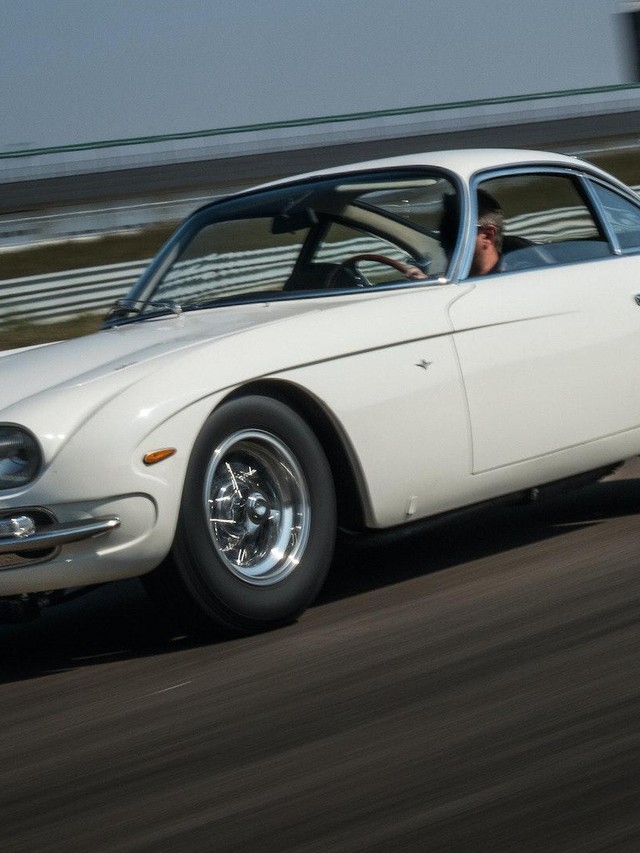
Chassis #0121 Returns to the Track
A 1964 Lamborghini 350 GT rolled onto the Autodromo di Modena recently, turned laps for 80 kilometers, and did so as if it were still brand new. Chassis #0121, one of the first 15 examples of Lamborghini’s inaugural production car, had just completed a full year-long restoration by the factory’s Polo Storico heritage division. The track debut came during the car’s official handover to its current owner, who specifically requested the circuit session rather than a static ceremony. The original owner was also present, watching a machine he once knew intimately prove itself all over again.
Lamborghini says the car demonstrated precise gear changes, responsive braking, and confident handling under sustained track driving. That last detail is the one worth pausing on. Most factory-restored classics get unveiled on a concours lawn, admired under roped stanchions, and trailered home. Polo Storico put this one on a racetrack and let it run. The distinction tells you something about what the division is actually selling: not a museum piece, but a machine that still works as Ferruccio Lamborghini intended it to. Every detail of this restoration, from the paint chemistry to the brake rework, was ultimately tested not by judges with magnifying glasses but by speed, heat, and lateral load.
Inside Polo Storico’s Obsession with Originality
The restoration consumed over 1,150 specialist hours on the body and interior alone, with another 780 hours dedicated to mechanical and electrical systems. Polo Storico used exclusively Lamborghini Original Spare Parts throughout, a constraint that limits what can be modernized but guarantees provenance.
Chassis #0121 is unusual even among early 350 GTs because it retains features from the original prototype that were altered as production matured. Polo Storico researched and reinstated those prototype-era characteristics, effectively reversing decades of incremental change to return the car to its earliest configuration. The original chassis and body panels were brought back to their factory geometry. The engine, cooling system, brakes, and fuel system all underwent extensive rework for both safety and period correctness.
The paint process alone reveals the philosophy at work. The body was refinished in its original delicate white using the period-correct nitroacrylic formula, applied in 22 layers with wet sanding by hand between each coat. The original rims were restored and authenticated by their original supplier, Ruote Borrani di Milano, then fitted with new Pirelli Cinturato 205/15 tires matching the original specification.
The interior tells a subtler story. Black leather was refurbished using processes from the car’s era, and the wooden steering wheel and original pedals were restored while deliberately preserving small signs of wear. The car’s original radio still works. Polo Storico’s approach here is worth noting for anyone considering a factory restoration: the goal is not to erase history but to stabilize it. The owner specifically wanted originality over perfection, and the division honored that by keeping the patina where it belonged. All of which makes the track session more meaningful. This was not a car rebuilt to modern tolerances with fresh components; it was a car returned to its 1964 self and then asked to perform.

The classic white Lamborghini 350 GT gracefully navigates the racetrack, a testament to timeless automotive design and performance.
Why the 350 GT Still Defines Lamborghini’s Foundation
The 350 GT occupies a singular place in the Lamborghini story. It debuted in prototype form at the 1963 Turin auto show, according to Motor Authority, and entered production by 1964. Before the Miura redefined what a supercar could look like, before the Countach became a bedroom-wall icon, the 350 GT established the fundamental promise: a grand tourer engineered to outclass the competition in refinement, power, and road manners.
Ferruccio Lamborghini famously built cars because he felt existing Italian GTs could be better. The 350 GT was his proof of concept, a front-engined V12 grand tourer designed by Franco Scaglione and powered by a Giotto Bizzarrini-derived engine. For collectors, early-production examples like chassis #0121 carry weight precisely because they sit so close to that founding moment. Owning one of the first 15 built is owning a piece of the argument that started the brand.
That Lamborghini chose to restore this specific car, rather than a flashier Miura or Countach, signals something about how the company wants its heritage read. The 350 GT is the root. And the decision to validate the restoration on a circuit rather than a show stand reinforces the point: this car was always meant to be driven, and Polo Storico’s job was to make sure it still could be.
Track Testing as Proof, Not Theater
Putting a freshly restored car from 1964 on a racetrack is a statement of confidence that static display cannot replicate. Concours-quality restorations prove cosmetic excellence. Track time proves that the engine, transmission, brakes, cooling, and chassis geometry actually function as an integrated system under stress.
Lamborghini reported the car completed its 80 kilometers without issue, which, for a car of this age and rarity, amounts to a factory warranty expressed in asphalt. Polo Storico reserved the Autodromo di Modena for the occasion, turning a delivery ceremony into a functional test witnessed by the original owner and the current one alike.
Collectors and enthusiasts who follow the classic market know that the gap between a car that looks correct and a car that drives correctly can be enormous. By making the track debut part of the handover, Polo Storico bridged that gap publicly. The 1,930 combined hours of restoration work were not validated by a clipboard inspection; they were validated by 80 kilometers of sustained running on a circuit built for racing.
What Factory Certification Means for Classic Lamborghini Values
Lamborghini does not publish fixed pricing for Polo Storico restorations, and the company did not disclose the cost of this project. One source reports that a typical full restoration can run around €300,000, with timelines stretching from 18 months to as long as three years depending on the model and scope. For context, the combined labor on chassis #0121 exceeded 1,930 hours across body, interior, mechanical, and electrical work, a figure that can exceed the hours required to build a new Aventador.
The practical question for owners is whether factory certification materially affects a classic Lamborghini’s market position. Lamborghini does not release data on value premiums, but the logic is straightforward: a car restored by the factory, using factory archives and original parts, with a documented provenance chain, occupies a different tier at auction and in private sales than one restored by even the most skilled independent shop. The factory stamp removes the single biggest variable in classic car transactions: doubt about authenticity.
One source reports that this 350 GT represents the fourth full restoration completed by Polo Storico, following a Miura, an LM002, and a Countach. If accurate, the division is still building its portfolio carefully rather than scaling for volume, which reinforces the exclusivity of each project. It is also reported that Lamborghini’s spare parts warehouse covers over 70 percent of its classic supercar fleet, a logistical foundation that few independent restorers can match. The track debut of chassis #0121 adds a layer that paperwork alone cannot: tangible, public proof that the restoration holds up under real driving conditions.
Polo Storico in Context
Lamborghini is not alone in offering factory-backed heritage restoration. Ferrari Classiche operates a well-established certification and restoration program. Porsche Classic maintains an extensive parts catalog and offers factory restorations through its Porsche Classic Partner network. Both programs carry significant brand prestige and influence resale values.
Where Polo Storico differentiates itself, at least in this case, is the track validation step. Ferrari Classiche certifications involve thorough inspection and documentation, but the public emphasis tends to land on the red book certification rather than dynamic proof. Porsche Classic similarly focuses on parts supply and cosmetic and mechanical authenticity. Lamborghini’s decision to put a restored car on a circuit and let it run 80 kilometers under the owner’s hands is a more visceral form of quality assurance, one that ties directly back to the founding ethos of the 350 GT itself: these were always cars built to be driven hard, not merely admired.
For anyone considering a classic Lamborghini purchase or restoration, the practical takeaway from chassis #0121 is clear. A Polo Storico restoration represents the highest available standard of factory authenticity, backed by access to original archives, original suppliers like Borrani, and period-correct materials. Whether that investment pencils out financially depends on the specific car, but the provenance argument is difficult to replicate outside Sant’Agata Bolognese. And after this track debut, neither is the confidence that the car will actually perform when you turn the key.


