Two Milestones, Two Very Different Stories
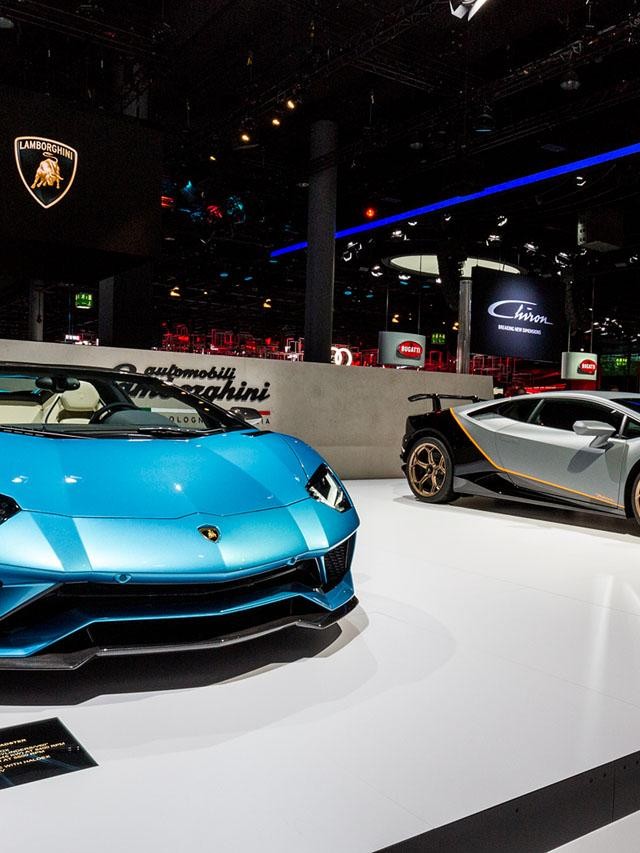
On October 27, 2017, Lamborghini confirmed that its Aventador had reached 7,000 units produced, six years after the V12 flagship entered production. The car wearing chassis number 7,000 is an Aventador S Roadster finished in Grigio Adamas, destined for the United States. That variant debuted at the Frankfurt auto show in September.
The Huracán, meanwhile, crossed 9,000 units in just three years. Chassis number 9,000 is a Huracán Performante in Blue Nethuns, bound for a customer in Dubai. Read those two figures side by side and a pattern emerges that goes well beyond factory bookkeeping: Lamborghini’s V10 line was producing cars at roughly triple the rate of its V12 flagship, and both models were outpacing every predecessor the company had built.
Together, the numbers illustrate a deliberate two-tier strategy that defined Lamborghini’s modern era: preserve the V12’s aura of scarcity while letting the V10 carry the financial weight of the company’s growth ambitions. Every section of this story traces how that single strategic logic played out across production planning, market positioning, competitive standing, and the groundwork for the next generation of raging bulls.
Why These Numbers Matter Beyond the Factory Floor
Production volume in the supercar world is a loaded subject. Build too few and you starve your dealer network. Build too many and you erode the exclusivity that justifies six-figure pricing. Lamborghini, historically, erred on the side of scarcity. The Countach managed roughly 2,000 units over its entire 16-year run. The Diablo, according to forum discussions among long-time collectors on FerrariChat’s Lamborghini board, averaged about 300 per year across its 11-year production span, totaling approximately 3,000 cars.
The Murciélago, which the Aventador replaced, concluded its nine-year career with 4,099 examples. So the Aventador reaching 7,000 in six years represents a dramatic acceleration in V12 output, nearly doubling the Murciélago’s lifetime total with years of production still ahead. The Huracán’s pace is even more striking when measured against the Gallardo, its direct predecessor. One report indicates the Gallardo sold approximately 14,000 units over its full 11-year life cycle. At 9,000 in three years, the Huracán was on track to surpass that total in roughly half the time.
The practical takeaway is straightforward: a company selling cars at this rate can invest in next-generation platforms, racing programs, and the kind of limited-edition variants that keep the collector market engaged. The two-tier strategy was not just a branding exercise; it was the financial engine behind everything Lamborghini planned to do next.
The Flagship’s Calculated Restraint: Aventador at 7,000
Averaging roughly 1,170 Aventadors per year might sound modest next to the Huracán’s output, but context matters. Lamborghini originally planned to limit Aventador production to 4,000 vehicles, a ceiling that was reached by early 2016, according to available reporting. Demand forced the company to keep building, and the introduction of variants like the SV, the S Coupe, and eventually the S Roadster gave the production line fresh commercial energy without requiring a clean-sheet redesign.
The choice of an Aventador S Roadster as the 7,000th car is worth noting. Open-top V12 Lamborghinis carry a particular cachet among collectors, and the S variant’s revised aerodynamics and rear-wheel steering represented the most technically refined version of the Aventador available at the time. Sending it to the American market, Lamborghini’s largest single-country customer base, was hardly accidental.
This is where the two-tier logic becomes visible at the production-planning level. The V12 car remained deliberately supply-constrained, with waiting lists that reinforced its desirability. Owners who specced an Aventador knew they were buying into relative rarity, and the production numbers bear that out. Even at 7,000 units, the Aventador was far from ubiquitous in any major market. That restraint protected residual values and kept the flagship feeling genuinely special, a calculation that would prove important when Lamborghini eventually needed to position the Revuelto as the Aventador’s successor at a substantially higher price point.
The Volume King: How the Huracán Rewrote Lamborghini’s Playbook
If the Aventador’s role was to guard the brand’s mystique, the Huracán’s job was to fund its future. At 3,000 units per year, the V10 model was generating revenue at a pace Lamborghini had never experienced. The Gallardo had been the company’s first genuine volume car, transforming it from a boutique operation into a credible business. The Huracán took that template and accelerated it.
Several factors drove the rapid uptake. The car launched into a supercar market that was expanding globally, with new wealth in the Middle East, China, and Southeast Asia creating buyer pools that barely existed during the Gallardo’s early years. The Performante variant, which wears chassis number 9,000, added a compelling track-focused option that broadened the car’s appeal beyond grand touring buyers. And the Huracán’s naturally aspirated V10, producing its power without turbocharging, gave it an emotional authenticity that resonated with enthusiasts who worried about the broader industry’s shift toward forced induction.
The 9,000th car heading to Dubai underscores how geographically diverse Lamborghini’s customer base had become. Where the Gallardo’s sales were heavily concentrated in Europe and North America, the Huracán found buyers across every major luxury market simultaneously. That geographic spread reduced Lamborghini’s vulnerability to any single regional economic downturn, a strategic advantage that would prove valuable in subsequent years.
Long-time Lamborghini watchers tend to appreciate one detail in particular: the Huracán’s production success funded investments that benefited the entire brand. Higher volume on the V10 line generated the cash flow that supported limited-run specials, motorsport programs, and eventually the development of the Urus SUV, which would transform Lamborghini’s business all over again. The volume king was not diluting the brand; it was bankrolling the brand’s ambitions.
Competitive Context: Where Lamborghini Stood in the Supercar Market
Lamborghini’s combined output of roughly 16,000 Aventadors and Huracáns in this period placed it in a competitive bracket that few rivals could match with mid-engine supercars alone. Ferrari’s total company deliveries were higher, but those numbers included GT cars, front-engine grand tourers, and a broader product range. McLaren, which had been scaling up aggressively since relaunching as a road-car manufacturer in 2011, was chasing similar volume ambitions with its Sports Series lineup but lacked Lamborghini’s decades of brand equity in the segment.
The more telling comparison is philosophical. Ferrari historically managed production with extreme discipline, using allocation and waiting lists as brand-management tools. Lamborghini, under Audi’s ownership, adopted a more pragmatic approach: build what the market will absorb, invest the proceeds in product development, and use limited editions to maintain the halo. The Huracán’s 3,000-per-year pace would have been unthinkable for any Lamborghini model a generation earlier, yet it worked because the car delivered genuine performance credibility. The Performante’s Nürburgring lap record, set earlier in 2017, gave the entire Huracán range a competitive legitimacy that justified the volume.
For buyers considering a Lamborghini during this period, the production numbers carried a practical implication as well. Higher volume meant a more developed dealer and service network, better parts availability, and a more competitive certified pre-owned market. The Huracán, in particular, benefited from the kind of infrastructure that only comes with scale, making it a more approachable ownership proposition than any previous Lamborghini V10 car. Scarcity and scale, working in tandem rather than in opposition, gave the brand a structural advantage its competitors struggled to replicate.
What These Milestones Signaled for the Next Generation
With hindsight, the 7,000 and 9,000 milestones look like a snapshot of a company preparing for a generational transition. The Aventador’s production arc, from a planned 4,000-unit run to an eventual total that one source places at 11,465 over 11 years, demonstrated that Lamborghini could sustain demand for a V12 supercar far longer than anyone initially projected. That confidence in the flagship segment’s commercial viability almost certainly influenced the decision to develop the Revuelto as a full hybrid V12 rather than downsizing the engine or abandoning the format entirely.
The Huracán’s trajectory carried different lessons. Its rapid sales validated the idea that Lamborghini could operate at genuine volume without destroying its brand positioning, provided the product delivered on the performance promise. The Temerario, which eventually replaced the Huracán with a twin-turbocharged V8 hybrid architecture, inherited a customer base that expected both emotional engagement and serious capability. The Huracán’s production success gave Lamborghini the commercial confidence to make bold technical choices with its successor, knowing that the market would follow if the car was good enough.
Lamborghini confirmed in 2023 that it broke 10,000 total annual deliveries for the first time, according to Car and Driver. The Urus SUV played the largest role in that figure, but the groundwork was laid during the Aventador and Huracán era. The production discipline applied to the V12 and the volume ambition applied to the V10 created a financial foundation that made everything that followed possible.
For current and prospective Lamborghini owners, the 2017 milestones marked the moment when Sant’Agata Bolognese proved it could balance exclusivity with growth. The Aventador remained rare enough to feel special. The Huracán sold briskly enough to fund the future. Both cars, in their own way, earned the celebration visible in that factory photograph: dozens of employees gathered around a Grigio Adamas Roadster and a Blue Nethuns Performante, the tangible results of a two-tier strategy that worked.
Gallery


