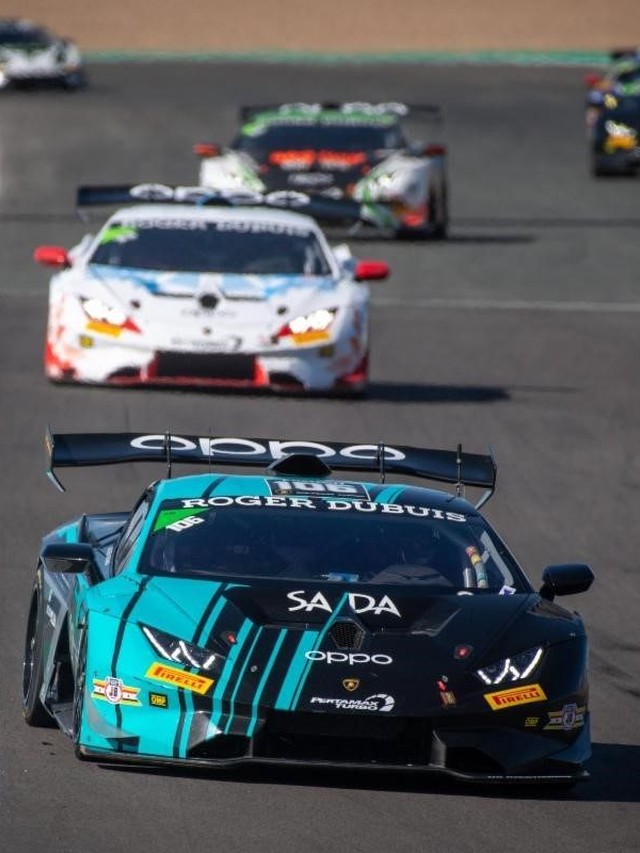
A Two-Point Margin, a Le Mans Invitation, and a Statement of Intent
On October 22, 2017, at Portugal’s Autódromo Internacional do Algarve in Portimão, the #46 Lamborghini Huracán GT3 entered by Italian squad Ebimotors clinched the Michelin GT3 Le Mans Cup championship. Drivers Fabio Babini and Emanuele Busnelli didn’t need to win the final race to seal the title. A fourth-place finish was enough. They edged the Mercedes AMG-GT of Lee Mowle’s team by the slimmest of margins: 104.5 points to 102.5.
That two-point gap tells the real story. Lamborghini says the championship came down to consistency rather than any single dominant weekend, and the season results support that. Babini and Busnelli took outright victories at Paul Ricard and the Red Bull Ring, then backed those up with podium finishes at Monza and Spa-Francorchamps. For Ebimotors, this was a first success in the ACO-organized European series for GT3 cars and LMP3 prototypes. The reward extended beyond the trophy: the championship carried an automatic invitation to the 2018 Le Mans 24 Hours.
For a brand that spent decades being defined almost entirely by its road cars, earning a ticket to Le Mans through competitive merit rather than simply buying an entry represented something genuinely new. It also marked the Huracán GT3’s third championship of the 2017 season, following victories in the Blancpain GT Series with Grasser Racing Team and the Italian GT Championship with Ombra Racing. Three titles, three different customer teams, one car. That breadth of success pointed to something more durable than a single favorable result.
Ebimotors and the Art of Racing a Season, Not a Sprint
Championships in endurance-adjacent series rarely go to the team with the fastest single lap. They go to the team that finishes reliably, scores points on bad weekends, and avoids the mechanical failures and driver errors that zero out an entire round. Ebimotors understood this calculus.
The Michelin GT3 Le Mans Cup ran six rounds across Europe’s most demanding circuits, with one taking place at Le Mans itself just days before the iconic 24-hour race. That schedule meant the Huracán GT3 needed to perform on everything from the high-speed sweeps of Spa to the technical, abrasive surface of Portimão. Babini, a veteran with deep experience in Italian GT racing, and Busnelli brought complementary strengths to the driver pairing, a factor that matters enormously in a series where each round features driver changes.
Sealing the title with a fourth-place finish in the finale speaks volumes about how they managed the season. They didn’t need heroics at Portimão. They needed to not make a mistake. That kind of pressure, knowing you can afford to finish mid-pack but cannot afford a retirement, tests a team’s discipline more than raw pace ever could. The consistency that carried Ebimotors to the championship also revealed something important about the car underneath them.
Why a Naturally Aspirated V10 Worked in an Endurance Format
The Huracán GT3 is a purpose-built racing car developed by Lamborghini Squadra Corse, based on the production Huracán supercar platform. At its heart sits a modified 5.2-liter naturally aspirated V10, an engine architecture that was already becoming unusual in GT3 by 2017. Most of the competitive field, including Ferrari’s 488 GT3 with its twin-turbocharged V8, relied on forced induction to produce competitive power within the constraints of Balance of Performance regulations.
The V10’s advantage in this context is subtle but real. A naturally aspirated engine delivers power in a linear, predictable fashion across the rev range. For a driver managing tire degradation over a stint, that predictability translates to smoother inputs and more consistent lap times. The engine redlines beyond 8,500 rpm, giving drivers a wide operating window. The car’s carbon fiber monocoque chassis with integrated roll cage, full carbon body panels, and adjustable aerodynamic elements provided a stable platform that rewarded precise driving rather than brute-force aggression.
In a class governed by Balance of Performance, where organizers equalize output through weight and power adjustments, engineering philosophy matters as much as peak numbers. The V10’s mechanical simplicity gave customer teams like Ebimotors a tangible advantage: no intercoolers to manage heat soak, no turbo lag to compensate for on corner exit. Running without the factory engineering resources of a works program, Ebimotors benefited from having fewer variables that could go wrong over a six-round championship. The same trait that made the Huracán GT3 rewarding to drive also made it forgiving to campaign.
The Competitive Landscape Lamborghini Was Fighting Through
Winning the Michelin GT3 Le Mans Cup in 2017 meant beating a field that included Mercedes-AMG GT3s, Ferrari 488 GT3s, and Porsche entries, all from manufacturers with longer, deeper histories in organized GT racing. The Mercedes-AMG GT3 that finished second in the championship was a formidable car with strong customer team support across Europe. Ferrari’s 488 GT3 brought the midrange torque advantage of its twin-turbo V8 and competed fiercely with the Huracán across multiple series that year.
Lamborghini’s position in this landscape was still being established. The fact that the Huracán GT3 won three championships in 2017 with three different customer teams across three different series is a strong indicator that the platform itself was competitive, not just benefiting from favorable Balance of Performance in a single paddock. For anyone tracking the brand’s competitive credibility, this distinction matters. Winning one championship can be circumstantial. Winning three in the same season points to a well-sorted car and a support infrastructure from Squadra Corse that gave privateers genuine tools to compete.
That customer-team model was central to the story. Ebimotors, Grasser Racing, and Ombra Racing were all independent operations, not factory squads with unlimited budgets. Their collective success validated Squadra Corse’s approach of building a car that smaller teams could run reliably and competitively across a full season.
From Portimão to the Temerario: What This Win Set in Motion
The 2017 Le Mans Cup championship and the resulting invitation to the 2018 Le Mans 24 Hours represented an inflection point for Lamborghini’s motorsport ambitions. Before this era, the brand’s racing efforts were often viewed as secondary to its road car identity. The Huracán GT3 program changed that perception through accumulated results.
Lamborghini says that before the Huracán GT3 Evo2 arrived in 2022, earlier generations of the car had secured over 40 international titles in six seasons. By 2025, the entire program had amassed 96 championship titles and 187 race victories. Those numbers build a case that the 2017 Le Mans Cup win was not an isolated achievement but an early chapter in a sustained competitive effort. The Evo2 itself, which drew heavily from the Huracán STO road car and featured a revised front splitter, larger rear diffuser, and swan-neck mounted rear wing, refined the platform further through a joint effort between Squadra Corse and the Centro Stile design team.
Now the baton passes to the Temerario GT3, which marks a significant milestone as the first race car entirely designed and developed in-house at Lamborghini’s Sant’Agata Bolognese facility. The Temerario GT3 will use a modified twin-turbocharged engine, as required by GT3 regulations, and Jalopnik reports that Lamborghini strips the hybrid system from the road car for racing. That transition from a naturally aspirated V10 to a twin-turbo powerplant mirrors the broader shift in Lamborghini’s road car lineup and raises genuine questions about whether the new car can replicate the Huracán’s endurance-racing consistency.
The SC63 LMDh program was reportedly discontinued for 2026, which concentrates Lamborghini’s factory motorsport energy even more squarely on the GT3 class. That makes the Temerario GT3’s success or failure the single most important competitive storyline for the brand in the near term. Ninety-six titles and nearly 200 race wins set an extraordinarily high bar. The foundation Ebimotors helped build at Portimão in October 2017, won on consistency by a small Italian team running a naturally aspirated V10, remains one of the clearest examples of what Lamborghini’s customer racing philosophy can produce when the car, the team, and the season-long strategy align. That foundation is still very much load-bearing.
Gallery


