Lamborghini Day Tokyo: A 50-Year Celebration Culminating in Bespoke Art
When a carmaker wants to honor its second-largest global market, it can unveil a plaque, deliver a speech, or do what Lamborghini did at The Prince Hotel in Tokyo on October 20, 2017: present five Aventador S Roadsters that could only exist for Japanese collectors. Each one-off creation drew from a different natural element in Japanese culture, and each demanded a combined 270 hours of specialist handwork before leaving Sant’Agata Bolognese. That investment of time and craft tells you everything about how Lamborghini views Japan.
The occasion was the 50th anniversary of the brand’s presence in the country, dating to the first imports of the 400 GT. Chairman and CEO Stefano Domenicali attended personally, and the event doubled as the Asian debut of the standard Aventador S Roadster, fresh from its world premiere at the Frankfurt Motor Show weeks earlier. Yet the production car was the supporting act. The real story was what Lamborghini’s Ad Personam department and Centro Stile had done to five of them, transforming a supercar into a series of culturally rooted, unrepeatable artworks.
Only the “water” version was physically presented that day. The remaining four, representing earth, fire, wind, and sky, were confirmed but deliberately withheld, a piece of theater that left the audience with one stunning car and four mysteries. Collectively titled the Aventador S Roadster 50th Anniversary Japan, the series stands as one of the most labor-intensive bespoke projects Lamborghini has undertaken for a single market.
The ‘Elemental’ Five: A Masterclass in Ad Personam Craftsmanship
The concept for the elemental series emerged from a collaboration between Ad Personam, Lamborghini’s customization department, and Centro Stile, its in-house design studio. The brief was to translate each of the five Japanese natural elements into a complete aesthetic identity, exterior through interior, without repeating a single detail across the series.
The “water” edition demonstrates the ambition. Its exterior paint transitions from deep blue into black through a shading technique that Lamborghini says required 170 hours of labor and the hands of ten paint specialists. For context, a standard Aventador S Roadster’s paint process, while meticulous by any industrial standard, is a fraction of that time. The shading effect on the elemental cars is essentially hand-applied art layered onto a supercar body, closer to bespoke coachwork than factory finish. Exposed carbon fiber on the windscreen frame and hard top grounds the visual drama in something unmistakably Lamborghini.
Inside, the “water” car wears Nero Ade black leather paired with Nero Cosmus black Alcantara. Seat embroidery evokes the Japanese symbol for bamboo, and the stitching color matches the exterior’s blue-to-black gradation. Lamborghini says achieving that interior color match required 100 hours of work by six specialists. A hexagonal carbon fiber plate bearing the Japanese symbol for the car’s elemental theme completes the cabin.
These are not sticker packages or dealer-applied graphics. Each car is a ground-up bespoke commission executed at the factory. The level of labor involved places them in a category closer to one-off coachbuilt projects than to typical limited editions, even by Lamborghini’s own standards. That distinction matters, because it reveals how seriously the company treats the relationship between its artisan capabilities and its most devoted collectors.

A man in a suit stands proudly next to a blue Lamborghini Aventador S Roadster at a special event.
Japan’s Enduring Passion: Why Lamborghini’s Second-Largest Market Deserves Bespoke Tributes
Domenicali’s comments at the event were direct. According to Lamborghini, Japan ranked as its second most important market worldwide by sales volume at the time, a position that explains the scale of the anniversary gesture. Five one-off cars, each requiring hundreds of hours of artisan labor, is an expensive way to say thank you. It also happens to be an effective one when your audience consists of collectors who can tell the difference between a bespoke commission and a marketing exercise.
Japan’s relationship with Lamborghini stretches back to the 400 GT imports of the late 1960s, and the country’s collector community is known for its exacting standards of preservation and specification. Japanese owners tend to appreciate personalization at a level that aligns naturally with what Ad Personam offers. The elemental series, rooted in cultural symbolism specific to Japan, signals that Lamborghini understood this audience well enough to build something that could only resonate in that market.
The company had already expanded its Japanese dealer network in January 2017 with new showrooms in Kobe and Yokohama, bringing the total to eight dealerships. Andrea Baldi, then Head of Lamborghini’s Asia Pacific operations, confirmed the company’s intention to continue growing that commercial footprint, especially with the Urus Super SUV arriving in 2018. Japan was clearly positioned as a key market for that expansion, and the elemental Roadsters served as both a celebration of the past and a statement of intent about the future.
The takeaway for collectors in other regions is straightforward: Japan’s importance to Lamborghini means the company invests design and engineering resources in culturally specific products for that market. If you are a Japanese collector with the right relationship and the budget, Lamborghini will build you something nobody else on the planet can own.
Beyond the Roadsters: The Strategic Significance of Lamborghini’s Japanese Market Focus
The elemental series is a showcase for Ad Personam at its most ambitious, but it also illuminates how Lamborghini wields bespoke work as a strategic tool. Building five culturally specific, labor-intensive one-offs for a single country is expensive, yet it cements relationships with the kind of collectors who buy multiple cars over a lifetime. In that light, the investment makes perfect sense.
Lamborghini did not simply offer a new color palette for Japan. It built an entire thematic framework around Japanese symbolism, then executed it with techniques that go well beyond what a configurator can produce. The 170 hours of paint labor alone on the “water” edition exceeds what most manufacturers would allocate to an entire limited-edition run. That level of commitment turns a car into a cultural artifact, something that belongs to a specific place and moment in a way that globally distributed numbered editions never quite achieve.
Lamborghini did not announce pricing for the elemental editions, and no confirmed figures have surfaced publicly. What the source does confirm is five units, Japan-only allocation, and a level of handwork that puts these cars in a different conversation than a standard Ad Personam order. Whether that approach yields greater long-term collector value is an open question. Some collectors argue that a unique spec commands a premium only if the execution is genuinely exceptional, while others suggest that the underlying model determines the floor. Online enthusiast discussion around one-off Lamborghini collectibility remains mixed on this point.
Regardless of where the market settles, the broader signal is clear. Lamborghini treats Ad Personam not as an accessory catalog but as a means of market cultivation, and the elemental Roadsters are perhaps the purest expression of that philosophy.
Aventador S Roadster: The Standard Bearer’s Asian Debut
Beneath the bespoke paintwork, the elemental cars share their mechanical identity with the standard Aventador S Roadster, which made its Asian debut at the same event. The S designation brought meaningful updates over the previous Aventador Roadster: revised aerodynamics, a recalibrated version of the naturally aspirated 6.5-liter V12, and the four-wheel steering system that sharpened the car’s handling character considerably.
For the Japanese market, the Roadster format carries particular appeal. Japan’s driving culture prizes the sensory experience of a car as much as its outright performance, and an open-top V12 Lamborghini delivers on that front in a way that few competitors can match. The Aventador’s single-clutch automated manual gearbox remained a point of contention among enthusiasts globally, but the V12’s top-end fury and the theater of the scissor doors continue to define the car’s identity years after production ended.
Multiple Aventador owners on enthusiast forums describe the car as a visceral, event-level experience that rewards those who appreciate mechanical drama over clinical efficiency. The S Roadster, with its improved dynamics and the open sky above, represented the most refined expression of that philosophy before the Ultimae closed the chapter. Presenting it alongside the elemental series in Tokyo gave Japanese buyers a clear spectrum: the standard car for those who wanted the definitive open-air V12 experience, and the one-offs for those who wanted something no configurator could ever replicate.
Concours d’Elegance: Celebrating Heritage
Lamborghini Day 2017 also hosted the second edition of the Lamborghini Day Concours d’Elegance Tokyo, a gathering of 50 classic Lamborghini automobiles judged by a panel of 13 international judges. The field included Miura, Diablo, and Countach examples, a cross-section of the models that built Lamborghini’s reputation in Japan over five decades.
Among the participants was a Miura SV restored by Lamborghini Polo Storico, the company’s in-house heritage division, which had previously won Best of Show at the Lamborghini & Design Concours d’Elegance in Neuchatel. The presence of a Polo Storico restoration underscores how seriously Lamborghini takes the provenance and condition of its classic cars, particularly in a market where collectors demand factory-correct standards.
The Best of Show prize in Tokyo went to an orange 1976 Countach LP 400 bearing serial number 1120186. The LP 400 is the original, purest expression of the Countach design before the later wide-body and wing additions, and it remains one of the most coveted variants among serious collectors. That a Japanese owner maintains one in concours condition speaks to the depth of the country’s Lamborghini community and reinforces the very argument the elemental Roadsters were built to make: Japan does not merely buy Lamborghinis, it preserves and elevates them.
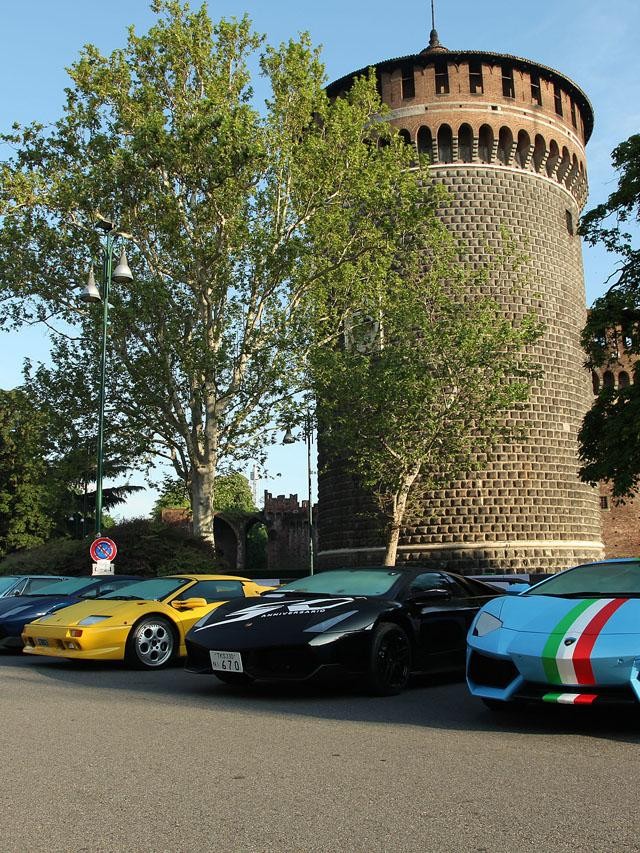
A parade of over eighty modern Lamborghinis through downtown Tokyo, passing the Tokyo Tower and the Ginza district, closed out the day’s events. The visual impact of that many Lamborghinis moving through one of the world’s most photographed cityscapes served as a fitting public demonstration of the brand’s Japanese following.
For LamboCars readers tracking the collector market, the elemental Aventador S Roadsters represent something worth watching. Five cars, zero possibility of replication, and a level of factory craftsmanship that Lamborghini reserved for a single country. Whether they appreciate in value or simply become prized possessions within Japan’s collector community, they stand as evidence that Lamborghini’s relationship with its second-largest market goes well beyond sales figures. The company built something that could only exist because of Japan, and that kind of specificity is rare in an industry that usually defaults to global editions and numbered plaques.


