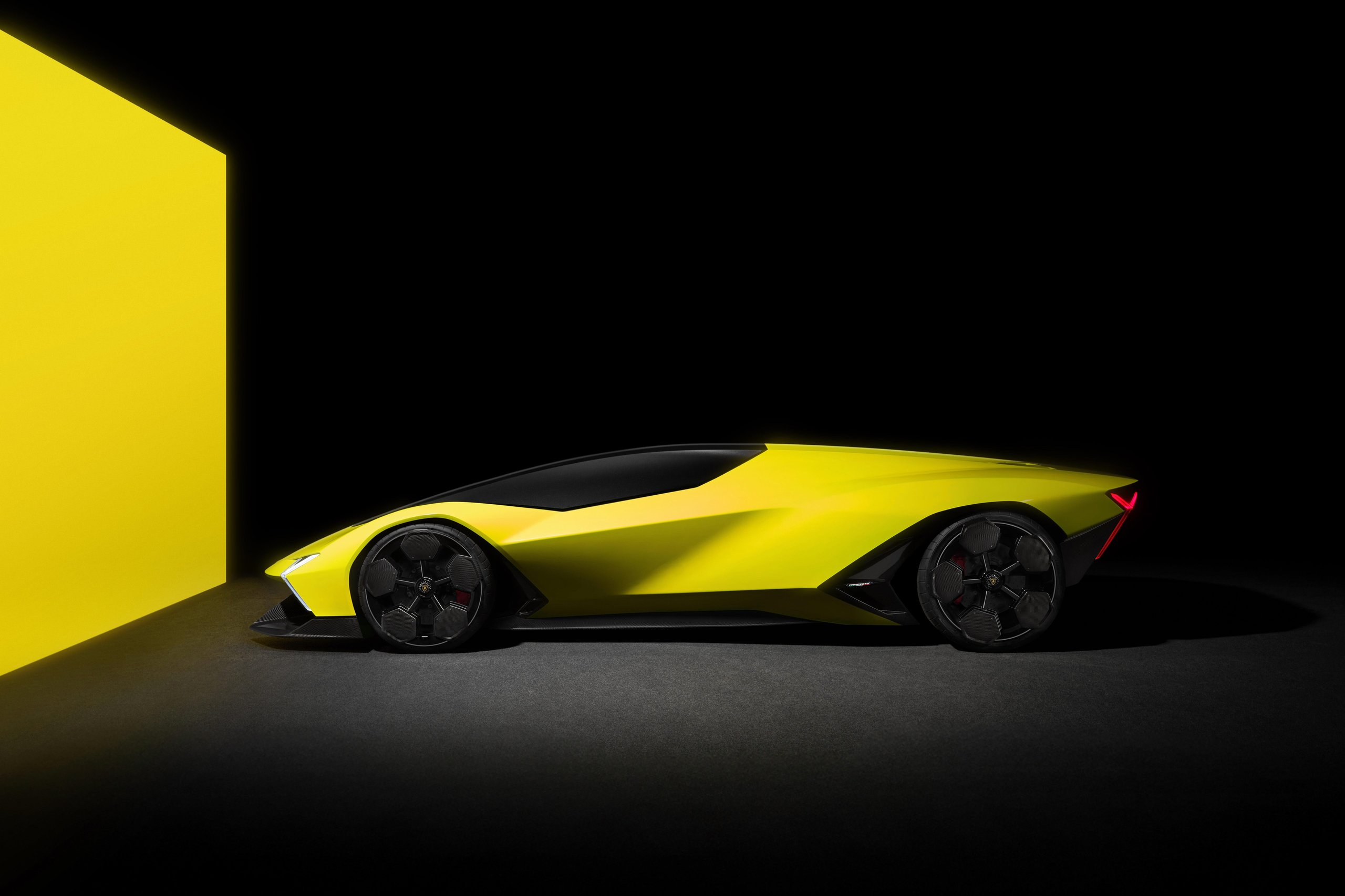
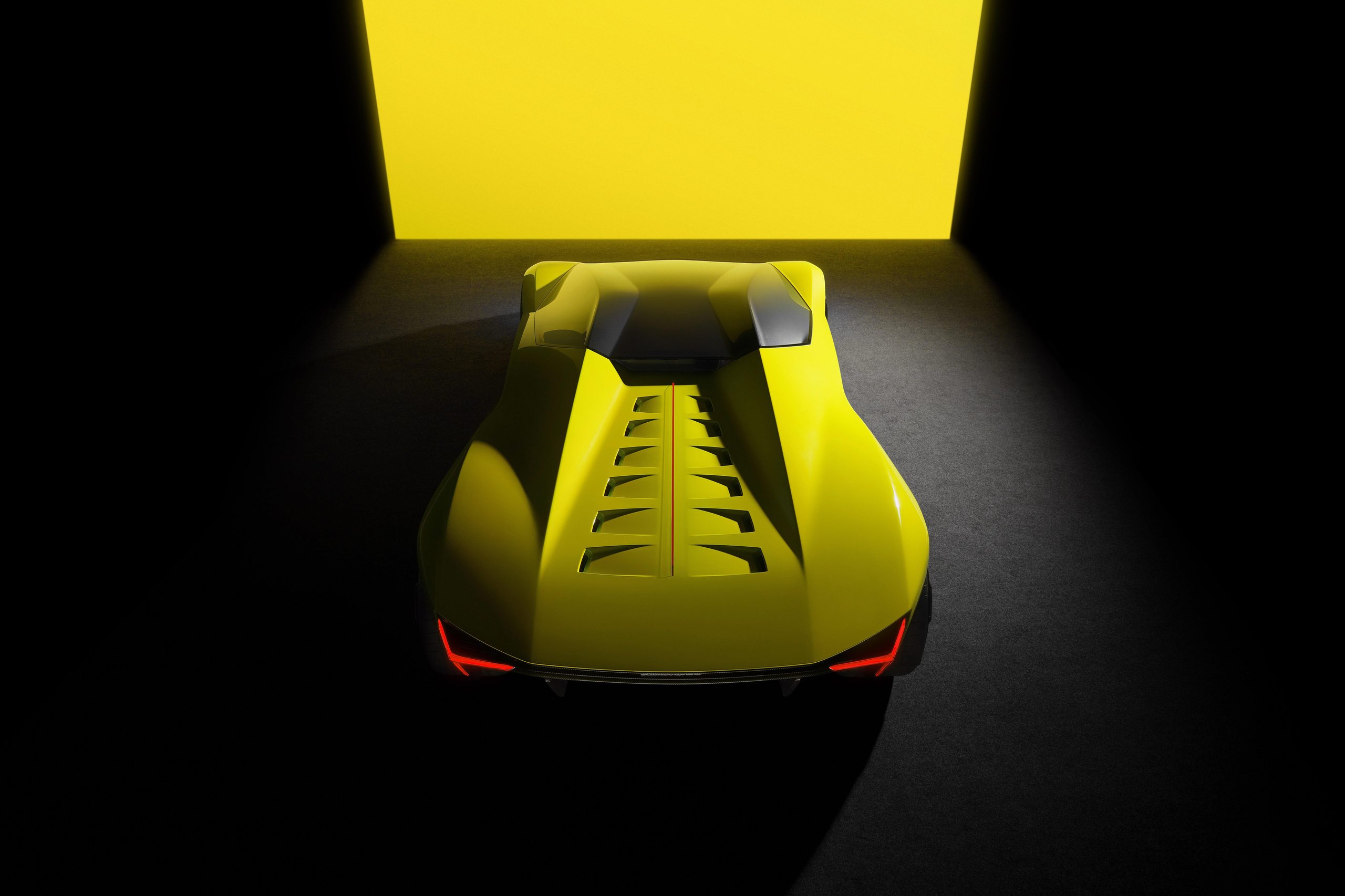
Twenty Years of Shaping the Wedge, and a New Concept to Prove It
Lamborghini marked the 20th anniversary of Centro Stile, its in-house design department in Sant’Agata Bolognese, by pulling the cover off a concept called Manifesto. The name is deliberately grand. Lamborghini describes it as a philosophical guide for the brand’s future design language, not a preview of any specific production car. Think of it as the successor to the 2017 Terzo Millennio concept, which Lamborghini says went on to inspire visual elements found in both the Revuelto and the Temerario. If that lineage holds, the Manifesto will quietly shape the look of every Lamborghini that reaches a showroom over the next decade or more.
The timing is deliberate. Centro Stile, founded in the early 2000s and fully operational from 2005, now controls the visual identity of every car in the current lineup. According to Lamborghini, every modern model from the Murcielago through the Revuelto and from the Gallardo to the new Temerario took shape inside this single building. Celebrating that track record with a forward-looking concept rather than a retrospective tells you where the company’s attention sits: not on the rearview mirror, but on the windshield.
Why an In-House Studio Changed Everything
Before Centro Stile existed, Lamborghini’s design story was written largely by external houses. Bertone gave the world the Countach and the Miura. Italdesign shaped the early Gallardo proposal. The shift to a permanent internal team was championed by Walter de Silva, then overseeing design for the Audi Brand Group, who pushed the idea that a company selling cars on visual drama above almost anything else could not afford to outsource that drama indefinitely.
Independent reports indicate that Luc Donckerwolke led Centro Stile from its opening in 2003, followed by Filippo Perini, who took over in 2006. Mitja Borkert, the current Design Director, arrived in 2016. Each tenure left a distinct mark, but the institutional value of the studio is continuity. Borkert frames the logic plainly: “Design is the number one reason customers buy a Lamborghini. It has to be developed in-house, in close dialogue with engineering and production, and in direct continuity with the brand’s DNA.”
That last point matters more than it sounds. When exterior designers sit in the same building as clay modelers, color-and-trim specialists, and feasibility engineers, a crease line on a concept sketch can be challenged for aerodynamic or manufacturing reality before lunch. Ferrari runs a similar in-house Centro Stile in Maranello, and McLaren keeps its design team tightly integrated at Woking. The competitive advantage is not the existence of the studio; it is how consistently the studio’s output remains identifiable at a glance. On that score, Lamborghini’s two-decade record is difficult to argue with.

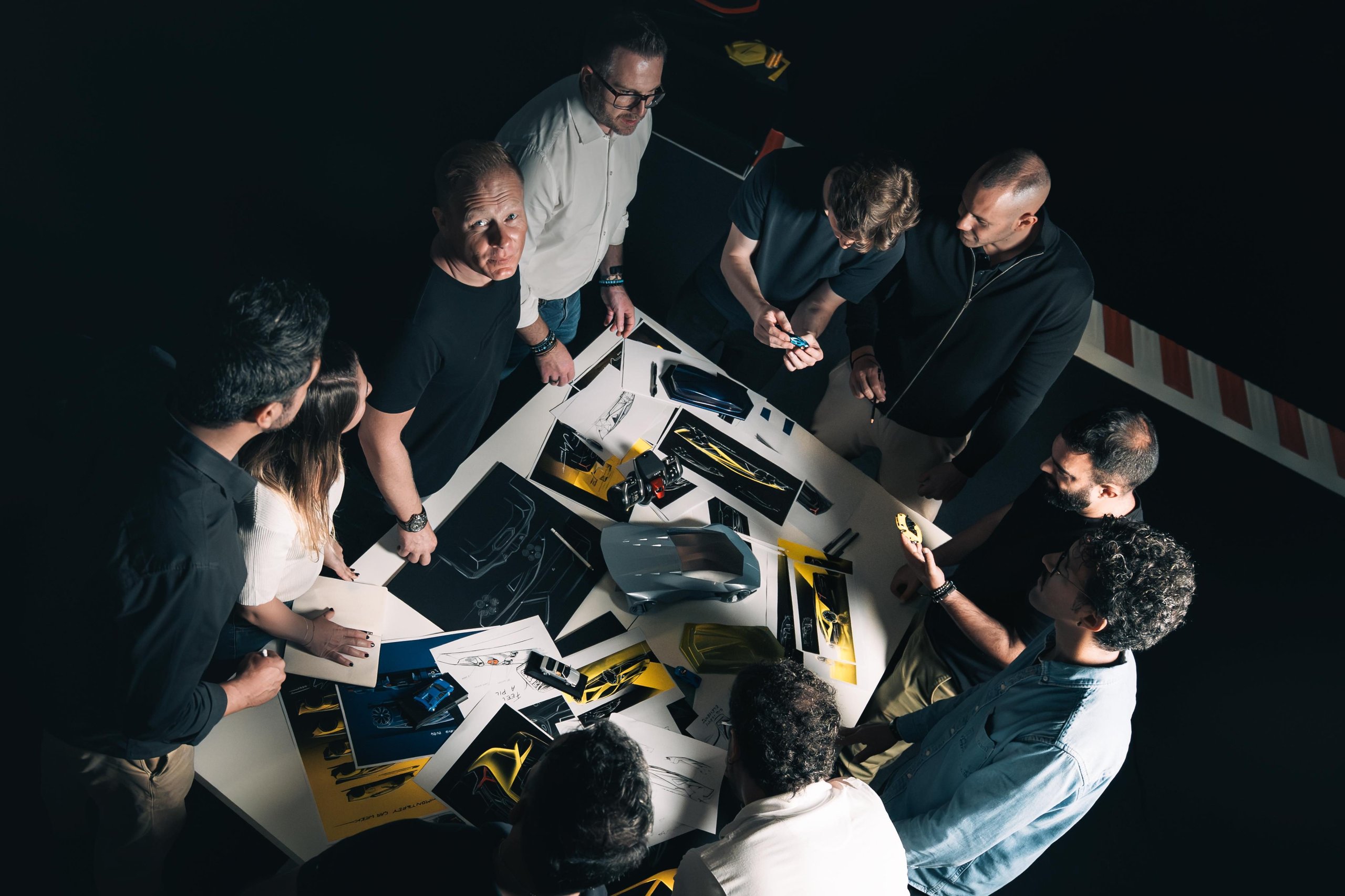
A vibrant collection of Lamborghini design sketches and models showcases the evolution of iconic styling.
Inside the 25-Person Team That Draws Your Dream Car
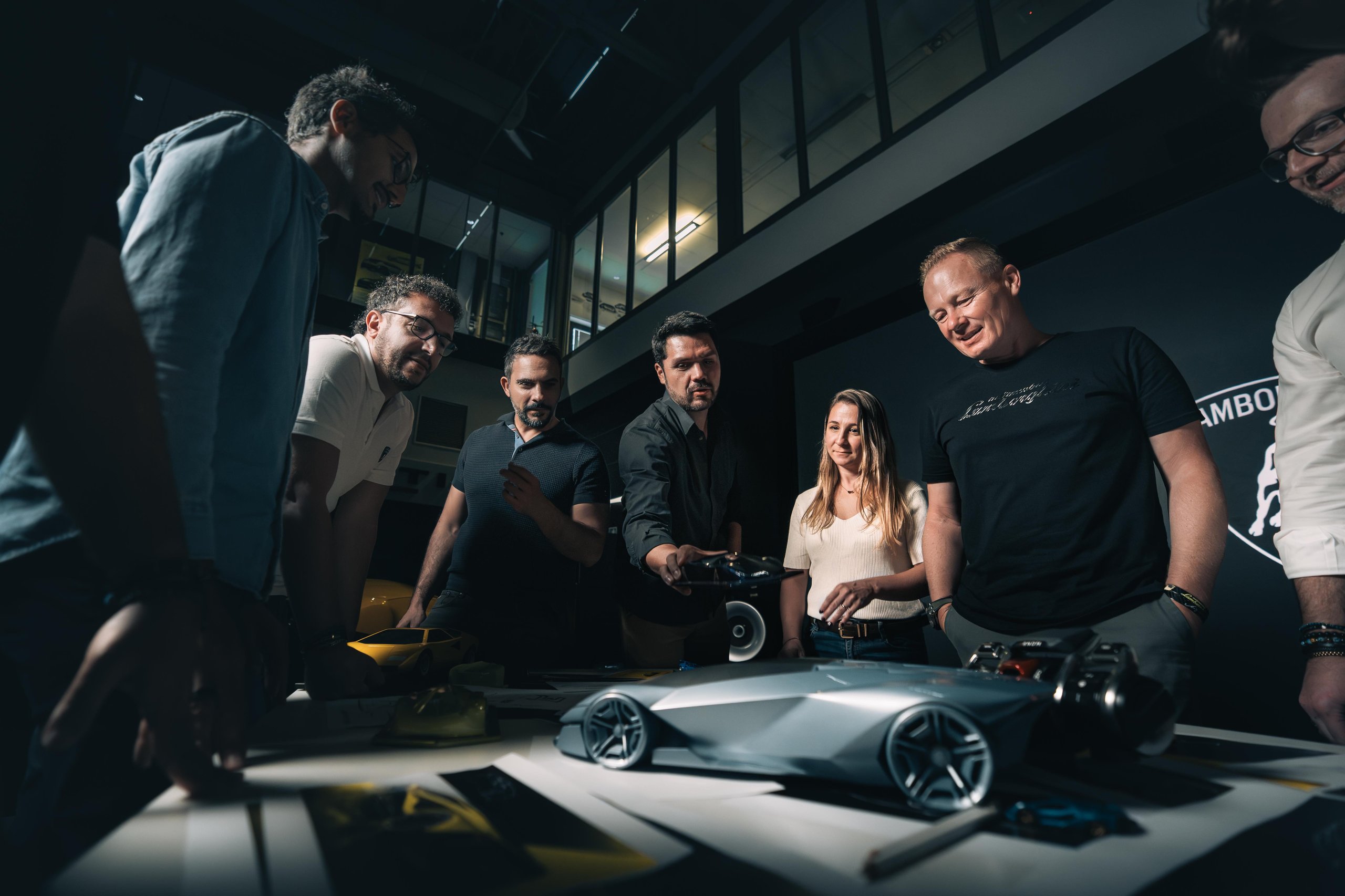
Lamborghini states that the Centro Stile team today comprises 25 specialists drawn from Italian, German, Portuguese, Polish, American, Japanese, and Chinese backgrounds. The youngest are in their late twenties; the most experienced are past fifty. Borkert compares the group to a football squad: “Each designer has their role. Some focus on early sketches, some on production feasibility, others on the big picture of design strategy. My job is to coach them.”
The disciplines are more varied than outsiders might expect. Exterior and interior designers handle proportions, lines, and ergonomics. Clay modelers give physical shape to ideas alongside digital 3D modelers producing virtual renderings. Color-and-trim experts develop the palettes and materials that define a car’s personality inside the cabin, while feasibility designers translate concepts into production reality, resolving tolerances down to the millimeter before a model reaches the factory floor.
One detail worth noting for anyone who follows how these cars get specced: the color-and-trim team’s influence extends directly into the Ad Personam customization program. When an owner orders a bespoke interior combination or a heritage-inspired exterior shade, the palette those choices draw from originates here. The 25 people in this studio shape not only what a Lamborghini looks like on a poster but what it looks like when it rolls off the line configured to a specific buyer’s taste.

Designers at Centro Stile Lamborghini meticulously refine concepts, surrounded by sketches and models.
Recognizability and Surprise: The Two Rules That Cannot Break
Every design house talks about brand DNA. Lamborghini’s version of that conversation boils down to two non-negotiable principles locked in permanent, productive tension: recognizability and surprise.
Recognizability means the silhouette. Borkert insists that the side view of any Lamborghini must be identifiable even at a distance, whether spotted on the road between Nonantola and Sant’Agata or pinned to a teenager’s bedroom wall. The Y-shaped light graphic and hexagonal geometry are equally sacred, linking modern Lamborghini design to its roots in 1960s Italian architecture and industrial form. Look at the Temerario‘s headlamp signature or the Revuelto‘s rear lighting, and the family resemblance is immediate.
Surprise means that recognizability alone is not enough. “Each car needs its own product identity,” Borkert explains. “Revuelto has one, Temerario another, Fenomeno another still. Derivatives like Huracán STO or Sterrato are all clearly Lamborghini, but each speaks a different language.” The challenge, as he frames it, is to remain recognizable while constantly exceeding expectations.
Enthusiast opinion on how well Lamborghini threads this needle is genuinely mixed. Forum discussions reveal strong feelings about individual models. The Aventador and Centenario are frequently cited as peak expressions of the design language, while the Revuelto draws more divided reactions, with some owners praising the front end and rear design separately but questioning whether the overall shape coheres as dramatically as the Aventador did. That kind of debate, frankly, is exactly what the “recognizability plus surprise” formula is designed to provoke. A Lamborghini that everyone agrees on would be a Lamborghini playing it safe.

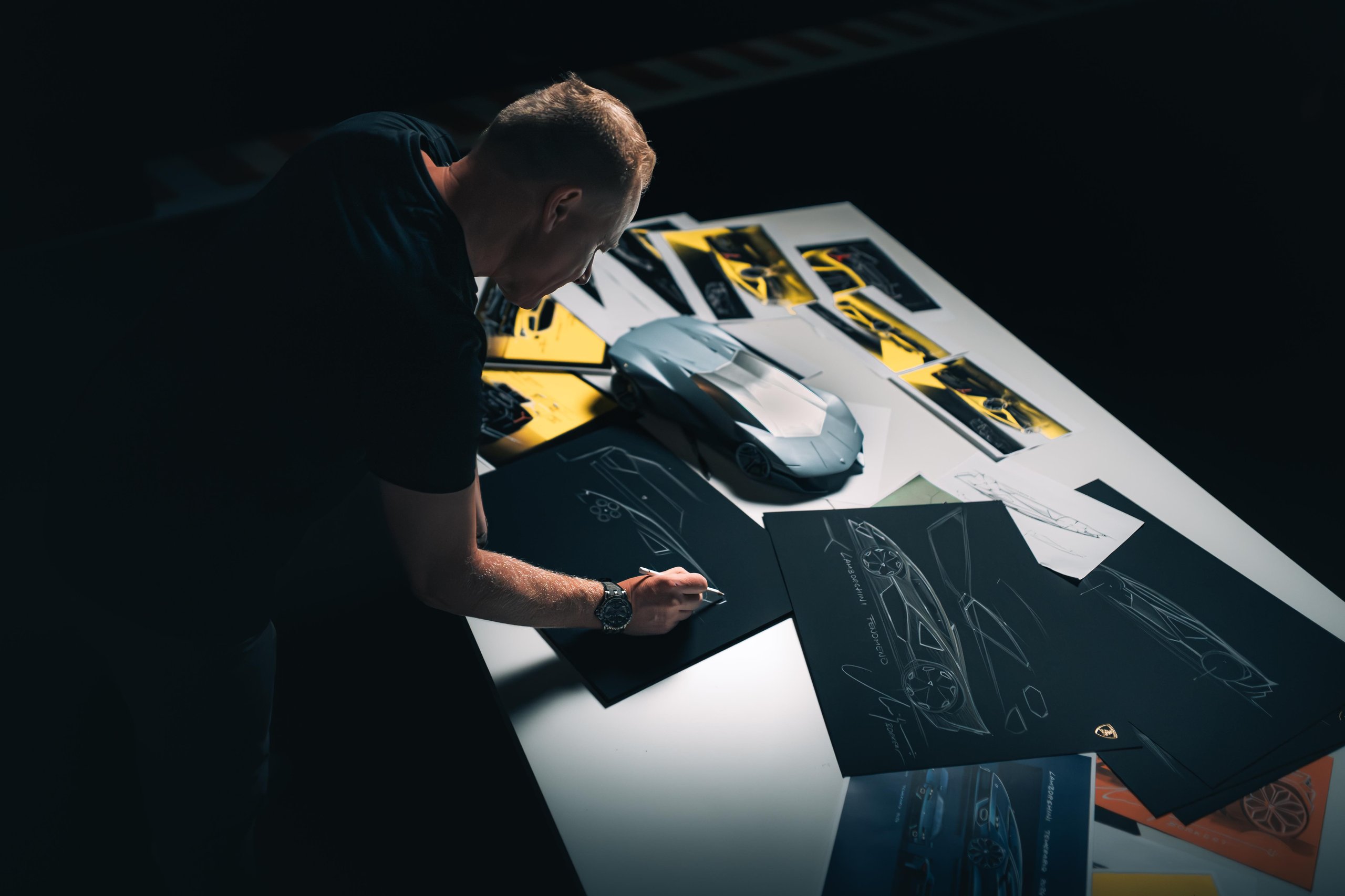
Detailed sketches reveal interior design concepts, emphasizing a pilot-like driving experience.
Unpacking the Manifesto: What the Concept Actually Signals
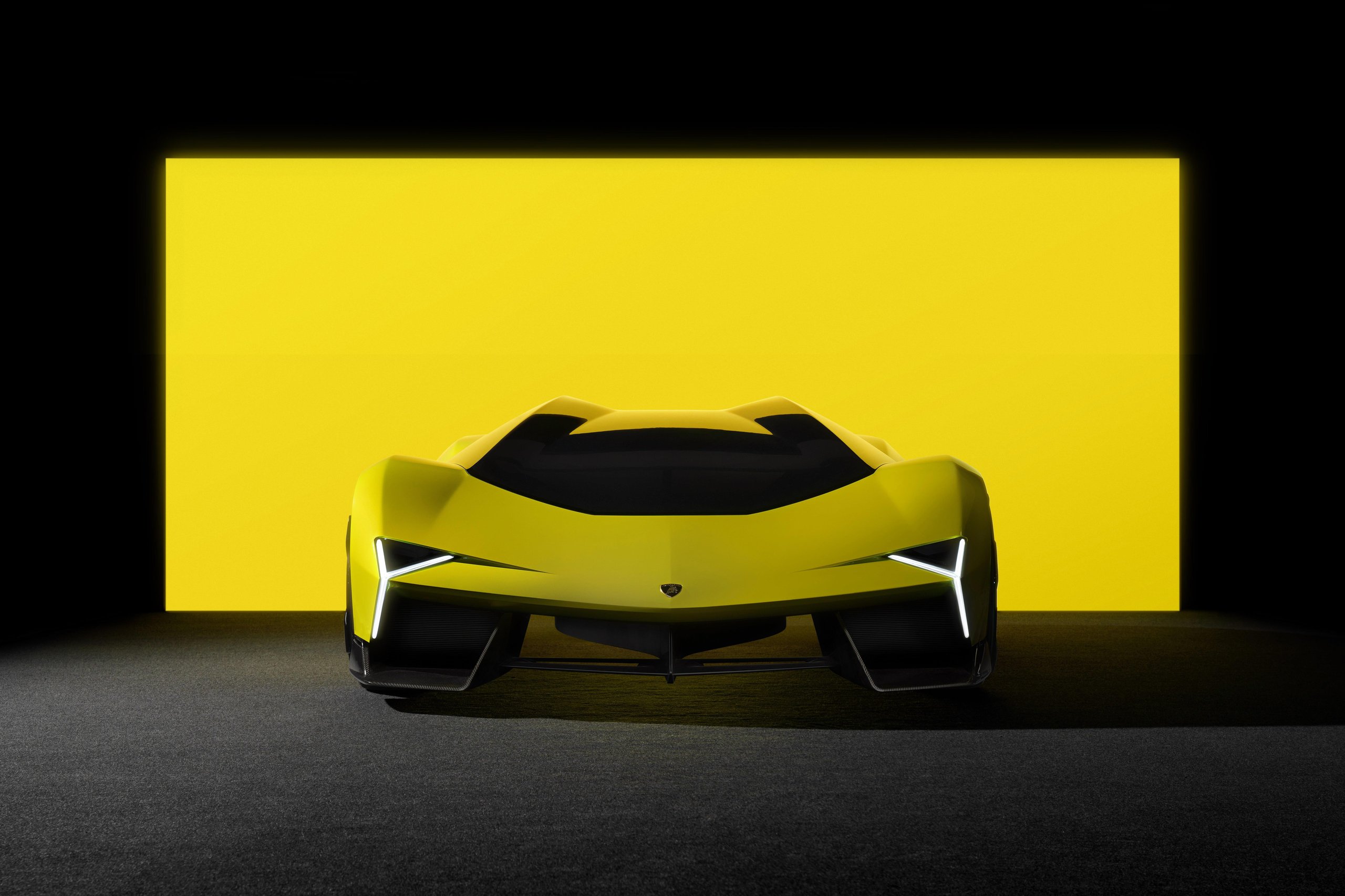
Lamborghini describes the Manifesto as a concept conceived to distill its design into “radical purity and powerful presence,” where every surface, angle, and proportion is sculpted to provoke an immediate emotional response. The company is explicit that this is a declaration of intent for the brand’s visual language in coming years, not a thinly veiled production car. As Road & Track reported, the Manifesto previews Lamborghini’s future “Design DNA” rather than any single model.
The precedent for taking this seriously is the Terzo Millennio. Presented in 2017 as a blue-sky exercise in electric supercar thinking, it looked like pure fantasy at the time. Yet Lamborghini says elements of the Terzo Millennio directly informed the Revuelto and Temerario. If the Manifesto follows the same trajectory, the details embedded in its surfaces, from evolved Y-shaped lighting to reinterpreted hexagonal patterns, will filter into production metal within the next product cycle.
What Lamborghini does not say is equally interesting. The company offers no powertrain context for the Manifesto, no mention of electrification strategy or platform architecture. Borkert is direct about the omission: “It is not about an engine or technology, but about imagination.” For a brand navigating the shift from naturally aspirated V12s and V10s to hybrid V12s and twin-turbo V8s, deliberately decoupling the design conversation from the powertrain conversation is a strategic choice. It tells buyers and enthusiasts that however the engineering evolves, the visual identity will remain the constant.

The aggressive front design of the Lamborghini V12 Vision Gran Turismo, featuring its signature Y-shaped headlights.
AI in the Design Studio: Amplifier, Not Replacement
Lamborghini indicates that artificial intelligence is now part of Centro Stile’s workflow, used to generate visualizations and accelerate the early stages of the design process. Borkert’s position is unambiguous: technology is a tool, and the final decision stays human.
The practical application appears more concrete than the usual corporate AI talking point. One report describes a specialized group within Centro Stile, informally called the “crazy corner,” that uses AI to conceptualize future models looking as far as two decades ahead. The process reportedly involves generating initial automotive concepts from sketches, then refining them into 3D models using software such as Vizcom and CATIA, bridging AI-driven ideation with precise CAD engineering.
For Lamborghini buyers, the relevant question is whether AI will homogenize the output. If every luxury automaker feeds similar prompts into similar generative tools, do the results start to converge? Lamborghini’s answer, at least implicitly, is that the design DNA encoded in the team’s training, the hexagonal grammar, the Y-shaped signatures, the insistence on a dramatic silhouette, acts as a filter that keeps AI-assisted output recognizably Lamborghini. Whether that holds over the next decade will be one of the more interesting tests of the brand’s design discipline.

Designers collaborate on a digital render of a striking yellow Lamborghini concept car in the studio.
Staking Out Territory No Rival Will Contest
Ferrari, McLaren, and Lamborghini all maintain in-house design teams, so the structural advantage of owning the creative process is shared across the top tier of the supercar market. The differentiation lies in philosophy. Ferrari’s Centro Stile in Maranello tends to evolve its design language incrementally, with each new model clearly descending from the last, producing elegance and coherence but rarely the kind of visual shock that stops traffic. McLaren’s team at Woking leans heavily into aerodynamic function dictating form, yielding cars that are technically beautiful but occasionally accused of looking too similar across the range. Lamborghini occupies a different position: its design language tolerates, even demands, a degree of visual aggression and drama that neither rival pursues as deliberately.
The Manifesto concept reinforces this positioning. By framing future design around emotional impact and sculptural presence rather than aerodynamic optimization or incremental refinement, Lamborghini is staking out territory that competitors are unlikely to contest. For buyers cross-shopping a Revuelto against a Ferrari 296 GTB or a McLaren 750S, design remains the most visceral differentiator. Lamborghini knows this, and Centro Stile exists precisely to protect that advantage.
The open question, and it is one Lamborghini clearly wants enthusiasts to consider, is how the Manifesto‘s design cues will translate into the next generation of production cars. Specific details remain unconfirmed. What the concept does confirm is that Lamborghini intends to keep pushing its visual identity further from the center of the supercar design consensus, not closer to it. For anyone who fell in love with the brand because a Countach poster rewired their understanding of what a car could look like, that commitment is the most reassuring signal Centro Stile could send at twenty years old.

A designer's hand precisely traces a critical line on a clay model, perfecting the vehicle's form.
Gallery